

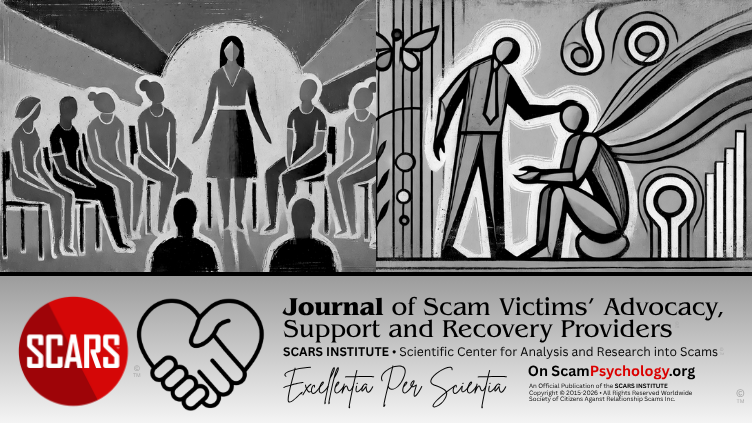
Support That Restores Agency
Applying Supportive Psychotherapy Principles in Scam Victim Communities
Author:
• Tim McGuinness, Ph.D. – Anthropologist, Scientist, Director of the Society of Citizens Against Relationship Scams Inc.
Abstract
Scam victim advocates and peers apply selected supportive psychotherapy principles through listening, education, practical assistance, and collaborative planning. This community process strengthens agency, coping, and daily functioning while maintaining clear boundaries between support and clinical treatment. Supporters establish expectations, check urgent needs, identify a current difficulty, validate feelings, and help survivors select manageable actions. Follow-up examines results and adjusts assistance without blame. Effective support produces greater independence, protective decisions, and stronger connections beyond the community. Persistent distress, dependency, worsening functioning, or pressure within the support relationship prompts review and appropriate referral. Leaders provide training, supervision, privacy procedures, and emergency plans. Clinical assessment addresses significant symptoms, while community support continues within its defined responsibilities and available resources, with the survivor’s participation guiding goals and next steps.
Keywords
Supportive Psychotherapy Principles, Scam Victim Support, Peer Support, Victim Advocacy, Survivor Agency, Trauma-Informed Care, Emotional Validation, Practical Problem-Solving, Support Boundaries, Recovery Progress
Support That Restores Agency: Applying Supportive Psychotherapy Principles in Scam Victim Communities
Key Points
- Supportive community care helps survivors rebuild agency, coping skills, and daily functioning.
- Advocates and peers apply supportive principles within clearly defined roles and training.
- Qualified clinicians retain responsibility for clinical assessment and treatment.
- Validation recognizes emotional pain without automatically endorsing every conclusion.
- Survivors participate in choosing goals, activities, and practical next steps.
- Support conversations prioritize urgent needs before broader recovery concerns.
- Manageable actions and consistent follow-up connect understanding with everyday progress.
- Effective support strengthens independence and relationships beyond the community.
- Persistent difficulties require review of both survivor needs and support methods.
- Community leaders establish supervision, privacy expectations, referral procedures, and emergency plans.
Author’s Note
This article is intended for support providers and advocates.
Supportive care requires both human understanding and a clear purpose. Scam survivors benefit from communities that respect their feelings, explain guidance, and help translate understanding into practical action. Advocates and peers strengthen that process through appropriate boundaries, honest follow-up, and recognition of the point at which professional assessment or treatment becomes necessary.
A Foundation for Meaningful Support
A traumatized scam survivor enters a support community with more than a story about stolen money. The person brings the consequences of deception, attachment, grief, shame, disrupted relationships, and difficult decisions. Effective support helps the survivor face those consequences while rebuilding the ability to manage everyday life.
Supportive psychotherapy offers useful principles for that work. Its clinical goals include strengthening coping, supporting self-esteem, reducing distress, and improving functioning. Scam victim advocates and peers adapt selected principles through listening, education, practical assistance, encouragement, and constructive feedback. The purpose is to help the survivor regain agency, meaning the ability to make choices and take purposeful action.
An important distinction defines the process. Supportive psychotherapy is clinical treatment delivered by a qualified professional within a therapeutic relationship. A peer or advocate uses related supportive skills within the responsibilities of the support role. Clinical credentials, professional scope, and the actual service determine whether an interaction constitutes psychotherapy. The title “supportive community process” accurately describes the adaptation presented here.
The steps that follow form a practical framework informed by supportive psychotherapy, trauma-informed peer support, and psychological first aid. They do not constitute a validated treatment protocol for scam victims. Psychological first aid originated in crisis and disaster settings, so its principles inform this adaptation without establishing its effectiveness for this particular population.
What Makes Support Therapeutic in Purpose
The supporter offers a steady relationship in which the survivor receives respect, clear information, and help addressing present difficulties. Consistency matters because the process gives the survivor repeated experiences of trustworthy interaction. The supporter explains the purpose of an activity rather than presenting it as an unexplained technique.
Every exercise needs an understandable goal. Preparing a conversation supports communication; organizing a task supports follow-through; identifying a trustworthy contact strengthens connection. A survivor’s temporary relief matters, but the process also looks for changes in choices, coping, and daily functioning.
Validation acknowledges feelings without automatically endorsing conclusions. A supporter recognizes the pain behind “Everyone will betray me” while helping the survivor examine whether that statement accurately describes every relationship. The survivor receives compassion alongside help developing a more workable understanding of the situation.
Support also includes accountability. Criminals bear responsibility for their crimes, while survivors receive assistance taking protective action now. Feedback focuses on specific behavior, its consequences, and the next useful step. Humiliation, labels, and demands for gratitude have no constructive role in that conversation.
The Responsibilities of Advocates, Peers, and Community Leaders
Advocates provide education, practical guidance, referrals, and assistance navigating the consequences of victimization. Peers contribute understanding grounded in lived experience, mutual respect, and examples of recovery work. Leaders establish boundaries, supervise practice, address harmful conduct, and maintain pathways to qualified care.
Lived experience does not establish clinical competence. Community supporters do not diagnose conditions, direct medication changes, conduct trauma exposure, or attempt to recover supposedly hidden memories. Clinical services remain the responsibility of appropriately qualified professionals acting within their professional roles.
The community establishes privacy rules and explains their limits before sensitive sharing begins. Members need to understand that a group agreement does not guarantee that every participant will protect information. Supporters discourage posting identifying documents, financial account details, intimate material, or unnecessary information about other people.
Support remains voluntary and collaborative. The survivor chooses personal goals, while the organization defines the conduct required for safe participation. Agreement with every suggestion is not a condition of respect, and disagreement does not automatically demonstrate resistance to recovery. These principles reflect SAMHSA’s emphasis on person-centered, voluntary, relationship-focused peer support.
Preparing the Community
Leaders establish written role descriptions, approved communication channels, supervision, referral procedures, and an emergency response plan. Supporters receive training in listening, boundaries, cultural responsiveness, and recognizing concerns that require professional attention. Scheduled availability prevents informal promises of continuous access.
The community also defines how moderators respond to threats, harassment, unauthorized financial requests, and repeated boundary violations. Any action addresses identifiable conduct and its effects on others. Distress, grief, or slow progress alone does not justify exclusion.
A Step-by-Step Support Process
Step 1: Establish Purpose, Choice, and Boundaries
The supporter begins by explaining the role, available time, privacy limits, and purpose of the conversation. The survivor identifies whether listening, information, or help with a practical problem would be most useful. This agreement reduces confusion about what support will involve.
The supporter checks permission before offering an exercise or detailed guidance. Participation does not require a complete account of the scam, agreement with a personal philosophy, or disclosure beyond the survivor’s comfort. A clear beginning gives both participants a shared direction.
Step 2: Check Immediate Safety and Essential Needs
The supporter first identifies urgent concerns, including ongoing criminal contact, a payment about to occur, threats, or unmet needs for food, shelter, or medical care. Immediate priorities take precedence over a general recovery discussion. The supporter follows established procedures and connects the survivor with the appropriate service.
Statements about suicide or harming others require prompt attention. A trained supporter asks directly about immediate danger and activates the organization’s crisis procedure rather than relying on a group discussion. Emergency services address imminent danger, and a qualified clinician assesses serious mental health concerns.
During an online emergency, staff establish the person’s current location and an appropriate way to reconnect, consistent with policy. Staff do not promise secrecy about an immediate threat to life. The emergency plan must exist before such a situation occurs.
Step 3: Identify One Current Difficulty
The supporter asks the survivor to identify the problem causing the greatest difficulty today. Examples include opening messages from a bank, managing an urge to contact the criminal, attending an appointment, or speaking with a relative. The conversation narrows from the entire recovery journey to a concern that permits useful action.
The survivor and supporter define the difficulty concretely. “Everything is impossible” becomes an examination of the task that feels impossible and the barrier preventing action. Narrowing the focus makes the work manageable without minimizing the wider harm.
Step 4: Listen and Reflect Accurately
The supporter gives the survivor time to speak, then briefly reflects the central feeling and concern. The reflection distinguishes what happened, what the survivor feels, and what the survivor believes it means. The supporter checks accuracy rather than assuming complete understanding.
Listening does not require repeated, detailed retelling. The supporter avoids intrusive questions, comparisons between victims, and a rapid shift into the supporter’s own story. Peer disclosure stays brief and serves the survivor’s needs. This approach follows psychological first aid guidance against pressuring distressed people to describe their experiences.
Step 5: Acknowledge Feelings and Examine Conclusions
The supporter recognizes grief, fear, anger, or shame in direct, respectful language. The conversation then examines conclusions such as “The crime proves that I am worthless.” The supporter helps separate the survivor’s identity from the criminal’s conduct.
This process also addresses attachment without treating attachment as proof of a genuine relationship. The survivor’s longing deserves acknowledgment, while the established facts of deception remain clear. The supporter avoids ridicule and arguments intended to overpower the person emotionally.
Step 6: Offer a Small Amount of Relevant Education
Education addresses the immediate concern in plain language. A survivor struggling with renewed romantic messages receives information about repeated targeting; someone overwhelmed by a task receives help understanding the task and available support. The supporter avoids overwhelming the person with a library of reading material.
The supporter asks the survivor to describe the useful point in personal words. This checks whether the explanation made sense and whether it fits the concern. Education supports understanding rather than testing obedience.
Step 7: Agree on One Practical Action
The survivor selects an achievable action with the supporter’s assistance. The plan identifies what will happen, when it will happen, and what help is needed. Examples include preparing questions for a bank, scheduling an appointment, or choosing a trusted person to accompany the survivor to a difficult meeting.
The task fits the survivor’s current capacity. If the proposed action is too large, the supporter helps divide it into smaller parts. The supporter provides assistance without taking control of the survivor’s accounts, money, or personal decisions.
Step 8: Rehearse the Difficult Part
The supporter offers brief practice when the barrier involves words, planning, or a predictable interaction. The survivor rehearses asking for assistance, explaining a boundary, or describing a concern to a professional. Practice stays focused on an ordinary present-day situation.
The supporter explains the purpose and asks permission before beginning. The exercise does not recreate the crime, imitate the scammer’s abuse, or provoke distress as a test. Its purpose is preparation for a chosen action.
Step 9: Support Coping and Connection
The survivor identifies a simple response to distress that interrupts the immediate problem. Examples include taking a pause, orienting to the room, contacting an agreed support person, or following an existing coping plan. The supporter stops an exercise that increases distress and seeks guidance when needed.
The conversation also identifies trustworthy human connections. Coordination with a designated support provider and an existing therapist reduces conflicting guidance, while healthy family and social relationships remain valuable. The community helps broaden the survivor’s life rather than becoming its exclusive center.
Practical assistance, social connection, information about coping, and links to additional services are established components of psychological first aid. They provide a useful foundation for organizing community support around the survivor’s identified needs.
Step 10: Close With a Clear Plan
Before ending, the supporter summarizes the concern, selected action, and follow-up arrangement. The survivor confirms what the plan means and identifies any remaining barrier. The supporter checks that the conversation has not left the person facing an unresolved urgent concern.
Any record follows organizational policy and includes only information necessary for continuity. It documents agreed actions, relevant observations, referrals, and safety steps without speculative diagnoses or judgments about character. Records remain within approved systems.
Step 11: Review What Happened
At follow-up, the supporter asks what the survivor attempted, what happened, and what helped or interfered. Completion receives specific acknowledgment, while an unfinished task prompts investigation rather than blame. The barrier might involve unclear instructions, practical limitations, fear, or a need beyond the support role.
The next action follows that review. An effective plan continues or develops; an ineffective plan changes. Repeating the same advice without examining the result does not constitute meaningful follow-up.
Step 12: Adjust Support and Arrange Further Care
The supporter reviews the overall pattern with a supervisor when difficulties persist or worsen. The response includes changing the format, reducing demands, resolving misunderstandings, or arranging professional assessment. Referral addresses the person’s needs and does not serve as punishment for disagreement.
Support and clinical treatment sometimes proceed together with the survivor’s permission and clear responsibilities. The community maintains appropriate contact during a referral within its capacity and policies. It does not promise services that it lacks the resources to provide.
Applying the Process in a Group
A group adapts the process through clear facilitation. The leader explains the purpose, time limits, privacy expectations, and permission to pass. Participants raise current concerns, and the facilitator helps identify one or two themes for discussion.
The group avoids an uncontrolled stream of advice. The facilitator first clarifies whether a member wants listening, shared experience, or practical suggestions, then limits responses to relevant contributions. Peers describe what helped in their own circumstances without presenting personal experience as a universal prescription.
The closing review invites members to identify a useful understanding or chosen action. Public promises, competitive progress reports, and forced disclosure add unnecessary pressure. Members also need a private route to report discomfort with the group or facilitator.
Signs That the Process Is Working
Effective support produces a pattern of greater agency, improved functioning, and more useful coping. Progress does not require constant calm or the disappearance of grief. The supporter compares the survivor’s present functioning with an agreed starting point rather than another member’s recovery.
Useful signs include:
- The survivor describes current difficulties more clearly and identifies priorities.
- The survivor attempts manageable actions between support contacts.
- The survivor uses coping strategies outside meetings and discusses their results.
- The survivor takes protective steps regarding criminal contact and financial demands.
- The survivor seeks appropriate assistance and reconnects with trustworthy people.
- The survivor asks questions, expresses disagreement, and makes choices with growing independence.
A brief review follows the goals the survivor selected. Changes in completed tasks, avoided responsibilities, distress-related disruption, and quality of connection provide more information than attendance alone. These observations guide support and do not substitute for clinical assessment.
Relief after a conversation also matters, especially during severe distress. However, temporary reassurance and lasting functional improvement answer different questions. The community examines both without dismissing either.
Signs That the Process Needs Adjustment
A single difficult meeting does not establish failure. The relevant concern is a persistent pattern of worsening functioning, unmet needs, ineffective methods, or harm within the support relationship. The supporter explores the cause before attributing the difficulty to the survivor’s attitude.
Warning signs include:
- Reassurance provides brief relief while the same difficulty repeatedly returns without a workable plan.
- Tasks remain unmanageable despite attempts to simplify them and address barriers.
- Support discussions repeatedly leave the survivor more distressed or less able to function.
- The survivor becomes increasingly dependent on one supporter’s permission or availability.
- The survivor withdraws from other healthy relationships as community involvement expands.
- The survivor reports feeling pressured, shamed, unsafe, or unable to disagree.
- Significant symptoms or daily impairment persist beyond the community’s support capacity.
These signs prompt a private review with the survivor and, where appropriate, supervision or clinical referral. The review examines the supporter’s methods, accessibility, cultural fit, practical constraints, and the survivor’s needs. Nonresponse does not prove unwillingness to recover.
Immediate danger requires a different response from a routine review. Suicidal intent, threats of violence, severe confusion, or inability to meet essential needs activates the appropriate urgent pathway. Supporters do not diagnose these presentations or attempt to manage them alone.
When Clinical Treatment Is Needed
Persistent intrusive memories, severe sleep disruption, depression, panic, or substantial impairment warrant assessment by a qualified clinician. Assessment determines the nature of the problem and the treatment options. Trauma-related distress does not automatically establish a PTSD diagnosis.
For diagnosed PTSD, trauma-focused psychotherapies have the strongest treatment evidence. Present-Centered Therapy is a separate, structured clinical option that addresses current difficulties and coping. Peer support does not replace these treatments, and survivors do not need to achieve perfect stability before discussing appropriate treatment with a clinician.
A Practical Example
A survivor reports repeatedly reading the criminal’s old messages before bed. The supporter listens and learns that the behavior centers on fear of being alone in the evening. Together, they select an immediate goal of changing the bedtime routine, while an existing therapist addresses the broader clinical concerns.
The survivor chooses to put the phone aside for a planned interval and arrange an earlier conversation with a trusted person. At follow-up, the supporter reviews what happened rather than asking only whether the survivor complied. If the plan failed because the loneliness remained overwhelming, the next conversation adjusts the support and considers whether further professional help is needed.
The useful outcome is increased understanding and a more effective response to the identified difficulty. A promise to stop, given under pressure, offers little information about actual improvement. Honest discussion of setbacks strengthens the usefulness of the process.
Top Down View
Supportive principles give scam victim communities a practical way to connect compassion with action. The process begins with respect for the survivor’s experience and continues through clear information, manageable choices, constructive feedback, and follow-up. Each interaction serves an understandable purpose that the survivor helps define.
The distinction between community support and psychotherapy protects the integrity of both. Advocates and peers contribute education, practical assistance, connection, and lived understanding, while qualified clinicians assess and treat conditions that require clinical care. Clear roles support cooperation and prevent confidence or personal experience from substituting for professional competence.
Progress appears in the survivor’s growing ability to manage life, seek help appropriately, and make choices with greater independence. Difficult feelings remain part of that work, and setbacks require attention rather than humiliation. A supportive community listens when an approach fails and takes responsibility for reviewing its own methods.
Effective support also respects the survivor’s freedom to question guidance and make informed decisions. Community boundaries address harmful conduct without turning agreement into a measure of recovery. The central goal is a person whose life and relationships gradually expand beyond both the crime and the support setting.
A well-run support process therefore offers more than reassurance that help is happening. It creates repeated opportunities to understand a difficulty, choose a response, try a practical step, and learn from the result. Its value rests in that honest, collaborative work.
Conclusion
Effective support helps traumatized scam survivors regain the ability to make decisions, address daily responsibilities, and build trustworthy relationships. Advocates and peers contribute to that work through attentive listening, practical education, manageable planning, and consistent follow-up. Their contribution becomes more useful when each conversation connects the survivor’s immediate concern with an understandable purpose and a chosen next step.
Clear responsibilities protect everyone involved. Community supporters provide assistance within their training and organizational roles, while qualified clinicians assess and treat conditions that require professional care. Privacy expectations, supervision, referral procedures, and emergency plans give supporters a reliable structure for responding to needs beyond their responsibilities.
The quality of support appears in its effects on everyday life. Greater independence, clearer priorities, protective decisions, and stronger connections provide meaningful signs of progress. Temporary relief also deserves recognition, but repeated reassurance without improvement calls for closer review. Persistent difficulties require attention to the survivor’s circumstances, the supporter’s methods, and the suitability of the assistance.
Compassion and accountability strengthen each other when feedback addresses behavior without attacking identity. Survivors retain the freedom to question guidance, decline an exercise, and describe an approach that feels unhelpful. Supporters respond by listening, clarifying, and adjusting the process.
A healthy community ultimately helps survivors expand their lives beyond the support setting. Its lasting contribution rests in helping people understand their difficulties, practice useful responses, and act with growing confidence in their own judgment.
Article Review
- Community supporters distinguish practical assistance and peer understanding from clinical psychotherapy.
- Supporters explain their roles, privacy limits, availability, and the purpose of each conversation.
- Immediate safety concerns and essential needs take priority over routine support discussions.
- Supporters focus on one current difficulty and listen without pressuring survivors to retell the crime.
- Validation acknowledges feelings while separating personal worth from the criminal’s conduct.
- Supporters provide relevant education in manageable amounts and check the survivor’s understanding.
- Survivors select achievable actions and rehearse difficult interactions with permission and clear purpose.
- Follow-up examines attempts, outcomes, and barriers before supporters adjust the next step.
- Group facilitators protect voluntary participation and keep advice relevant to the member’s stated needs.
- Progress appears in improved functioning, protective choices, and greater independence outside meetings.
- Persistent dependency, worsening distress, or pressure within the support relationship prompts review.
- Qualified clinicians assess significant symptoms, while trained staff follow emergency procedures when immediate danger arises.
Final Question
How would meaningful support help a survivor take one manageable step toward greater independence, and what change in daily life would show that the support is helping?
Glossary
- Accountability
- Agency
- Approved communication channels
- Clinical assessment
- Clinical competence
- Clinical credentials
- Clinical referral
- Collaborative planning
- Community boundaries
- Constructive feedback
- Continuity of support
- Coping plan
- Coping skills
- Crisis procedure
- Cultural responsiveness
- Daily functioning
- Emergency response plan
- Essential needs
- Follow-up
- Functional improvement
- Group facilitation
- Identifying information
- Intrusive memories
- Lived experience
- Manageable actions
- Nonresponse
- Peer disclosure
- Peer support
- Permission to pass
- Person-centered support
- Posttraumatic stress disorder
- Practical assistance
- Present-Centered Therapy
- Privacy limits
- Professional scope
- Psychological first aid
- Reflective listening
- Role descriptions
- Self-esteem
- Supervision
- Support capacity
- Support dependency
- Supportive community process
- Supportive psychotherapy
- Survivor-selected goals
- Therapeutic relationship
- Trauma-focused psychotherapy
- Trauma-informed peer support
- Validated treatment protocol
- Validation
- Voluntary participation



Leave A Comment