



REBT – Rational Emotive Behavior Therapy and Scam Victim Recovery
A SCARS Institute Scam Victim/Survivor Self-Help Guide
Principal Category: Psychology / Therapy / Recovery / Recoverology
Author:
• Tim McGuinness, Ph.D. – Anthropologist, Scientist, Polymath, Director of the Society of Citizens Against Relationship Scams Inc.
Abstract
Rational Emotive Behavior Therapy, developed by psychologist Albert Ellis, examines how beliefs about events influence emotional and behavioral reactions. Its ABCDE model identifies an activating event, the belief attached to it, resulting consequences, disputation of irrational beliefs, and a more rational replacement belief. For scam victims, REBT can address self-blame, catastrophic conclusions, distrust of personal judgment, rigid expectations about recovery, frustration intolerance, and global judgments of personal worth. Self-help practice involves identifying one distressing reaction at a time, testing beliefs against evidence and logic, writing a defensible alternative, and reinforcing it through behavior. REBT does not treat trauma as a thinking error and does not replace professional mental health treatment when serious psychological symptoms are present.
Keywords
Rational Emotive Behavior Therapy, REBT, ABCDE Model, Scam Victims, Irrational Beliefs, Self-Blame, Unconditional Self-Acceptance, Self-Trust, Trauma Recovery, Cognitive Behavioral Therapy

Rational Emotive Behavior Therapy (REBT) and Scam Victim Recovery
Author’s Note
Rational Emotive Behavior Therapy (REBT) deserves attention in scam victim recovery because many of the beliefs that appear after fraud are expressed as absolute judgments about intelligence, trust, worth, responsibility, and the future. The purpose of examining REBT in this context is to give scam victims another structured way to question those conclusions without minimizing the crime or excusing the criminal. REBT also offers something especially practical: a method that can be written down, repeated, reviewed, and discussed with a therapist or support provider when additional guidance is needed.
Prof. Emeritus Tim McGuinness, Ph.D.
August, 2026
Educational and Mental Health Disclaimer
This information about Rational Emotive Behavior Therapy (REBT) is provided for educational purposes and is not a substitute for psychotherapy, psychological assessment, psychiatric care, diagnosis, or treatment by a qualified mental health professional. REBT self-help exercises can help a person examine beliefs and emotional reactions, but they do not replace professional treatment for trauma, PTSD, depression, suicidal thinking, dissociation, severe anxiety, or other serious psychological conditions. A person who is already receiving therapy should discuss the use of REBT self-help exercises with the treating professional, particularly when another therapeutic approach is already being used.
— PART ONE: WHAT IS REBT
A scam can end in a matter of minutes once the deception becomes visible, yet the beliefs created around the experience can remain active for months or years. A victim discovers that the person was fictional, the investment was fraudulent, the emergency was manufactured, or the promised future never existed. Those facts settle one question, but they create others. A victim starts asking what the experience says about personal intelligence, judgment, worth, safety, relationships, and the future.
Those conclusions matter because factual recognition of a crime does not automatically correct everything a victim has come to believe about the crime or about the self. A person can fully understand that a criminal committed deliberate deception while continuing to believe, “I should have known,” “I cannot trust my own judgment,” or “Only a stupid person would have fallen for this.” The criminal’s story has been rejected, but another harmful story has taken its place.
Rational Emotive Behavior Therapy, commonly known as REBT, provides a structured way to examine those beliefs.
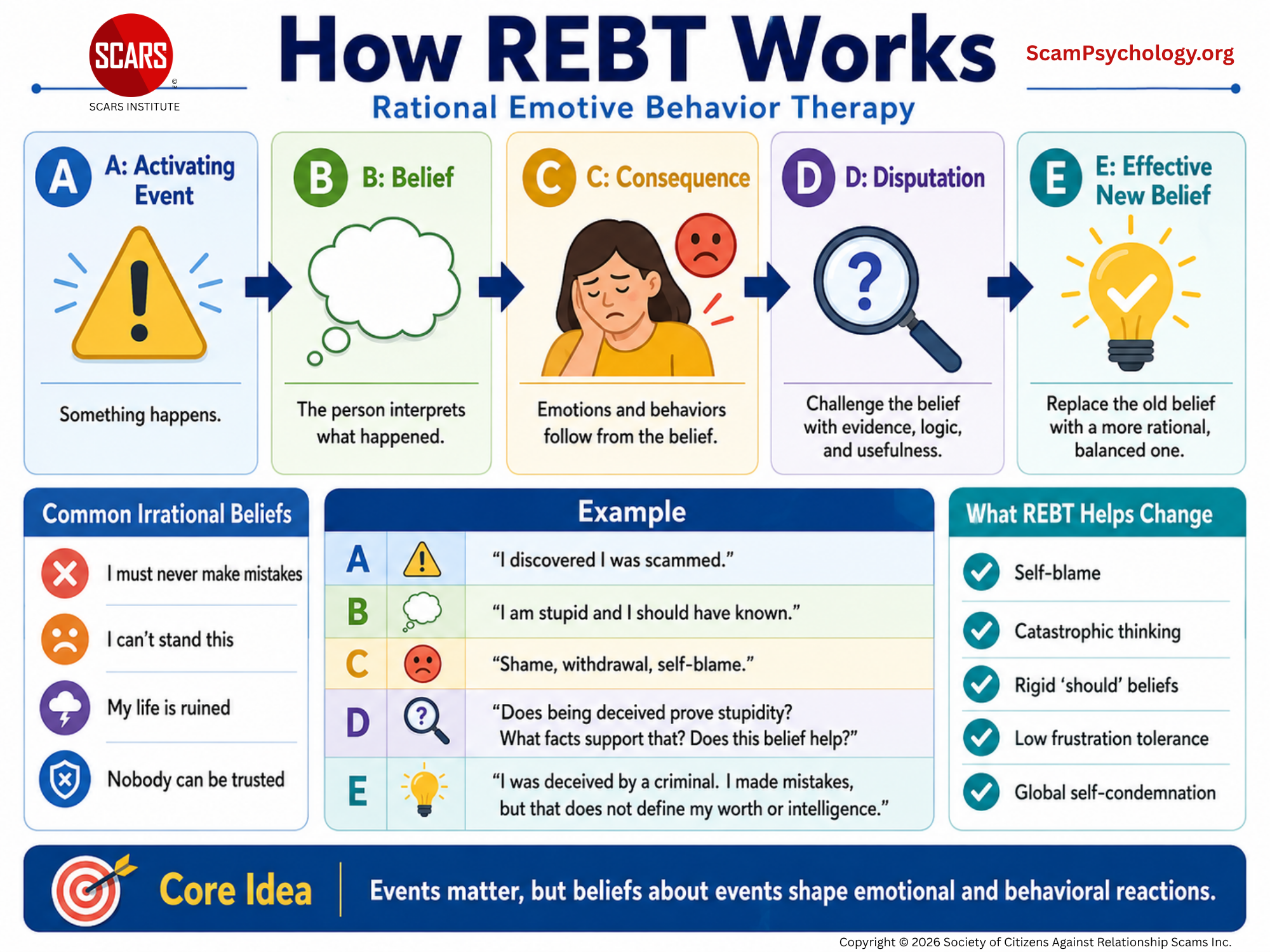
Developed by psychologist Albert Ellis during the 1950s, REBT became one of the earliest cognitive behavioral psychotherapies. Ellis argued that human emotional responses cannot be explained by events alone. People continuously interpret events, judge them, assign meaning to them, and develop beliefs about what those events say about themselves, other people, and life. Those beliefs affect emotion and behavior. Modern REBT continues to use this principle through what is called the ABC (sometimes the ABCDE) model.
This does not mean that a traumatized person created the trauma through irrational thinking. A scam victim did not cause a criminal to lie, steal an identity, manufacture a relationship, manipulate emotions, or take money. REBT addresses a different problem. It examines what the victim believes after those things happen and whether those beliefs accurately describe reality or add another layer of suffering to an already painful experience.
The Belief Between the Event and the Reaction
REBT describes an Activating Event as A, a Belief about the event as B, and the emotional and behavioral Consequences as C. The letters make the process easy to remember, but the psychological idea behind them deserves more attention than the shorthand sometimes receives.
An activating event occurs. A spouse leaves. A job ends. A friend rejects someone. A criminal steals money. A scam relationship collapses. A person discovers that months of intimate conversations came from an organized criminal group rather than the person represented in photographs.
The human mind does not simply record that event and produce an automatic emotional response with no interpretation in between. It evaluates what happened. It decides whether the event is terrible, unfair, threatening, humiliating, tolerable, permanent, reversible, deserved, survivable, or evidence of something larger.
Consider a scam victim who loses $40,000. The financial loss is real regardless of what the victim thinks about it. But several different beliefs could follow. The victim could conclude that the loss created a serious financial problem that requires planning and adjustment. The victim could instead decide that losing the money proves personal stupidity and permanent inability to make financial decisions. Another victim could conclude that no human being can ever be trusted again. Another could decide that life has been permanently destroyed.
Each belief attaches a different meaning to the same underlying event.
REBT does not argue that victims should reinterpret terrible events as pleasant ones. Losing retirement savings remains a serious loss. Discovering that a loved relationship was manufactured remains painful. Family conflict created during the scam remains real. The therapy asks whether the person’s conclusions accurately follow from those facts.
That question sounds simple until shame enters the room.
Ellis Was Interested in the Demands People Place on Reality
Albert Ellis paid particular attention to rigid demands expressed through words such as must, should, ought, and have to. REBT does not treat every use of those words as irrational. The problem appears when a preference becomes an absolute requirement that reality has supposedly violated.
A person naturally prefers honesty. A person wants to make good decisions. A victim wishes the scam had been recognized sooner. A survivor wants emotional pain to diminish.
- Those preferences become psychologically different when they turn into demands.
- A victim no longer thinks that recognizing the scam earlier would have been preferable. The belief becomes, “I should have known.”
- A person no longer wishes other people had behaved honestly. The belief becomes, “People must treat me fairly.”
- A survivor no longer wishes recovery were progressing faster. The belief becomes, “I should be over this already.”
REBT treats this demanding quality as one of the major forms of irrational belief. Ellis also described related beliefs involving awfulizing, frustration intolerance, and global ratings of personal worth or the worth of other people. These remain part of contemporary REBT teaching.
The difference between preference and demand has serious consequences after a scam. A victim who thinks, “I wish I had recognized the deception sooner,” confronts regret. A victim who thinks, “I absolutely should have recognized it,” creates an impossible argument with the past.
The first position allows examination. The second places the past self on trial.
“I Should Have Known” Is Not a Complete Explanation
Few statements appear as persistently after scam victimization as “I should have known better.” It sounds reasonable because hindsight supplies information that the victim did not possess while the crime was unfolding. After exposure, the stolen photograph is obvious. The fabricated emergency looks absurd. The financial requests appear suspicious. The inconsistencies stand out. Friends who warned the victim seem plainly correct. But the person reviewing the events after discovery has access to the answer. The person living through the scam did not. That difference matters.
The criminal controlled information, supplied explanations, created emotional attachment, answered doubts, manipulated urgency, reinforced hope, and presented fabricated evidence. In relationship scams, a victim also accumulated memories and emotional experiences that seemed to confirm the criminal’s identity. The victim did not evaluate one suspicious message in isolation. Every new event entered an existing story that had already acquired personal meaning.
REBT does not excuse every decision a victim made. A victim could have ignored warnings, concealed transfers, rejected advice, or returned to the criminal after evidence appeared. Those behaviors deserve examination because understanding them can improve future decisions.
The problem begins when specific behavior becomes a global judgment. A victim moves from “I ignored that warning” to “I am stupid.” The first statement identifies an event. The second condemns a person.
REBT strongly rejects this type of global self-rating.
Judging an Action Is Different From Judging an Entire Human Being
Ellis developed the idea of unconditional self-acceptance partly as an answer to global self-condemnation. The principle does not ask people to approve of everything they do. It asks them to stop assigning a single total rating to themselves on the basis of particular actions, characteristics, failures, or successes.
A person makes thousands of decisions over a lifetime. Some are intelligent. Some are careless. Some are generous. Some are selfish. Some work well. Some create serious consequences. Reducing the entire person to one adjective based on a selected group of decisions ignores almost everything else about that person’s life.
Scam victims regularly do exactly that after discovery. A retired physician who successfully treated patients for forty years can decide that believing an impersonator proves stupidity. A business owner who made thousands of successful professional decisions can view one relationship scam as evidence of defective judgment. A teacher can spend decades helping students think critically and still condemn herself because a criminal exploited loneliness after the death of a spouse.
REBT asks whether the conclusion follows logically. It does not. A serious error remains serious without becoming a definition of the human being who made it.
This distinction does not weaken accountability. It makes accountability more useful. A victim who identifies a specific behavior has something concrete to examine. A victim who labels the whole self defective has produced a verdict, not an explanation.
Awfulizing Changes “Terrible” Into “Unsurvivable”
REBT also examines the tendency Ellis called awfulizing. A person experiences something very bad and mentally pushes the judgment beyond the available facts.
A victim loses $100,000 and thinks that the loss is terrible. That assessment could be entirely reasonable. The same victim then concludes that life is completely ruined and nothing meaningful remains possible. The second conclusion reaches much farther. The difference matters because serious adversity does not require exaggerated language to be serious. Financial devastation hurts. Betrayal hurts. Divorce hurts. Public embarrassment hurts. Discovering that a relationship existed only as criminal manipulation hurts.
REBT asks the person to describe those realities accurately rather than inflating them into absolute catastrophe.
A victim who says life has been destroyed can examine what has actually been damaged. Savings could be gone. Retirement plans could require change. A marriage could be under severe strain. Trust could be damaged. Anxiety could interfere with sleep. Social embarrassment could feel intense. Those are concrete problems. “Everything is ruined” is not concrete. It gathers every part of life into one sentence and declares the entire structure lost. That conclusion leaves little room for action because nothing specific remains to address.
The Difference Between Pain and Intolerance
Another REBT concept concerns frustration intolerance, sometimes expressed through beliefs such as “I can’t stand this.”
A person usually means that an experience is extremely unpleasant rather than literally impossible to survive. Language matters because repeated descriptions gradually influence how a person understands personal capacity.
- A scam victim says that seeing the criminal’s photograph is unbearable. Yet the victim sees it and remains alive.
- A survivor says that telling family members what happened cannot be tolerated. The conversation feels humiliating, frightening, and painful, but those emotions are not the same as impossibility.
REBT replaces the false claim of incapacity with a more accurate recognition of difficulty. A person can hate an experience while still tolerating it. A person can dread embarrassment and endure embarrassment. A person can feel grief without being destroyed by grief. This distinction becomes especially useful when avoidance starts controlling recovery behavior.
Avoiding photographs, financial statements, conversations, community participation, police reports, or discussions about the crime produces immediate relief. That relief teaches the person to avoid again. The feared experience remains untested, and the belief that it cannot be tolerated grows stronger. Behavioral practice interrupts that pattern. The person encounters manageable discomfort and discovers that discomfort has limits.
REBT Does More Than Identify Irrational Beliefs
Finding an irrational belief is only the beginning of the process. REBT uses disputation to make the belief defend itself.
The expanded model is commonly written as ABCDE.
- A represents the activating event,
- B the belief, and
- C the consequence.
- D stands for disputation, where the person challenges the irrational belief.
- E represents an effective rational belief or new philosophy that replaces it.
Disputation is not an argument designed to make the person feel better for five minutes. It examines whether the belief is supported by evidence, whether it follows logically, and whether holding it helps the person pursue reasonable goals.
A scam victim who believes that being deceived proves stupidity could examine the claim through each of those tests.
- The evidence test asks whether intelligent people are immune to deception. They are not. Fraud succeeds precisely because criminals exploit normal human trust, emotion, incomplete information, social expectations, authority, attachment, and cognitive weaknesses.
- The logical test asks whether one episode of failed judgment establishes the quality of every other judgment a person makes. It does not.
- The practical test asks what happens when the person repeatedly thinks, “I am stupid.” The belief rarely produces careful analysis. It produces shame, secrecy, avoidance, defensiveness, and withdrawal.
A rational replacement does not need to sound comforting. It needs to describe reality more accurately.
The victim was deceived. The victim made decisions under manipulated circumstances. Some decisions could have been better. Those decisions created consequences. The victim remains capable of learning why they happened. Every one of those statements can be true at the same time.
Rational Thinking Is Not Positive Thinking
REBT is sometimes reduced to the idea of replacing negative thoughts with positive ones. That description misses what Ellis was trying to accomplish.
- A rational belief does not need to be pleasant.
- A widow who discovers that a romance scammer stole $200,000 does not need to believe that everything will work out perfectly. Nobody knows that.
- A victim whose marriage ended because of events surrounding the scam does not need to declare the experience beneficial.
- A person facing bankruptcy does not need to pretend that money is unimportant.
REBT demands accuracy, not cheerfulness.
- A victim could rationally conclude that financial circumstances have become extremely difficult and major changes will be required. That belief acknowledges reality without declaring the future worthless.
- A person could admit that trusting again feels frightening while rejecting the conclusion that every future person will betray that trust.
- A survivor could continue grieving the false relationship while recognizing that emotional attachment does not prove the criminal identity was genuine.
The distinction protects recovery education from becoming another source of pressure. Victims do not need to perform optimism. They need beliefs that match reality.
Scam Victimization Creates an Unusual Crisis of Interpretation
Many crimes injure a person without requiring the victim to reconstruct months or years of personal memory. Relationship scams do.
A victim learns that conversations remembered as intimate were manipulative. Expressions of affection become parts of a criminal process. Shared plans become tools of persuasion. Emergencies become extraction devices. Photographs become stolen property belonging to an uninvolved person. The past itself changes meaning. That reversal explains why factual discovery alone does not settle the psychological problem. The victim has to reinterpret an entire period of life after the underlying story collapses.
REBT has particular relevance here because it asks the victim to examine conclusions created during that reinterpretation.
- One victim concludes that personal feelings were fake because the criminal identity was fake. But the victim’s feelings were real.
- Another concludes that missing the criminal proves continuing belief in the scam. But attachment does not disappear simply because factual knowledge changes.
- Another concludes that personal judgment has become permanently unreliable. But a failure under specific conditions does not establish universal incompetence.
REBT repeatedly narrows absolute claims until they match the evidence.
Loss of Self-Trust Becomes More Manageable When It Becomes Specific
“I cannot trust myself” sounds like a statement about safety. It is actually so broad that it provides almost no useful guidance.
A person makes hundreds of judgments every day. The victim still chooses food, drives a car, manages appointments, speaks with family members, reads information, solves problems, and makes countless ordinary decisions without disaster. The real question concerns the circumstances under which judgment became vulnerable during the scam.
- Emotional attachment could have mattered.
- Urgency could have mattered.
- Isolation could have reduced outside correction.
- Repeated reassurance could have weakened doubt.
- Financial promises could have activated hope.
The criminal could have supplied explanations every time conflicting evidence appeared.
Once the victim identifies those conditions, the belief changes character. Instead of “My judgment cannot be trusted,” the person can recognize that judgment became unreliable under a particular combination of manipulation, attachment, secrecy, urgency, and unverified information. That conclusion leads somewhere. It supports verification practices, consultation with trusted outsiders, slower financial decisions, better recognition of manipulation, and greater attention to secrecy demands. Global self-condemnation does none of that.
Distrust of Everyone Creates Another Irrational Absolute
Scam victims sometimes respond to betrayal by deciding never to trust anyone again. The conclusion makes emotional sense because complete distrust appears to eliminate the possibility of another betrayal. It also eliminates the distinction between trustworthy and untrustworthy people.
REBT challenges the absolute rather than demanding immediate trust.
No human relationship offers perfect certainty. A person can verify identity, watch behavior over time, check claims independently, maintain financial boundaries, listen to concerns from trusted people, and slow down major commitments. None of these actions requires blind trust.
The more rational position accepts uncertainty while improving judgment. One criminal does not represent all people. One failed judgment does not predict every future judgment. One deception does not establish that all appearances are false. These are not comforting slogans. They follow from the evidence available.
Recovery Itself Can Become the Next Activating Event
REBT also explains a problem that appears after the initial crisis begins to settle. A victim notices that emotional pain remains and starts developing beliefs about having emotional pain.
The person feels grief and then thinks, “I should not still feel this way.” The person experiences anxiety and decides, “Recovery must not be working.” The person misses the imagined relationship and concludes, “Something must be wrong with me.” Now an emotional consequence of the scam becomes a new activating event.
Contemporary REBT theory recognizes this recursive process. A consequence at one stage can become another activating event that generates new beliefs and new consequences.
This matters because a victim can become distressed about being distressed. The original grief remains, but shame about the grief gets added to it. The original anxiety remains, but fear of the anxiety joins it. The person now has two problems where there was previously one.
REBT challenges the demand that emotional recovery follow an arbitrary schedule. A person can strongly want the pain to end without deciding that continued pain proves failure.
Behavior Gives Rational Beliefs Something to Stand On
REBT includes behavioral work because a person does not build new emotional responses through intellectual agreement alone. A victim can write that embarrassment is tolerable while still avoiding every situation in which embarrassment could occur. The old belief remains protected because it never faces evidence. A survivor can write that safe people exist while refusing all meaningful social contact. Again, nothing tests the conclusion.
Behavior changes that.
- A person who fears discussing the scam can speak about it gradually in an appropriate setting.
- A person who believes asking for help proves weakness can ask a trusted professional or support provider a specific question.
- A victim who fears making another decision can make small decisions using verification and then examine the outcome.
Each behavior gives the new belief contact with reality. This does not require reckless exposure to overwhelming distress. Trauma treatment requires attention to the person’s condition, capacity, symptoms, and safety. But avoidance cannot remain the permanent answer to every uncomfortable emotion.
REBT and Trauma Are Not the Same Subject
REBT addresses beliefs, emotions, and behavior, but trauma involves processes that extend beyond conscious thought.
Traumatic stress affects memory, attention, sleep, physiological arousal, threat detection, emotional conditioning, avoidance, and other processes. A person experiencing intrusive memories or strong autonomic reactions is not simply making an intellectual mistake that can be argued away. This distinction matters for scam victims because self-help techniques have limits.
A person experiencing severe or persistent trauma symptoms, major depression, suicidal thinking, disabling anxiety, dissociation, or serious impairment requires professional mental health assessment. REBT belongs within psychotherapy when a qualified clinician determines that it fits the person’s needs. Written self-disputation does not replace treatment for serious psychological conditions.
REBT still offers useful material for personal practice. Its ABC framework gives people a repeatable way to identify the beliefs attached to distressing events, examine those beliefs, and develop alternatives grounded in evidence and logic.
The Albert Ellis Institute continues to teach REBT for individual, group, couple, and family work, along with health promotion and clinical treatment. REBT remains an active psychotherapy rather than a historical precursor that disappeared when broader cognitive behavioral therapy became prominent.
What Research Says About REBT
REBT has accumulated a substantial research literature, although the quality of that literature is uneven.
A 2017 systematic review and meta-analysis examined 84 articles covering approximately fifty years of REBT research. The researchers reported medium effects for psychological outcomes and irrational beliefs compared with other interventions and concluded that REBT represented a sound psychological intervention. They also identified limitations in the available studies and called for stronger research designs.
A broader systematic review published in 2024 identified 162 REBT intervention studies that included validated measures of rational or irrational beliefs. Across the literature, researchers reported reductions in irrational beliefs, increases in rational beliefs, and improvements in broader mental health outcomes, including depression. The review found better results in studies where trained REBT practitioners delivered the intervention, where the ABC framework was used, and where treatment lasted longer. The authors also found substantial weaknesses in research quality outside some study areas, which prevents treating every positive finding as equally strong evidence.
No established body of research identifies REBT as a specific treatment for scam victimization. Applying REBT to scam victims rests on the relevance of its established methods to beliefs that appear after deception and betrayal: self-condemnation, rigid expectations, catastrophic conclusions, intolerance of emotional distress, and sweeping judgments about trust.
That difference should remain clear. REBT is an established psychotherapy. A scam-specific application represents the use of its principles in a particular victim population.
Turning “I Am Stupid” Into Something That Can Be Examined
A useful REBT exercise begins with precision.A victim who writes “I am stupid” has created a conclusion too broad to investigate properly. The statement needs to be taken apart.
- What exactly happened?
- What did the victim believe at the time?
- What information supported that belief?
- What information contradicted it?
How did the criminal respond when contradictions appeared?
- What emotions were active?
- What decision followed?
- What does the victim now believe that decision proves?
The process turns a verdict into evidence.
A victim can discover that attachment affected judgment without deciding that attachment makes a person defective. A victim can admit that a warning was ignored without concluding that every future warning will be ignored. A victim can recognize susceptibility to authority without assuming permanent helplessness.
This is where REBT becomes particularly useful after scams. The therapy refuses vague condemnation. It wants the belief stated clearly enough that it can be tested.
Recovery Does Not Require Acquitting Every Decision
Scam victims sometimes fear that reducing self-blame means denying responsibility for their own choices. That creates another false choice.
A person can accept responsibility for a decision without accepting responsibility for the criminal’s deception. The victim decided to send money. The criminal created the fraudulent circumstances under which that decision appeared reasonable. Both statements can exist together.
The victim can examine why verification did not happen, why warnings were rejected, why secrecy developed, or why emotional attachment became stronger than conflicting evidence. Those questions support learning. They do not require the victim to accept the criminal’s preferred explanation of the crime, which is that the victim caused the harm by being foolish enough to believe.
REBT provides a cleaner distinction. Behavior can be evaluated. Beliefs can be challenged. Future decisions can change. The whole human being does not need to be condemned in the process.
A victim working through REBT eventually encounters a very different question than “What kind of person falls for a scam?” The more useful question is narrower and harder: “What did this person believe, why did that belief make sense at the time, what kept it alive, and what belief would fit the evidence better now?”
That question does not flatter the victim. It does something more useful. It gives the facts somewhere to go.
How to Recognize if You Are Already Receiving REBT
A person who is already receiving Rational Emotive Behavior Therapy will usually recognize a fairly direct and structured style of treatment. The therapist will repeatedly connect distressing events with the beliefs attached to them, then examine whether those beliefs are rigid, exaggerated, self-condemning, or inconsistent with the available evidence. Sessions can include discussion of ideas such as “must,” “should,” “cannot stand,” catastrophizing, global self-rating, unconditional self-acceptance, and the ABC or ABCDE model. The therapist may challenge statements such as “I am stupid,” “I cannot cope,” or “people must treat me fairly,” then help the person develop a more rational belief that acknowledges the difficulty without condemning the self or demanding that reality be different.
A person should not assume that therapy is REBT simply because a therapist challenges negative thoughts. Many forms of cognitive behavioral therapy use related methods, and some therapists incorporate REBT techniques without identifying their treatment exclusively as REBT. The clearest way to know is to ask the therapist directly whether Rational Emotive Behavior Therapy is being used and how it fits into the treatment plan. A person already receiving REBT will usually see repeated practice between sessions as well, such as written ABCDE exercises, belief disputation, behavioral assignments, rational coping statements, or exercises designed to build tolerance for uncomfortable emotions. Knowing the therapy being used also helps prevent conflicting self-help methods from being added without discussing them with the treating professional.
— PART TWO: USING REBT
Using REBT as a Self-Help Practice After a Scam
REBT becomes useful as self-help when it moves out of theory and into a repeatable written practice. A scam victim does not need to become a therapist or learn every part of Rational Emotive Behavior Therapy before using its basic method. The person needs to identify a distressing event, separate that event from the belief attached to it, examine the belief honestly, and replace an irrational conclusion with one that fits the facts more closely.
This work should not be rushed. Trauma can make emotional reactions intense, and a person can understand a rational argument intellectually while still feeling the older belief emotionally. Repetition matters. A belief rehearsed for months will rarely disappear because it was challenged once on a worksheet.
REBT self-help works best when one specific reaction is examined at a time.
Step 1: “A” – Identify the Activating Event
The first step is to write down what happened as plainly as possible.
REBT calls this the Activating Event, or A.
The description should contain the event itself rather than the person’s judgment about it.
For example:
- “My daughter told me that I should have listened to her.”
- “I saw the photograph the scammer used.”
- “I received a bank statement showing the money I lost.”
- “I remembered sending the final payment.”
- “I attended a support meeting and heard another victim describe recognizing warning signs sooner than I did.”
These are events.
Statements such as “My daughter thinks I am stupid” or “Seeing the photograph proves I am still obsessed” are not simply events. They already contain interpretations.
Keeping “A” factual helps prevent the event and the belief from becoming tangled together.
NOTE: For the Self-Help approach to REBT, we are going to reverse the “B” and the “C” sets for clarity.
Step 2: “C” – Write Down the Emotional and Behavioral Reaction
Before examining the belief, the person should describe what happened emotionally and behaviorally. This is “C,” the Consequence.
The emotional response could include shame, anger, sadness, fear, guilt, anxiety, resentment, humiliation, hopelessness, or grief. The behavioral response matters just as much.
A victim might withdraw, stop answering messages, avoid a support meeting, cry, argue with family members, repeatedly check old photographs, contact the criminal, stay in bed, refuse to look at financial information, or spend hours replaying the scam.
A useful entry could look like this:
- A: “My brother said that the warning signs seemed obvious.”
- C: “I felt ashamed and angry. I ended the conversation, avoided him for two days, and spent the evening thinking about everything I did wrong.”
The purpose is not to judge the reaction. The purpose is to see it clearly.
Step 3: “B” – Find the Belief Between the Event and the Reaction
Now the person looks for B, the Belief. This is usually the most revealing part of the exercise. The belief is what the person told themselves about the event.
Using the example above and below:
- A: “My brother said that the warning signs seemed obvious.”
- B: “He thinks I am stupid. I should have recognized everything he recognized. I cannot stand having my family see me this way.”
- C: Shame, anger, withdrawal, rumination.
The belief explains much more than the event alone. A different victim could hear the same comment and think, “That hurts, but he had information I was refusing to hear at the time.” That person would probably experience a different emotional reaction.
This is where REBT begins giving the victim something that can actually be examined.
Step 4: Look for Rigid Words
Certain words deserve attention because they frequently reveal demanding beliefs.
The person should look for words and ideas such as:
- I must.
- I should.
- I have to.
- They must.
- They should.
- I cannot stand this.
- This is unbearable.
- This proves I am stupid.
- I will never recover.
- Nobody can be trusted.
- My life is ruined.
These statements are not automatically irrational because they sound negative. The question is whether they accurately follow from the facts.
“I lost my retirement savings and face serious financial consequences” could be completely rational. “My life is permanently worthless because I lost my retirement savings” goes much farther than the evidence allows. REBT asks the person to catch that difference.
Step 5: Separate Preference From Demand
A useful self-help question is: “What did the person strongly want to happen, and when did that preference become a demand?”
A victim might strongly wish that the scam had been recognized earlier.
- The rigid belief becomes: “I should have known.”
A victim might strongly want family members to understand the psychological manipulation involved.
- The rigid belief becomes: “They must understand.”
A survivor might desperately want emotional pain to diminish.
- The rigid belief becomes: “I should be over this by now.”
The person can then rewrite the belief as a preference.
- “I deeply wish I had recognized the scam earlier, but I did not.”
- “I want my family to understand what happened, but I cannot require them to understand it perfectly.”
- “I want this pain to end faster, but recovery does not have to follow the schedule I would prefer.”
The facts have not changed. The impossible demand has.
Step 6: “D” – Dispute the Belief
D stands for Disputation. This is where the person puts the belief on trial instead of putting themselves on trial.
Three questions work well.
- First, is the belief factually true?
- Second, does the belief logically follow from what happened?
- Third, does repeatedly believing it help the person respond constructively?
Consider: “I was scammed, so I am stupid.”
- The factual question asks whether being deceived proves stupidity. It does not.
- The logical question asks whether one period of manipulated judgment establishes the quality of a person’s entire intelligence. It does not.
- The practical question asks what happens when the person repeats the belief. If the result is shame, hiding, withdrawal, refusal to learn, or self-punishment, the belief is doing little useful work.
Another example would be: “I cannot trust myself.”
The person can ask: Does one failed judgment prove that every future judgment will fail?
- What conditions were present during the scam?
- Was the person emotionally attached?
- Was information being controlled?
- Was urgency present?
- Were warnings explained away?
- Was secrecy involved?
- Was the victim isolated from people who could challenge the story?
The broad conclusion begins breaking apart. The problem was not that the person had no capacity for judgment. Judgment failed under identifiable conditions. That difference matters because conditions can be recognized and changed.
Step 7: “E” – Write an Effective Rational Belief
E represents the Effective New Belief. This should not be a positive affirmation chosen because it sounds comforting. It should be a statement the person can defend with evidence.
- Instead of: “I am brilliant and never make mistakes.” A rational belief would be: “I made serious decisions while being deceived. Some of those decisions had painful consequences, but they do not define my entire intelligence or worth.”
- Instead of: “I will never trust anyone again.” A rational belief would be: “One person or criminal group betrayed my trust. I can learn to verify people and make trust more gradual without assuming that everyone will betray me.”
- Instead of: “I cannot stand thinking about the scam.” A rational belief would be: “Thinking about the scam is painful, and I strongly dislike it. I have already survived many painful thoughts about it, which means I can tolerate them even when I do not want them.”
- Instead of: “I should be over this.” A rational belief would be: “I want to feel better, but emotional healing does not have to meet an arbitrary deadline. Continued distress means there is still work to do, not that recovery has failed.”
The replacement belief should be believable. If the person does not believe what has been written, the exercise needs more work.
Step 8: Rate How Strongly the Old Belief Is Still Felt
REBT self-help becomes easier to track when the person rates the emotional strength of the belief.
A simple 0 to 10 scale works.
- Before disputation: “I am stupid because I was scammed.” Belief strength: 9 out of 10.
- After disputation: Belief strength: 6 out of 10.
That does not mean the exercise failed. Dropping from 9 to 6 means the belief has started losing authority.
The same belief can be disputed again the next day. A month later it might be a 3.
The goal is not to force the number down. The rating gives the person a way to notice whether repeated work is changing the emotional conviction behind the belief.
Step 9: Test the New Belief Through Behavior
REBT does not stop with writing. A person strengthens new beliefs by behaving as though they are true.
- If the new belief is, “I can tolerate discussing what happened,” the person can talk about one part of the scam with a trusted person or support group.
- If the belief is, “Making a mistake does not make me worthless,” the person can make an ordinary decision without spending hours trying to guarantee perfection.
- If the belief is, “I can ask for help without becoming helpless,” the person can ask a specific question of a therapist, support provider, financial professional, or trusted family member.
- If the belief is, “I can tolerate embarrassment,” the person can allow a trusted person to know something that previously felt too humiliating to discuss.
The behavior supplies evidence that argument alone cannot provide. A person who believes discomfort is survivable eventually has to experience some discomfort and discover that the belief is true.
Step 10: Repeat the Exercise When the Same Belief Returns
Irrational beliefs return. That does not mean REBT failed.
A victim can challenge “I should have known” on Monday and feel it again on Thursday after finding an old message. Emotional learning does not disappear because a rational explanation has been understood once.
The person repeats the ABCDE process.
- A: What happened this time?
- B: What belief appeared?
- C: What did the person feel and do?
- D: What evidence challenges the belief?
- E: What belief fits reality better?
Repeated practice teaches the person to recognize the belief sooner. Eventually the irrational conclusion becomes less automatic.
A Complete Scam Recovery Example
A victim receives a social media memory containing a photograph associated with the criminal.
- A: “The photograph appeared on my screen.”
- B: “I still miss the person in that photograph. That means part of me still believes the relationship was real. I should not still feel this way.”
- C: The victim feels shame, grief, and confusion, then spends an hour rereading old messages.
The disputation begins.
- Does missing someone prove that the person’s represented identity was genuine? No.
- Did the victim experience real emotional attachment during the scam? Yes.
- Does factual discovery instantly erase attachment? No.
- Is there a rule requiring emotional attachment to disappear immediately once fraud is exposed? No.
- Does shame help the attachment resolve? Probably not.
The effective belief becomes: “My attachment developed through real emotional experiences inside me, even though the criminal identity was false. Missing what I believed I had does not make the scam real, and it does not mean I want to be victimized again. I can grieve the attachment while continuing to accept the facts.”
That statement gives the person room to experience grief without turning grief into evidence against recovery.
Another Example: “I Cannot Trust My Judgment”
A victim discovers another financial decision that was influenced by the scam.
- A: “I found a record of an additional transfer I had forgotten.”
- B: “I cannot believe I did this. I cannot trust myself with money anymore.”
- C: Fear, shame, avoidance of financial records, and dependence on other people to make decisions.
Disputation asks whether the evidence supports permanent inability to manage money.
- The person examines decades of financial behavior before the scam.
- The person identifies what was different during the victimization: emotional attachment, urgency, criminal coaching, secrecy, repeated promises, fabricated emergencies, and pressure.
- The effective belief becomes: “My financial judgment failed under specific manipulated conditions. I can identify those conditions and add safeguards instead of declaring myself permanently incapable.”
- The person can then act on that belief by introducing practical verification rules for future transactions.
REBT has now moved from self-condemnation into learning.
Keep a Written REBT Record
A notebook orjournal can make the process easier.
Each entry needs only five headings:
- A: What happened?
- B: What did the person believe about it?
- C: What emotions and behaviors followed?
- D: What evidence, logic, or practical consequences challenge the belief?
- E: What more rational belief fits the facts?
The exercise does not need to become a long essay. What matters is accuracy.
A victim who writes regularly will also begin noticing repeated beliefs. “I should have known” might appear in ten different situations. “I cannot trust myself” could appear whenever money, relationships, or family criticism arise. The repetition reveals the deeper belief that needs continued attention.
REBT Should Not Become Another Way to Attack the Self
A traumatized person can misuse almost any recovery method by turning it into another standard for self-criticism. REBT is no exception.
NOTE: If you do not think you can do this on your own, seek out a therapist to help you.
- A person notices an irrational belief and then thinks: “I should not be thinking this way.” Now the REBT exercise has produced another irrational demand.
- The person feels anxiety and thinks: “I know this belief is irrational, so I should be able to stop feeling anxious.”
That creates another problem.
- The correct response is closer to: “I am noticing the same irrational belief again. I have practiced it many times, so its return is not surprising. I can dispute it again.”
REBT requires persistence, not perfection.
Trauma Symptoms Are Not Arguments to Be Won
Some reactions after a scam should not be treated as if they are merely incorrect thoughts. Nightmares, panic reactions, intrusive memories, severe depression, dissociation, suicidal thinking, intense physiological arousal, serious sleep disturbance, or major impairment in daily functioning require appropriate professional attention. A person experiencing these symptoms should not conclude that better disputation alone should fix them.
REBT self-help addresses beliefs. Trauma involves other psychological and physiological processes as well.
A qualified mental health professional can determine whether REBT belongs within a larger treatment plan and whether other trauma-focused methods, psychiatric care, or additional clinical support are needed.
A Simple Daily Practice
A victim does not need to spend hours performing REBT exercises.
One meaningful ABCDE exercise each day can be enough to begin recognizing patterns. The person can choose the strongest distressing thought of the day, write the activating event, identify the belief, describe the consequence, dispute the belief, and write a rational alternative. The next day, another belief can be examined. Over time, several recurring themes usually become visible:
- “I should have known.”
- “I am stupid.”
- “I cannot trust myself.”
- “Nobody can be trusted.”
- “I cannot tolerate this.”
- “My life is ruined.”
- “I should already be better.”
Those beliefs deserve repeated attention because they can quietly influence behavior long after the criminal has disappeared.
REBT gives the person a way to stop accepting every painful thought as a fact. The victim learns to ask a harder question: What evidence does this belief have to support itself?
Some beliefs survive that question. Others begin to collapse.
— Conclusion
Rational Emotive Behavior Therapy gives scam victims a disciplined way to separate what happened to them from the conclusions they have formed about what happened. The crime remains real. Financial losses remain real. Betrayal, grief, fear, humiliation, damaged relationships, and disrupted plans do not disappear because a person examines personal beliefs. REBT addresses the additional suffering created when those experiences become evidence for absolute judgments such as “I am stupid,” “I cannot trust myself,” “Nobody can be trusted,” or “My life is ruined.”
The ABCDE process gives those beliefs somewhere to be examined rather than simply repeated. A victim identifies what happened, recognizes the emotional and behavioral reaction, finds the belief connecting the two, disputes that belief against evidence and logic, and develops a more rational conclusion. Repeated practice also helps expose recurring patterns involving rigid demands, awfulizing, frustration intolerance, global self-condemnation, and exaggerated conclusions about trust or personal ability.
For traumatized scam victims, the greatest value of REBT may lie in its insistence on precision. A person can acknowledge ignored warnings without becoming “a stupid person.” A victim can regret sending money without accepting responsibility for the criminal’s deception. A survivor can experience grief without deciding that continued grief proves failure. A person can distrust personal judgment under certain conditions without concluding that all future judgment is permanently defective.
REBT self-help also has limits. Severe trauma symptoms, major depression, suicidal thinking, dissociation, disabling anxiety, persistent sleep disturbance, or serious impairment require professional mental health assessment rather than greater effort with a worksheet. When REBT fits the person’s needs, however, repeated examination of irrational beliefs can turn vague self-condemnation into specific questions that can be answered, tested, and gradually changed.

Glossary
- ABC Model — The ABC Model is the basic REBT structure that connects an Activating Event with a person’s Belief about that event and the emotional or behavioral Consequence that follows. It helps a scam victim distinguish what actually happened from what the person concluded that the event meant. This distinction allows harmful interpretations to be examined instead of being mistaken for direct consequences of the crime. — Cognitive Therapy
- ABCDE Model — The ABCDE Model expands the original ABC structure by adding Disputation and an Effective New Belief. The person identifies the event, belief, and consequence, challenges the irrational belief, and develops a conclusion that fits the available evidence more accurately. REBT self-help uses this structure as a repeatable method for examining distressing reactions after scam victimization. — Recovery Practice
- Absolute Judgment — An absolute judgment is a conclusion stated as though no exceptions, alternatives, or future changes are possible. Scam victims can develop absolute judgments such as believing that nobody can ever be trusted or that one failed decision proves permanent incompetence. REBT examines whether the evidence actually supports such sweeping conclusions. — Belief Distortion
- Activating Event — An Activating Event is the event or situation identified as A within the REBT model. It should describe what happened without adding assumptions about motives, meaning, or personal worth, such as receiving a bank statement or hearing criticism from a family member. Keeping the description factual helps separate the event itself from the belief that developed around it. — Cognitive Therapy
- Arbitrary Recovery Deadline — An arbitrary recovery deadline appears when a scam victim decides that emotional healing should have occurred by a particular point without a sound clinical or personal basis for that expectation. Continued sadness, anxiety, grief, or attachment can then become evidence in the person’s mind that recovery has failed. REBT challenges the demand for a fixed emotional timetable and replaces it with a more realistic assessment of continuing recovery work. — Recovery Expectation
- Awfulizing — Awfulizing is the REBT term for taking a genuinely bad event and describing it in absolute terms that extend beyond the facts. A severe financial loss can become the belief that life has been completely destroyed, even though other parts of the person’s life remain intact. REBT asks the person to describe the actual damage precisely rather than turning serious adversity into total catastrophe. — Belief Distortion
- Behavioral Assignment — A behavioral assignment is an activity performed outside a therapy session or written exercise to test a belief through direct experience. A scam victim who believes that asking for help proves weakness could practice asking a trusted person or professional for specific assistance. The resulting experience provides evidence that can support or challenge the person’s existing belief. — Recovery Practice
- Behavioral Consequence — A behavioral consequence is an action that follows a person’s interpretation of an activating event. Shame after a scam can lead to withdrawal, avoidance of support, arguments with family members, repeated checking of old messages, or refusal to examine financial records. REBT treats these behaviors as part of the consequence that should be identified and examined. — Behavioral Response
- Behavioral Practice — Behavioral practice is the use of deliberate action to test whether a new rational belief works outside written reasoning. A person who believes embarrassment is survivable can gradually participate in appropriate conversations where some embarrassment could occur. Direct experience gives the new belief support that intellectual agreement alone cannot provide. — Recovery Practice
- Belief — A belief is the interpretation, judgment, demand, or conclusion that a person attaches to an event within the REBT model. The belief helps explain why people experiencing comparable events can develop different emotional and behavioral reactions. After a scam, beliefs about intelligence, trust, responsibility, worth, or the future can become major sources of continuing distress. — Cognitive Process
- Belief Disputation — Belief disputation is the REBT process of challenging an irrational belief rather than automatically accepting it as true. The person examines factual evidence, logical consistency, and the practical effects of continuing to hold the belief. Disputation turns statements such as “I am stupid” into claims that must support themselves with evidence. — Cognitive Therapy
- Belief Strength Rating — A belief strength rating is a numerical estimate of how strongly a person currently accepts a particular belief, commonly using a scale such as 0 to 10. A scam victim can record the strength of a belief before and after disputation to observe whether emotional conviction is changing. The rating is used for observation rather than as a demand for immediate improvement. — Recovery Tracking
- Catastrophic Conclusion — A catastrophic conclusion takes a serious problem and extends it into a prediction of complete or permanent disaster. A scam victim facing financial loss can move from recognizing severe hardship to believing that nothing meaningful remains possible. REBT separates the actual consequences of the crime from conclusions that exceed what the evidence establishes. — Belief Distortion
- Cognitive Behavioral Psychotherapy — Cognitive behavioral psychotherapy refers to psychological treatment that examines relationships among thoughts, beliefs, emotions, and behavior. REBT developed as one of the earliest forms of this treatment approach under psychologist Albert Ellis. Its emphasis on beliefs gives scam victims a structured way to examine the meanings they assign to deception, loss, betrayal, and personal decisions. — Psychological Treatment
- Consequence — A Consequence is the emotional or behavioral reaction identified as C within the REBT model. Consequences can include shame, grief, anger, anxiety, avoidance, withdrawal, rumination, or other reactions connected with the person’s belief about an event. Identifying consequences clearly helps reveal which beliefs are producing continuing problems. — Emotional Response
- Demandingness — Demandingness is the REBT pattern of converting a strong preference into an absolute requirement. A scam victim can move from wishing the deception had been recognized sooner to believing that it absolutely should have been recognized. The demand creates an impossible argument with an event that has already occurred. — Belief Distortion
- Discomfort Tolerance — Discomfort tolerance is the recognition that painful emotions and unpleasant experiences can be endured even when a person strongly dislikes them. A scam victim can experience embarrassment, grief, anxiety, or painful memories without those experiences becoming literally impossible to survive. REBT strengthens this distinction when avoidance has begun controlling behavior. — Emotional Regulation
- Effective New Belief — An Effective New Belief is the rational conclusion represented by E in the ABCDE model. It replaces an irrational belief with a statement supported by evidence, logic, and a realistic understanding of the person’s circumstances. An effective belief does not need to sound cheerful, but it should describe reality without unnecessary self-condemnation or exaggeration. — Cognitive Therapy
- Emotional and Behavioral Reaction — An emotional and behavioral reaction includes both what a person feels and what the person does after an activating event. A scam victim can feel shame and anger while also withdrawing, arguing, avoiding support, or repeatedly reviewing past messages. Recording both parts gives a fuller picture of the consequence being examined through REBT. — Trauma Response
- Emotional Conviction — Emotional conviction is the felt sense that a belief remains true even after a person understands intellectually that the belief is weak or irrational. A scam victim can logically understand that deception does not prove stupidity while still feeling deeply defective. Repeated disputation and behavioral practice help reduce the authority of such beliefs over time. — Cognitive Process
- Evidence Test — The evidence test is one form of REBT disputation that asks whether facts actually support a person’s conclusion. A victim who believes that being scammed proves low intelligence can examine evidence showing successful decisions, professional competence, and the deliberate manipulation used by criminals. The test requires the belief to survive factual examination rather than emotional repetition. — Reality Testing
- Frustration Intolerance — Frustration intolerance is the belief that an unpleasant emotional state or difficult experience cannot be endured. It appears in statements such as “I cannot stand this” when the person is experiencing severe discomfort rather than literal impossibility. REBT helps the person distinguish intense dislike from inability to tolerate the experience. — Emotional Regulation
- Global Evaluation — Global evaluation occurs when a person assigns a total judgment to the entire self based on selected behaviors, characteristics, failures, or successes. A scam victim can treat one period of manipulated judgment as proof of permanent stupidity or incompetence. REBT rejects this total rating because a human life contains far more information than any single event can represent. — Belief Distortion
- Global Self-Condemnation — Global self-condemnation occurs when a person converts specific regretted actions into a negative judgment about the whole person. A victim who ignored warnings can move from evaluating that behavior to deciding that the entire self is defective. REBT redirects attention toward specific conduct that can be understood and changed without turning accountability into self-hatred. — Moral Emotion
- Global Self-Rating — Global self-rating is the practice of assigning a single value or label to the entire person based on selected evidence. Labels such as stupid, gullible, worthless, or incapable can emerge after scam victimization when painful decisions become measures of total personal worth. REBT replaces global rating with evaluation of specific actions and circumstances. — Self-Acceptance
- Irrational Absolute — An irrational absolute is a rigid conclusion that removes reasonable variation, uncertainty, or exceptions. Statements such as “Nobody can be trusted” and “I will never recover” convert painful experiences into permanent rules about the future. REBT challenges these absolutes by comparing them with actual evidence and alternative possibilities. — Belief Distortion
- Irrational Belief — An irrational belief is a rigid, illogical, exaggerated, or self-defeating conclusion that contributes to unhealthy emotional or behavioral consequences. REBT does not define a belief as irrational merely because it is negative or painful. The belief becomes a target for examination when it conflicts with evidence, logic, or the person’s reasonable goals. — Cognitive Process
- Logical Test — The logical test is a method of disputation that asks whether a conclusion actually follows from the facts that came before it. Being deceived during one relationship does not logically prove that every future judgment will fail. REBT uses this test to expose conclusions that feel convincing but contain unsupported leaps in reasoning. — Reality Testing
- Loss of Self-Trust — Loss of self-trust occurs when a scam victim interprets failed judgment during victimization as evidence that personal judgment is permanently unreliable. The belief can expand far beyond the circumstances in which manipulation actually occurred. REBT narrows the problem by identifying the specific conditions under which judgment became vulnerable and separating them from the person’s broader decision-making ability. — Recovery Process
- Manipulated Judgment — Manipulated judgment describes decision-making that occurred while a criminal controlled information, created emotional pressure, supplied explanations, reinforced hope, or encouraged secrecy. The concept allows a scam victim to examine personal decisions without pretending those decisions occurred under ordinary conditions. REBT uses this distinction to support specific accountability without turning manipulated decisions into global self-condemnation. — Decision-Making Pattern
- Positive Thinking Distinction — The positive thinking distinction separates REBT from the idea that painful thoughts should simply be replaced with pleasant ones. Rational beliefs can acknowledge bankruptcy, grief, damaged relationships, or financial hardship without pretending that those problems are minor. REBT seeks accuracy rather than forced optimism. — Cognitive Therapy
- Practical Test — The practical test asks what effect a belief has on the person’s behavior, emotional state, and ability to respond constructively. A belief such as “I am stupid” can produce hiding, shame, withdrawal, and refusal to learn rather than better judgment. REBT uses this test to determine whether repeatedly holding a belief supports or interferes with reasonable goals. — Recovery Insight
- Preference — A preference is something a person strongly wants without declaring that reality must provide it. A scam victim can prefer that family members understand the manipulation, wish the crime had been recognized earlier, or want recovery to progress faster. REBT considers these wishes differently from rigid demands because a preference allows disappointment without declaring reality unacceptable. — Cognitive Process
- Preference-to-Demand Shift — The preference-to-demand shift occurs when a strong desire becomes an absolute requirement expressed through ideas such as must, should, ought, or have to. A victim can move from wishing for earlier recognition of the scam to insisting that earlier recognition was psychologically required. REBT identifies this shift because the rigid demand can intensify shame, anger, guilt, and frustration. — Belief Distortion
- Rational Alternative — A rational alternative is a replacement interpretation that accounts for the facts without unnecessary exaggeration or self-condemnation. A victim who believes personal judgment can never be trusted might instead recognize that judgment failed under identifiable conditions involving manipulation, secrecy, urgency, and emotional attachment. The alternative creates a basis for practical safeguards rather than permanent helplessness. — Recovery Practice
- Rational Belief — A rational belief is a flexible, evidence-based conclusion that acknowledges reality without imposing unsupported demands or global judgments. It can remain painful because rational thinking does not require an event to be viewed positively. REBT seeks beliefs that allow the person to respond to actual problems without adding conclusions that exceed the evidence. — Cognitive Process
- Rational Coping Statement — A rational coping statement is a brief statement used to reinforce a more accurate interpretation during emotional distress. It can remind a scam victim that a painful experience is tolerable, that one mistake does not define personal worth, or that uncertainty does not prove danger. These statements work best when the person can defend them with evidence rather than repeating them as empty reassurance. — Emotional Regulation
- Rational Emotive Behavior Therapy — Rational Emotive Behavior Therapy, or REBT, is a cognitive behavioral psychotherapy developed by psychologist Albert Ellis during the 1950s. It examines how beliefs about events influence emotional and behavioral reactions and teaches people to challenge irrational beliefs through structured disputation. Its methods can be used clinically and can also provide educational self-help exercises when appropriate. — Psychological Treatment
- Rational Replacement — A rational replacement is the belief developed after an irrational conclusion has been examined and disputed. It should describe the person’s circumstances accurately without creating an unrealistic positive story simply to reduce discomfort. A scam victim should be able to explain why the replacement belief is more defensible than the belief it replaces. — Cognitive Therapy
- Recovery Self-Criticism — Recovery self-criticism develops when a victim begins judging personal emotional reactions or the pace of recovery as additional failures. A person can feel grief and then condemn the continuing grief, creating another layer of distress. REBT challenges beliefs that demand emotional recovery according to an arbitrary personal timetable. — Recovery Distortion
- Recursive Emotional Reaction — A recursive emotional reaction occurs when an emotional consequence becomes a new activating event that generates another belief and another emotional consequence. A scam victim can feel anxiety and then become anxious about still feeling anxious, or experience grief and then feel shame about continuing to grieve. REBT identifies this pattern so the secondary reaction can be examined separately. — Emotional Regulation
- REBT Self-Help Exercise — An REBT self-help exercise is a structured personal practice in which a person records an event, reaction, belief, disputation, and rational replacement. The exercise allows a scam victim to examine one distressing reaction at a time instead of trying to solve every recovery problem at once. Repeated written practice can reveal beliefs that recur across different situations. — Self-Help Practice
- REBT Self-Help Practice — REBT self-help practice is the repeated personal use of REBT principles outside formal psychotherapy. A scam victim identifies irrational beliefs, challenges them, develops rational alternatives, and tests those alternatives through appropriate behavior. Self-help remains educational and does not replace professional treatment for severe or persistent trauma-related symptoms. — Recovery Practice
- REBT Therapy Recognition — REBT therapy recognition involves identifying the structured methods that suggest a therapist is using Rational Emotive Behavior Therapy. Sessions can involve the ABCDE model, disputation of rigid beliefs, examination of must and should statements, unconditional self-acceptance, behavioral assignments, and rational coping statements. A person can confirm the treatment approach by asking the therapist directly. — Treatment Awareness
- Repeated Disputation — Repeated disputation is the continuing practice of challenging the same irrational belief when it returns. A belief such as “I should have known” can reappear after photographs, financial records, family conversations, or other reminders even after earlier work weakened it. REBT treats recurrence as a reason for further practice rather than evidence that the method has failed. — Recovery Practice
- Rigid Demand — A rigid demand is an absolute psychological requirement that a person places on the self, other people, or reality. Statements involving must, should, ought, and have to can reveal such demands when they leave no room for human fallibility or unwanted events. REBT helps convert rigid demands into strong preferences that acknowledge what happened without approving of it. — Belief Distortion
- Self-Condemnation — Self-condemnation occurs when a person treats regretted behavior as evidence that the entire self deserves rejection or contempt. After scam victimization, ignored warnings, financial transfers, secrecy, or continued contact with the criminal can become material for harsh personal judgments. REBT separates evaluation of those actions from condemnation of the whole person. — Moral Emotion
- Self-Help ABCDE Record — A self-help ABCDE record is a written form that organizes a distressing experience into the five components used in REBT. The person records what happened, the belief involved, the resulting emotional and behavioral consequences, the challenge to the belief, and the more rational conclusion. Maintaining these records helps identify patterns that become difficult to see when thoughts remain unexamined. — Self-Help Practice
- Trauma Symptoms — Trauma symptoms include reactions such as nightmares, panic responses, intrusive memories, dissociation, severe anxiety, sleep disturbance, major depression, suicidal thinking, and serious impairment in daily functioning. REBT self-help should not treat these reactions as simple thinking errors that greater disputation will automatically correct. Persistent or severe symptoms require appropriate professional mental health assessment and treatment. — Trauma Response
- Unconditional Self-Acceptance — Unconditional self-acceptance is the REBT principle that a person does not need to assign a total value to the self based on individual behaviors, failures, characteristics, or successes. A scam victim can acknowledge poor decisions and serious consequences without converting them into proof of personal worthlessness. This approach allows accountability to remain specific while preserving the person’s broader human value. — Self-Acceptance
- Written REBT Record — A written REBT record is a notebook or journal entry used to document recurring events, beliefs, emotional reactions, disputation, and rational alternatives. Recording the process makes repeated patterns such as “I cannot trust myself” or “I should have known” easier to recognize across different situations. The record also gives a person material that can be reviewed independently or discussed with a treating professional. — Recovery Tracking
Sources & References
- A Systematic Review of the Nature and Efficacy of Rational Emotive Behaviour Therapy Interventions
Ailish M. King, Carolyn R. Plateau, Martin J. Turner, Paul Young, Jamie B. Barker. PLOS ONE, 2024, 19(7): e0306835. DOI: 10.1371/journal.pone.0306835. This is the most current comprehensive systematic review located. It identified 162 REBT intervention studies and found recurring reductions in irrational beliefs, increases in rational beliefs, and improvements in mental health outcomes, while also documenting weaknesses in portions of the evidence base.
Link: https://pubmed.ncbi.nlm.nih.gov/38980891/ - 50 Years of Rational-Emotive and Cognitive-Behavioral Therapy: A Systematic Review and Meta-Analysis
Daniel David, Carmen Cotet, Silviu Matu, Cristina Mogoase, Simona Stefan. Journal of Clinical Psychology, 2018, 74(3):304-318. DOI: 10.1002/jclp.22514. This meta-analysis examined 84 articles and found medium effects for REBT on psychological outcomes and irrational beliefs. It is one of the strongest broad sources supporting REBT as an established psychological intervention.
Link: https://pubmed.ncbi.nlm.nih.gov/28898411/ - Irrational Beliefs and Psychological Distress: A Meta-Analysis
Andreea Vîslă, Christoph Flückiger, Martin grosse Holtforth, Daniel David. Psychotherapy and Psychosomatics, 2016, 85(1):8-15. DOI: 10.1159/000441231. The review analyzed 100 independent samples and found a moderate positive relationship between irrational beliefs and psychological distress, including anxiety, depression, anger, and guilt. This directly supports the discussion of rigid and irrational beliefs increasing emotional distress.
Link: https://pubmed.ncbi.nlm.nih.gov/26609889/ - A Meta-Analysis of the Relationship Between Rational Beliefs and Psychological Distress
Horea-Radu Oltean, Daniel Ovidiu David. Journal of Clinical Psychology, 2018, 74(6):883-895. DOI: 10.1002/jclp.22562. The researchers found a medium negative association between rational beliefs and psychological distress. Unconditional acceptance showed the strongest association among the rational belief categories studied, making this especially relevant to the material on unconditional self-acceptance.
Link: https://pubmed.ncbi.nlm.nih.gov/29168176/ - Rational Emotive Behavior Therapy, Cognitive Therapy, and Medication in the Treatment of Major Depressive Disorder: A Randomized Clinical Trial, Posttreatment Outcomes, and Six-Month Follow-Up
Daniel David, Aurora Szentagotai, Viorel Lupu, Doina Cosman. Journal of Clinical Psychology, 2008, 64(6):728-746. DOI: 10.1002/jclp.20487. This randomized clinical trial assigned 170 patients with major depressive disorder to REBT, cognitive therapy, or fluoxetine and found no significant differences among the treatments at posttreatment.
Link: https://pubmed.ncbi.nlm.nih.gov/18473339/ - Rational Emotive Behavior Therapy Versus Cognitive Therapy Versus Pharmacotherapy in the Treatment of Major Depressive Disorder: Mechanisms of Change Analysis
Aurora Szentagotai, Daniel David, Viorel Lupu, Doina Cosman. Psychotherapy, 2008, 45(4):523-538. DOI: 10.1037/a0014332. This study examined mechanisms underlying REBT and cognitive therapy and found that changes in cognitive processes, including demandingness, were related to treatment outcomes. It supports the emphasis on identifying and changing rigid beliefs rather than treating REBT as simple positive thinking.
Link: https://pubmed.ncbi.nlm.nih.gov/22122538/ - Rational Emotive Behavior Therapy: Current Status
Windy Dryden, Daniel David. Journal of Cognitive Psychotherapy, 2008, 22(3):195-209. DOI: 10.1891/0889-8391.22.3.195. This peer-reviewed review explains REBT’s theoretical and practical features and its relationship with the broader cognitive behavioral therapy tradition. It is useful for supporting the historical and conceptual sections.
Link: https://doi.org/10.1891/0889-8391.22.3.195 - Rational Emotive Behavior Therapy (REBT), Irrational and Rational Beliefs, and the Mental Health of Athletes
Martin J. Turner. Frontiers in Psychology, 2016, 7:1423. DOI: 10.3389/fpsyg.2016.01423. Although written in an athletic context, this scholarly review clearly explains demandingness, awfulizing, frustration intolerance, self-depreciation, rational beliefs, and unconditional self-acceptance. Those concepts directly support the explanatory portions of the REBT material.
Link: https://doi.org/10.3389/fpsyg.2016.01423 - Irrational Beliefs in Posttraumatic Stress Responses: A Rational Emotive Behavior Therapy Approach
Philip Hyland, Mark Shevlin, Gary Adamson, Daniel Boduszek. Journal of Loss and Trauma, 2015, 20(2):171-188. DOI: 10.1080/15325024.2013.839772. This study involved 313 trauma-exposed emergency service workers and found that an REBT-based model accounted for substantial variance in posttraumatic stress symptoms. It is particularly relevant to extending REBT concepts into trauma-related reactions.
Link: https://doi.org/10.1080/15325024.2013.839772 - The Moderating Role of Rational Beliefs in the Relationship Between Irrational Beliefs and Posttraumatic Stress Symptomology
Philip Hyland, Mark Shevlin, Gary Adamson, Daniel Boduszek. Behavioural and Cognitive Psychotherapy, 2014, 42(3):312-326. DOI: 10.1017/S1352465813000064. The study specifically examined REBT’s proposition that rational beliefs can act as protective cognitive factors in posttraumatic stress responses.
Link: https://pubmed.ncbi.nlm.nih.gov/23481443/ - Effectiveness of a Rational Emotive Behavior Therapy (REBT)-Informed Group for Post-9/11 Veterans With Posttraumatic Stress Disorder (PTSD)
Allen B. Grove et al. Military Psychology, 2021, 33(4):217-227. DOI: 10.1080/08995605.2021.1897496. In veterans with PTSD, a five-session REBT-informed group produced significant reductions in depression and PTSD symptoms. This is one of the most directly relevant clinical sources for discussing REBT in a trauma-exposed population.
Link: https://pubmed.ncbi.nlm.nih.gov/34334948/ - The Effect of a Reduction in Irrational Beliefs on Posttraumatic Stress Disorder (PTSD), Depression, and Anxiety Symptoms in a Group Treatment for Post-9/11 Veterans
Allen B. Grove et al. Military Psychology, 2024. PMID: 37486709. This follow-up research examined mechanisms of change in 86 combat veterans. Reductions in irrational beliefs predicted decreases in PTSD, depression, and anxiety symptoms, providing direct support for the REBT theory that belief change can accompany improvement in trauma-related distress.
Link: https://pubmed.ncbi.nlm.nih.gov/37486709/ - The Effectiveness of a Rational-Emotive Intervention on Teachers’ Unconditional Self-Acceptance, Perfectionism, and Pupil Control Ideology
Elena Mirela Samfira, Florin Alin Sava. Frontiers in Psychology, 2023, 14:1240269. DOI: 10.3389/fpsyg.2023.1240269. A six-week REBT intervention significantly increased unconditional self-acceptance, with improvement maintained at six-month follow-up. This provides direct empirical support for the self-acceptance component discussed in the material.
Link: https://pubmed.ncbi.nlm.nih.gov/38155692/ - Effectiveness of Outpatient Rational Emotive Behavior Therapy Over One Decade
Oana A. David, Alina Cîmpean, Cristina Costescu, Raymond DiGiuseppe, Kristene Doyle, Michael Hickey, Daniel David. American Journal of Psychotherapy, 2021. DOI: 10.1176/appi.psychotherapy.20200009. This clinical effectiveness study examined 349 patients who received psychotherapy through the Albert Ellis Institute between 2007 and 2016, making it useful evidence for REBT’s use in routine outpatient practice rather than only controlled experiments.
Link: https://pubmed.ncbi.nlm.nih.gov/34325525/ - Clinical Practice Guideline for the Treatment of Posttraumatic Stress Disorder in Adults
American Psychological Association, updated 2025. This guideline is useful for the sections explaining that trauma involves more than irrational beliefs and that self-help REBT should not substitute for appropriate professional trauma treatment. APA’s current guideline recommends established psychotherapies for PTSD and stresses individualized treatment decisions based on clinical evidence, patient history, preferences, and professional judgment.
Link: https://www.apa.org/ptsd-guideline - Rational Emotive Behavior Therapy in the Context of Modern Psychological Research
Albert Ellis Institute. This professional research overview explains the modern ABC model, rational and irrational beliefs, demandingness, unconditional acceptance, cognitive vulnerability, behavioral techniques, and current REBT research. It is particularly useful as an authoritative practitioner source for explaining how contemporary REBT conceptualizes A, B, and C rather than relying solely on simplified descriptions of Ellis’s original model.
Link: https://albertellis.org/rebt-therapy-in-the-context-of-modern-psychological-research/
IMPORTANT NOTE: This article is intended to be an introductory overview of complex psychological, neurological, physiological, or other concepts, written primarily to help victims of crime understand the wide-ranging actual or potential effects of psychological trauma they may be experiencing. The goal is to provide clarity and validation for the confusing and often overwhelming symptoms that can follow a traumatic event. It is critical to understand that this content is for informational purposes only and does not constitute or is not a substitute for professional medical advice, diagnosis, or treatment. If you are experiencing distress or believe you are suffering from trauma or its effects, it is essential to consult with a qualified mental health professional for personalized care and support.
-/ 30 /-

Want the Definition of a Term?
Search Here

Welcome to the SCARS INSTITUTE Journal of Scam Psychology & Recoverology®
A Journal of Applied Scam, Fraud, and Cybercrime Psychology/Recoverology – and Allied Sciences
A dedicated site for psychology, psychotraumatology, thanotology, recoverology, victimology, criminology, applied sociology and anthropology, and allied sciences, published by the SCARS INSTITUTE™ – Society of Citizens Against Relationship Scams Inc.
TABLE OF CONTENTS
- REBT – Rational Emotive Behavior Therapy and Scam Victim Recovery
- A SCARS Institute Scam Victim/Survivor Self-Help Guide
- Rational Emotive Behavior Therapy (REBT) and Scam Victim Recovery
- Author’s Note
- Educational and Mental Health Disclaimer
- — PART ONE: WHAT IS REBT
- The Belief Between the Event and the Reaction
- Ellis Was Interested in the Demands People Place on Reality
- “I Should Have Known” Is Not a Complete Explanation
- Judging an Action Is Different From Judging an Entire Human Being
- Awfulizing Changes “Terrible” Into “Unsurvivable”
- The Difference Between Pain and Intolerance
- REBT Does More Than Identify Irrational Beliefs
- Rational Thinking Is Not Positive Thinking
- Scam Victimization Creates an Unusual Crisis of Interpretation
- Loss of Self-Trust Becomes More Manageable When It Becomes Specific
- Distrust of Everyone Creates Another Irrational Absolute
- Recovery Itself Can Become the Next Activating Event
- Behavior Gives Rational Beliefs Something to Stand On
- REBT and Trauma Are Not the Same Subject
- What Research Says About REBT
- Turning “I Am Stupid” Into Something That Can Be Examined
- Recovery Does Not Require Acquitting Every Decision
- How to Recognize if You Are Already Receiving REBT
- — PART TWO: USING REBT
- Using REBT as a Self-Help Practice After a Scam
- Step 1: “A” – Identify the Activating Event
- Step 2: “C” – Write Down the Emotional and Behavioral Reaction
- Step 3: “B” – Find the Belief Between the Event and the Reaction
- Step 4: Look for Rigid Words
- Step 5: Separate Preference From Demand
- Step 6: “D” – Dispute the Belief
- Step 7: “E” – Write an Effective Rational Belief
- Step 8: Rate How Strongly the Old Belief Is Still Felt
- Step 9: Test the New Belief Through Behavior
- Step 10: Repeat the Exercise When the Same Belief Returns
- A Complete Scam Recovery Example
- Another Example: “I Cannot Trust My Judgment”
- Keep a Written REBT Record
- REBT Should Not Become Another Way to Attack the Self
- Trauma Symptoms Are Not Arguments to Be Won
- A Simple Daily Practice
- — Conclusion
- Glossary
- Sources & References
Please Tell Us What You Learned From This?
Please Leave A Comment!
Commenting Is An Essential Part Of Healing
Read • Think • Write
Recent Comments
On Other Articles
A Note About Labeling!
We often use the term ‘scam victim’ in our articles, but this is a convenience to help those searching for information in search engines like Google. It is just a convenience and has no deeper meaning. If you have come through such an experience, YOU are a Survivor! It was not your fault. You are not alone! Axios!
A Question of Trust
At the SCARS Institute, we invite you to do your own research on the topics we speak about and publish, Our team investigates the subject being discussed, especially when it comes to understanding the scam victims-survivors experience. You can do Google searches but in many cases, you will have to wade through scientific papers and studies. However, remember that biases and perspectives matter and influence the outcome. Regardless, we encourage you to explore these topics as thoroughly as you can for your own awareness.
Statement About Victim Blaming
Some of our articles discuss various aspects of victims. This is both about better understanding victims (the science of victimology) and their behaviors and psychology. This helps us to educate victims/survivors about why these crimes happened and to not blame themselves, better develop recovery programs, and to help victims avoid scams in the future. At times this may sound like blaming the victim, but it does not blame scam victims, we are simply explaining the hows and whys of the experience victims have.
These articles, about the Psychology of Scams or Victim Psychology – meaning that all humans have psychological or cognitive characteristics in common that can either be exploited or work against us – help us all to understand the unique challenges victims face before, during, and after scams, fraud, or cybercrimes. These sometimes talk about some of the vulnerabilities the scammers exploit. Victims rarely have control of them or are even aware of them, until something like a scam happens and then they can learn how their mind works and how to overcome these mechanisms.
Articles like these help victims and others understand these processes and how to help prevent them from being exploited again or to help them recover more easily by understanding their post-scam behaviors. Learn more about the Psychology of Scams at www.ScamPsychology.org
Psychology Disclaimer:
All articles about psychology, neurology, and the human brain on this website are for information & education only
The information provided in these articles is intended for educational and self-help purposes only and should not be construed as a substitute for professional therapy or counseling.
While any self-help techniques outlined herein may be beneficial for scam victims seeking to recover from their experience and move towards recovery, it is important to consult with a qualified mental health professional before initiating any course of action. Each individual’s experience and needs are unique, and what works for one person may not be suitable for another.
Additionally, any approach may not be appropriate for individuals with certain pre-existing mental health conditions or trauma histories. It is advisable to seek guidance from a licensed therapist or counselor who can provide personalized support, guidance, and treatment tailored to your specific needs.
If you are experiencing significant distress or emotional difficulties related to a scam or other traumatic event, please consult your doctor or mental health provider for appropriate care and support.
Also, please read our SCARS Institute Statement About Professional Care for Scam Victims – here
If you are in crisis, feeling desperate, or in despair please call 988 or your local crisis hotline.
SCARS Institute Resources:
- If you are a victim of scams, go to www.ScamVictimsSupport.org for real knowledge and help
- Enroll in SCARS Scam Survivor’s School now at www.SCARSeducation.org
- To report criminals, visit reporting.AgainstScams.org – we will NEVER give your data to money recovery companies like some do!
- Sign up for our free support & recovery help at www.SCARScommunity.org
- Follow us and find our podcasts, webinars, and helpful videos on YouTube: www.youtube.com/@RomancescamsNowcom
- SCARS Institute Songs for Victim-Survivors: www.youtube.com/playlist…
- Learn about the Psychology of Scams at www.ScamPsychology.org
- Dig deeper into the reality of scams, fraud, and cybercrime at www.ScamsNOW.com and www.RomanceScamsNOW.com
- Scam Survivor’s Stories: www.ScamSurvivorStories.org
- For Scam Victim Advocates, visit www.ScamVictimsAdvocates.org
- See more scammer photos on www.ScammerPhotos.com


When I started taking therapy two years ago through Better Help some of the exercises were challenging negative thoughts.
But I see that REBT helps to identify the patterns we have, emotional and behavioral. It is different from just challenging the tought and replacing it with a grounded one because, as this article explains, there can be emotions and behaviors associated with a belief and is easy to normalize them, and even feel worse for feeling them. I get that it is important to discuss its practice eith iur therapist because it is useful but might not be particularly suitable for us.