



The Three Trauma Model: A Mechanism-Based Framework for Understanding Psychological Trauma
Principal Category: Trauma & Scam Victim Recovery Psychology / Recoverology
Author:
• Tim McGuinness, Ph.D. – Anthropologist, Scientist, Polymath, Director of the Society of Citizens Against Relationship Scams Inc.
Abstract
The Three Trauma Model presents a mechanism-based framework for understanding psychological trauma by focusing on the psychological system that sustains the primary injury rather than the external event alone. The model identifies three core trauma categories: Threat-of-Death Trauma, which injures the survival system; Attachment Trauma, which injures the attachment system; and Betrayal Trauma, which injures the trust system. It proposes that these mechanisms help explain differences in symptom development, PTSD prevalence, treatment needs, and recovery pathways. Particular attention is given to relationship scams and other trust-based crimes as examples of severe Betrayal Trauma capable of producing PTSD-like symptoms despite the absence of physical danger. The framework emphasizes assessment of dominant injury mechanisms, recognition of overlapping trauma patterns, and restoration of injured psychological systems as central components of recovery.
Keywords
Three Trauma Model, Betrayal Trauma, Attachment Trauma, Threat-of-Death Trauma, PTSD, Complex Trauma, Relationship Scams, Trust System, Trauma Recovery, Psychological Injury, Tim McGuinness Ph.D.
The Three Trauma Model: A Mechanism-Based Framework for Understanding Psychological Trauma
A SCARS Institute White Paper by Tim McGuinness, Ph.D.
PART 1: EXECUTIVE SUMMARY AND INTRODUCTION
Summary
Psychological trauma has traditionally been classified according to the nature of the event that produced it. Diagnostic frameworks, epidemiological studies, and treatment models have historically focused on categories such as combat exposure, physical assault, sexual violence, natural disasters, serious accidents, childhood abuse, and medical crises. This event-based approach has produced valuable clinical insights and has significantly advanced the understanding of Post-Traumatic Stress Disorder (PTSD). However, it may not fully explain why individuals exposed to very different traumatic experiences often display remarkably similar symptoms, nor does it adequately explain why some forms of trauma produce distinct patterns of psychological injury despite sharing common diagnostic criteria.
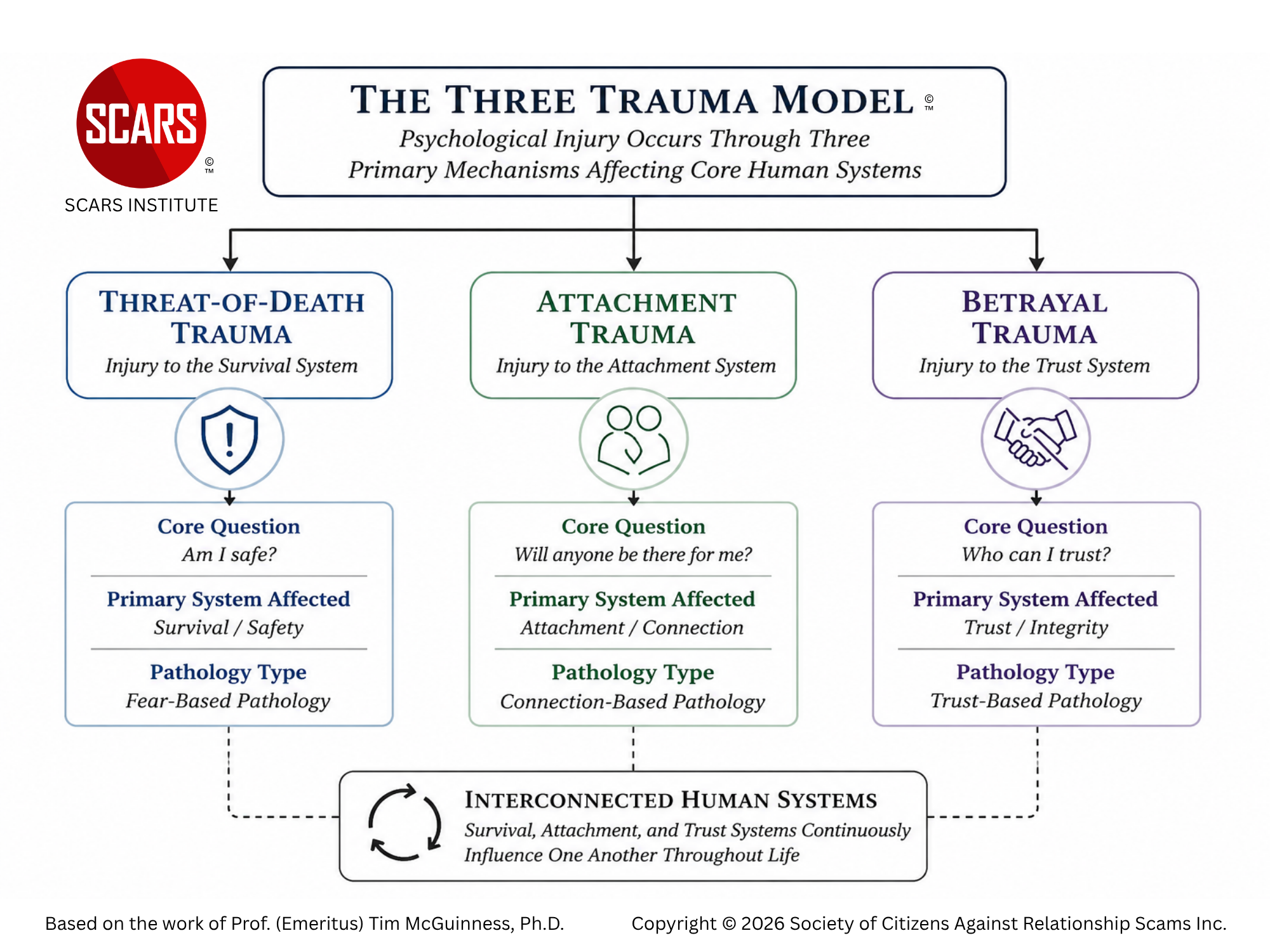
The Three Trauma Model proposes an alternative framework for understanding psychological trauma. Rather than classifying trauma according to the external event, the model classifies trauma according to the primary psychological system that is injured during the traumatic experience. The model identifies three principal categories of trauma: Threat-of-Death Trauma, Attachment Trauma, and Betrayal Trauma.
Threat-of-Death Trauma involves experiences that directly challenge an individual’s perception of physical survival. Attachment Trauma involves disruption, abandonment, neglect, or loss within critical attachment relationships. Betrayal Trauma involves injury caused through the violation of trust by individuals, institutions, or systems upon which a person depends for safety, support, guidance, or connection.
The model suggests that different trauma mechanisms may produce different psychological outcomes, even when symptoms overlap. It further proposes that PTSD may be disproportionately associated with Threat-of-Death Trauma and Betrayal Trauma, while Attachment Trauma may more frequently produce developmental disturbances, emotional dysregulation, attachment dysfunction, depression, anxiety, and complex trauma presentations.
Particular attention is given to relationship scams and other forms of interpersonal exploitation as examples of Betrayal Trauma. These experiences frequently produce severe psychological distress despite the absence of direct physical threat, suggesting that catastrophic violations of trust may activate trauma mechanisms comparable in severity to traditional life-threatening experiences.
The purpose of this framework is not to replace existing trauma theories but to provide an additional lens through which trauma can be understood, researched, diagnosed, and treated. By focusing on the psychological system that has been injured rather than solely on the external event, clinicians and researchers may gain a deeper understanding of trauma pathology and recovery.
Introduction
For more than four decades, trauma research has been heavily influenced by models developed through the study of combat veterans, disaster survivors, victims of violent crime, and individuals exposed to life-threatening events. These populations played a critical role in the development of modern trauma theory and contributed substantially to the recognition of PTSD as a distinct psychological condition. As a result, much of contemporary trauma research continues to emphasize experiences involving danger, injury, violence, and threats to survival.
This emphasis has produced significant advances in clinical understanding. Researchers have identified mechanisms associated with fear conditioning, hypervigilance, intrusive memories, avoidance behaviors, and physiological arousal. These findings have helped explain many trauma responses and have guided the development of effective treatment approaches.
Despite these advances, important questions remain unanswered.
Individuals exposed to dramatically different traumatic experiences often present with similar symptoms. A combat veteran, a victim of domestic violence, a survivor of sexual exploitation, a victim of institutional betrayal, and an individual who has been manipulated through a long-term relationship scam may all exhibit intrusive thoughts, hypervigilance, emotional numbing, avoidance behaviors, sleep disturbances, concentration difficulties, and profound disruptions in trust and identity.
At the same time, individuals exposed to similar traumatic events may experience very different outcomes. Some develop classic PTSD. Others develop chronic attachment disturbances. Some struggle primarily with emotional regulation, while others experience profound disruptions in trust, meaning, and interpersonal functioning.
These observations raise an important question. Is the traumatic event itself the most useful way to classify psychological injury, or does the primary injury mechanism provide a more informative framework?
Modern medicine frequently classifies injuries according to the systems affected rather than the specific event that caused them. A broken bone remains an orthopedic injury regardless of whether it occurred during a sporting event, a motor vehicle accident, or a fall. Similarly, a neurological injury is classified according to the affected system rather than the specific circumstances surrounding the event.
Psychological trauma may benefit from a similar perspective.
Two individuals may experience entirely different events while sustaining injuries to the same psychological system. Conversely, two individuals exposed to the same event may experience injury to different psychological systems depending upon their developmental history, relationships, perceptions, and circumstances.
The Three Trauma Model proposes that trauma can be understood through three primary mechanisms of injury.
- Attachment Trauma involves injury to the attachment system. These injuries typically emerge through abandonment, neglect, inconsistent caregiving, attachment disruption, or the loss of significant attachment figures. Attachment Trauma often influences emotional regulation, relationship formation, self-concept, and developmental functioning throughout the lifespan. Our best estimates are that this represents about 50% of instances of psychological trauma.
- Threat-of-Death Trauma involves experiences in which the individual’s survival system becomes overwhelmed by perceived or actual threats to life or physical safety. These experiences align closely with traditional PTSD models and include many forms of combat exposure, violent assault, severe accidents, natural disasters, and life-threatening medical events. Our best estimates are that this represents about 35% of instances of psychological trauma.
- Betrayal Trauma involves injury to the trust system. In these cases, the source of safety, support, guidance, love, or protection becomes the source of harm. Betrayal Trauma occurs when trust is weaponized against the individual. Examples include relationship scams, infidelity, trusted-person abuse, institutional betrayal, clergy abuse, financial exploitation, and other forms of manipulation involving trusted relationships. Our best estimates are that this represents about 15% of instances of psychological trauma.
This distinction is particularly important because betrayal appears capable of producing trauma responses that closely resemble those associated with life-threatening experiences. Individuals who have experienced severe betrayal frequently exhibit intrusive memories, avoidance behaviors, hypervigilance, emotional numbing, persistent threat monitoring, and significant alterations in identity and worldview. Yet these experiences often occur in the absence of direct physical danger.
Such observations suggest that the human nervous system may respond not only to threats against survival, but also to catastrophic violations of trust. If this is true, existing trauma frameworks may underestimate the significance of betrayal-based injuries and may overemphasize physical threat as the primary pathway to severe trauma responses.
The Three Trauma Model seeks to address these questions by shifting attention away from the event itself and toward the psychological system that has been injured. This approach does not deny the importance of traumatic events. Rather, it proposes that a deeper understanding of trauma may emerge when clinicians and researchers examine how different experiences affect the survival system, the attachment system, and the trust system.
By focusing on injury mechanisms rather than event categories, the model offers a framework for exploring why certain traumas produce PTSD, why others produce developmental disturbances, and why some forms of betrayal appear capable of generating profound and enduring psychological consequences. It further provides a foundation for examining trauma experiences, including relationship scams, that have historically occupied an uncertain position within traditional trauma theory.
The sections that follow examine the limitations of event-based trauma classification, review the historical origins of PTSD and threat-based trauma models, and introduce a mechanism-based framework that may provide a more comprehensive understanding of psychological injury across a broad range of traumatic experiences.
The Limitations of Event-Based Trauma Classification
Modern trauma theory has been extraordinarily successful in identifying and treating the psychological consequences of traumatic experiences. The recognition of PTSD as a diagnosable condition represented a major advancement in mental health research and helped legitimize the experiences of countless trauma survivors. Despite these achievements, the dominant approach to trauma classification continues to rely heavily upon the nature of the precipitating event rather than the psychological mechanisms through which injury occurs.
Current diagnostic and research frameworks typically organize trauma according to external categories. Researchers examine combat exposure, physical assault, sexual violence, childhood abuse, natural disasters, serious accidents, terrorism, medical crises, and other forms of potentially traumatic experiences. This approach provides useful descriptive information regarding the circumstances surrounding trauma exposure. However, it often reveals little about the psychological systems that were actually injured during the event.
Two individuals may experience identical events while sustaining dramatically different psychological injuries. A soldier exposed to combat may emerge primarily concerned with physical safety and survival. Another soldier exposed to the same combat conditions may experience the greatest psychological injury through the betrayal of trusted leaders, the loss of trusted comrades, or violations of deeply held moral beliefs. Although the external event remains identical, the primary mechanism of injury differs substantially.
Similarly, individuals exposed to very different events may develop remarkably similar symptom profiles. A victim of a violent assault and a victim of a long-term relationship scam may both experience intrusive thoughts, hypervigilance, emotional numbing, avoidance behaviors, sleep disturbances, and profound alterations in worldview. Traditional event-based classification places these individuals in entirely separate categories despite significant overlap in their psychological responses.
This limitation becomes increasingly apparent when examining trauma experiences that do not fit neatly into conventional threat-based frameworks. Relationship scams provide a useful example. Victims frequently report symptoms commonly associated with PTSD, including intrusive memories, hypervigilance, emotional dysregulation, concentration difficulties, avoidance, and persistent threat monitoring. Yet many of these individuals were never exposed to direct physical danger. Their injuries emerged through manipulation, deception, attachment, and betrayal rather than through threats to survival.
Traditional trauma frameworks often struggle to explain such cases because they were largely developed around experiences involving physical threat. As a result, trauma that emerges through violations of trust, attachment disruption, identity collapse, or emotional exploitation may receive less attention despite producing substantial psychological harm.
Another limitation of event-based classification involves the overlap among trauma categories. Many traumatic experiences contain multiple injury mechanisms simultaneously. Childhood abuse may involve attachment disruption, betrayal, and physical threat. Domestic violence may involve fear, dependency, coercion, attachment injury, and betrayal. Sexual assault may involve physical danger, betrayal, humiliation, and loss of control. Because these experiences contain multiple dimensions of injury, classification based solely upon the event itself may obscure the mechanisms most responsible for long-term psychological consequences.
The challenge becomes even more apparent when considering treatment outcomes. Individuals sharing the same diagnosis often respond differently to identical interventions. Some benefit primarily from approaches focused on fear extinction and threat processing. Others require interventions that address attachment disruptions, trust violations, identity disturbances, or relational functioning. These differences suggest that the underlying injury mechanism may influence treatment needs as much as, or perhaps more than, the event itself.
The evolution of medicine provides a useful comparison. Medical science originally classified many illnesses according to observable symptoms. Over time, advances in biological understanding shifted attention toward underlying mechanisms. Diseases that appeared similar on the surface were found to arise through entirely different physiological processes. Conversely, seemingly unrelated symptoms were discovered to originate from common biological causes.
Trauma theory may be approaching a similar point of development. The field has become increasingly effective at identifying symptoms and describing traumatic events. The next stage of advancement may require greater attention to the psychological systems that sustain injury during those events.
A mechanism-based framework does not seek to eliminate event-based classification. Information regarding the nature of traumatic experiences remains critically important. However, a more complete understanding of trauma may emerge when event categories are supplemented by an examination of the survival system, attachment system, and trust system. Such an approach may help explain symptom variation, treatment responsiveness, recovery trajectories, and the substantial overlap observed across apparently different forms of trauma.
The Three Trauma Model emerges from this perspective. It proposes that understanding what happened is only the first step. Understanding what psychological system was injured may ultimately provide a more useful foundation for understanding how recovery occurs.
The Origins of PTSD and Threat-Based Trauma Theory
Any effort to develop a new framework for understanding trauma must begin with an appreciation for the historical origins of modern trauma theory. The contemporary understanding of PTSD did not emerge in isolation. It developed through decades of observation, research, and clinical experience involving individuals exposed to overwhelming threats to survival.
Historical descriptions of trauma-related symptoms can be found throughout recorded history. Ancient writings describe soldiers who returned from battle profoundly altered by their experiences. During the American Civil War, physicians documented conditions referred to as “soldiers’ heart” and other stress-related syndromes. Similar observations appeared following World War I under labels such as “shell shock” and during World War II under terms including “combat fatigue.”
Although terminology varied, a common pattern emerged. Individuals exposed to extreme danger often developed persistent psychological symptoms long after the threat had passed. They experienced nightmares, intrusive memories, heightened arousal, emotional distress, and difficulties returning to normal functioning.
The Vietnam War significantly accelerated the study of these conditions. Large numbers of returning veterans exhibited persistent psychological difficulties that could not be adequately explained through existing psychiatric models. Their experiences contributed directly to the eventual inclusion of PTSD in the third edition of the Diagnostic and Statistical Manual of Mental Disorders (DSM-III) in 1980.
The diagnostic criteria reflected the evidence available at the time. PTSD was conceptualized primarily as a response to extraordinary events involving actual or threatened death, serious injury, or threats to physical integrity. This formulation was logical given the populations through which the condition had been studied. Combat veterans, disaster survivors, victims of violent crime, and individuals exposed to life-threatening circumstances formed the foundation of early PTSD research.
As research expanded, investigators identified a number of mechanisms associated with traumatic stress. Fear conditioning emerged as a central explanatory model. During highly threatening experiences, the nervous system rapidly learns associations between environmental cues and danger. These associations can persist long after the original threat has disappeared, leading to hypervigilance, avoidance, intrusive recollections, and exaggerated startle responses.
Neuroscientific research further strengthened threat-based models of trauma. Investigators documented changes involving the amygdala, hippocampus, prefrontal cortex, autonomic nervous system, and stress-response systems. Many of these findings appeared consistent with the understanding of trauma as a survival-related phenomenon. The brain and body were responding as though danger remained present even after the traumatic event had ended.
This body of research transformed trauma treatment. Exposure therapies, cognitive interventions, stress-management techniques, and other evidence-based approaches emerged from an increasingly sophisticated understanding of how fear and survival systems operate.
These developments represented major achievements. However, they also shaped the assumptions underlying modern trauma theory.
Because PTSD was largely developed through the study of threat-based experiences, physical danger became the dominant lens through which trauma was understood. The central question often became whether an event involved actual or perceived threats to survival. Events that fit this framework were readily recognized as traumatic. Events that did not fit the framework sometimes occupied a more ambiguous position.
As trauma research expanded beyond combat and disaster populations, investigators began encountering experiences that challenged purely threat-based explanations. Survivors of childhood neglect, emotional abuse, attachment disruption, institutional betrayal, and interpersonal exploitation frequently exhibited profound psychological symptoms despite limited exposure to direct physical danger. Their suffering was often unmistakable, yet the mechanisms driving that suffering did not always align neatly with traditional survival-based models.
This tension has become increasingly apparent within contemporary trauma literature. Concepts such as developmental trauma, complex trauma, moral injury, attachment injury, and betrayal trauma have emerged in part because traditional threat-based frameworks do not fully account for all forms of psychological injury.
These developments do not invalidate threat-based trauma theory. On the contrary, they demonstrate its strengths. Threat-of-death trauma remains one of the most powerful and well-established pathways to PTSD. However, the expansion of trauma research suggests that survival threats may represent only one category of psychological injury.
The growing recognition of attachment-related injuries and trust-related injuries raises an important possibility. The same nervous system that responds to threats against physical survival may also respond to catastrophic disruptions of attachment and trust. If this is true, trauma theory may benefit from a framework capable of distinguishing among these mechanisms while recognizing their overlapping effects.
The Three Trauma Model begins with this premise. Rather than viewing trauma solely through the lens of physical danger, it proposes that psychological injury may emerge through threats to survival, disruptions of attachment, and violations of trust. Each pathway appears capable of producing profound consequences, yet each may operate through distinct psychological mechanisms and generate different patterns of pathology, recovery, and resilience.
PART 2: THE THREE TRAUMA MODEL
A Mechanism-Based Framework for Psychological Injury
The central proposition of the Three Trauma Model is that psychological trauma may be more accurately understood by examining the primary mechanism of injury rather than focusing exclusively on the external event. Traditional trauma classifications have generally emphasized what happened to the individual. The Three Trauma Model instead asks a different question: What psychological system was injured?
This distinction is not merely semantic. It has important implications for understanding symptom development, diagnostic formulation, treatment planning, recovery trajectories, and long-term adaptation. Two individuals exposed to different traumatic events may sustain injuries to the same psychological system and therefore exhibit similar symptom patterns. Conversely, two individuals exposed to the same event may sustain injuries to different psychological systems and require substantially different approaches to recovery.
The model proposes three primary categories of psychological injury: Threat-of-Death Trauma, Attachment Trauma, and Betrayal Trauma. Each category is defined not by the event itself but by the dominant psychological system affected by the traumatic experience.
- Attachment Trauma primarily injures the attachment system.
- Threat-of-Death Trauma primarily injures the survival system.
- Betrayal Trauma primarily injures the trust system.
Although these categories frequently overlap, distinguishing among them may help explain why trauma presentations vary so significantly across individuals and populations.
Type 1: Attachment Trauma
If Threat-of-Death Trauma centers upon injury to the survival system, Attachment Trauma centers upon injury to the attachment system.
The attachment system is one of the most important psychological structures in human development. From infancy onward, human beings depend upon attachment relationships for safety, emotional regulation, learning, identity formation, and social development. Unlike many species that become independent shortly after birth, humans require prolonged caregiving relationships to survive and thrive. As a result, the human nervous system evolved to prioritize connection with caregivers and significant attachment figures.
Attachment is not simply a social preference. It is a biological necessity.
Attachment theory, originally developed by John Bowlby and later expanded by Mary Ainsworth, proposed that human beings are biologically driven to seek proximity to trusted caregivers during times of stress, uncertainty, and vulnerability. Secure attachment relationships provide emotional stability, facilitate healthy development, and create internal models that shape future relationships.
When attachment systems function effectively, individuals develop a sense of security that supports emotional regulation, resilience, interpersonal trust, and healthy identity formation. When attachment systems are disrupted, injured, or chronically neglected, significant psychological consequences can emerge.
The Three Trauma Model identifies these injuries as Attachment Trauma.
Defining Attachment Trauma
Attachment Trauma occurs when the individual’s primary attachment system experiences disruption, instability, abandonment, neglect, loss, or chronic inconsistency.
- Unlike Threat-of-Death Trauma, the defining feature is not danger.
- Unlike Betrayal Trauma, the defining feature is not deception.
The defining feature is the disruption of attachment security.
Attachment Trauma can emerge through numerous pathways. Childhood neglect, emotional abandonment, inconsistent caregiving, prolonged separation from caregivers, parental substance abuse, institutionalization, foster care instability, parental mental illness, chronic emotional unavailability, and the loss of significant attachment figures all have the potential to injure the attachment system.
The death of a parent during childhood provides one example.
The child may never experience direct physical danger. No assault occurs. No threat to survival is present. Yet the psychological consequences can be profound because the attachment figure who provided safety, comfort, and emotional regulation is suddenly absent.
Similarly, emotional neglect may occur without overt abuse. A child may receive food, shelter, education, and physical care while remaining emotionally unseen, unsupported, or disconnected from caregivers. Although no single catastrophic event occurs, the chronic absence of secure attachment can produce long-term developmental consequences.
The injury mechanism is attachment disruption itself.
The Biological Importance of Attachment
Understanding Attachment Trauma requires recognizing the biological significance of attachment relationships.
Throughout human evolution, separation from caregivers often carried serious survival implications. Young children who became isolated from caregivers faced increased vulnerability to environmental dangers, predation, illness, and resource scarcity. Consequently, the human nervous system evolved to treat attachment disruptions as highly significant events.
Research has repeatedly demonstrated that attachment relationships influence physiological regulation. Secure attachment affects stress hormones, autonomic nervous system functioning, emotional development, and social learning. Caregivers help children regulate distress before they possess the capacity to regulate themselves.
In many respects, attachment figures function as external regulators of emotional states. When those relationships are disrupted, the developing nervous system may struggle to establish stable patterns of emotional regulation.
This perspective helps explain why attachment injuries often exert long-lasting effects. The attachment system influences not only relationships but also identity formation, emotional processing, self-worth, interpersonal expectations, and resilience.
- The injury extends beyond the loss of a relationship.
- The injury affects the system through which emotional security is established.
The Developmental Consequences of Attachment Trauma
One of the most important distinctions between Attachment Trauma and Threat-of-Death Trauma involves the developmental nature of the injury. Threat-of-Death Trauma often results from identifiable events occurring at specific points in time. A combat engagement, assault, accident, or disaster may be clearly remembered and associated with a distinct traumatic experience.
Attachment Trauma frequently develops gradually. The injury may emerge through years of inconsistent caregiving, chronic neglect, repeated abandonment, or persistent emotional unavailability. Because these experiences become integrated into the developmental environment, they may not be experienced as isolated events.
Instead, they become part of the individual’s understanding of relationships, self-worth, and emotional expectations. The resulting consequences can be extensive.
Individuals affected by Attachment Trauma may struggle with emotional regulation, interpersonal relationships, self-esteem, boundaries, dependency, intimacy, abandonment fears, and chronic insecurity. They may experience depression, anxiety, shame, loneliness, emotional dysregulation, or persistent difficulties forming secure relationships.
These consequences often reflect adaptations to early attachment environments rather than reactions to discrete traumatic events. As a result, Attachment Trauma frequently appears in clinical settings through patterns of functioning rather than through classic PTSD symptoms.
Why Attachment Trauma May Produce Lower Rates of Classic PTSD
The Three Trauma Model proposes that Attachment Trauma is likely among the most common forms of psychological injury in the general population. Childhood adversity, parental loss, neglect, abandonment, attachment disruptions, and caregiver instability occur across cultures and throughout the lifespan.
Yet Attachment Trauma does not appear to produce PTSD at rates comparable to Threat-of-Death Trauma or Betrayal Trauma. This observation raises an important question. Why would one of the most common forms of trauma appear to generate relatively fewer cases of classic PTSD?
One possible explanation involves the nature of the injury itself. PTSD symptoms are often associated with fear conditioning, intrusive recollections, hypervigilance, avoidance, and persistent threat monitoring. These symptoms emerge naturally when the survival system has been overwhelmed by danger.
Attachment Trauma affects a different psychological system. The attachment system is concerned primarily with connection, security, regulation, belonging, and relational stability. Injuries to this system may therefore produce different forms of adaptation.
Rather than developing intense fear-based symptoms, individuals may develop chronic attachment insecurity, emotional dysregulation, relationship difficulties, depression, anxiety, identity disturbances, or maladaptive interpersonal patterns.
The pathology becomes developmental rather than primarily fear-based. This does not imply that Attachment Trauma is less serious. In many cases, its effects may persist for decades and influence virtually every aspect of psychological functioning.
The distinction lies in the form the injury takes. Threat-of-Death Trauma often produces symptoms centered upon survival. Attachment Trauma often produces symptoms centered on connection.
Attachment Trauma Across the Lifespan
Although attachment theory originated through the study of childhood development, attachment injuries are not limited to childhood.
Adults continue to form significant attachment relationships throughout life. Spouses, romantic partners, family members, close friends, mentors, and caregivers often assume attachment functions that influence emotional security and regulation.
The sudden death of a spouse, for example, may create profound attachment injury even in psychologically healthy adults. The loss extends beyond grief. The individual may lose a primary source of emotional regulation, support, companionship, identity reinforcement, and daily stability.
Similarly, abandonment, prolonged separation, or attachment disruption can produce substantial distress even when no betrayal or threat is involved. The nervous system continues responding to attachment loss because attachment remains a fundamental human need throughout life.
This perspective helps explain why attachment injuries remain clinically significant across developmental stages. The attachment system does not disappear after childhood. It continues shaping emotional experience, relationship functioning, and psychological well-being throughout the lifespan.
The Relationship Between Attachment Trauma and the Other Trauma Categories
Although the Three Trauma Model distinguishes among trauma mechanisms, these categories frequently overlap.
Childhood abuse may involve Attachment Trauma because the caregiver relationship is disrupted. The same experience may involve Threat-of-Death Trauma if physical danger is present. It may also involve Betrayal Trauma if the caregiver becomes the source of harm.
Similarly, the sudden death of an attachment figure may create Attachment Trauma while also activating fears related to mortality, vulnerability, or survival. The purpose of the model is not to force every traumatic experience into a single category. Rather, it seeks to identify the dominant injury mechanism most responsible for the resulting pathology.
Understanding the primary injury mechanism may provide valuable insights into treatment needs, symptom development, recovery challenges, and long-term adaptation.
The next section examines Betrayal Trauma, a category of psychological injury centered upon the destruction of trust. As will be explored, Betrayal Trauma may represent one of the most underrecognized yet psychologically devastating forms of trauma, particularly in cases involving interpersonal exploitation, institutional betrayal, and relationship scams.
Type 2: Threat-of-Death Trauma
Threat-of-Death Trauma represents the most familiar and extensively researched category of psychological trauma. It encompasses experiences in which an individual perceives an actual or imminent threat to physical survival, bodily integrity, or safety.
Examples include combat exposure, violent assaults, armed robberies, terrorist attacks, severe accidents, natural disasters, life-threatening medical emergencies, kidnappings, and other situations involving realistic fears of death or serious injury.
The defining characteristic is the activation of the survival system. Human beings possess sophisticated biological mechanisms designed to detect and respond to danger. Throughout evolutionary history, rapid responses to life-threatening situations increased the likelihood of survival. The nervous system, therefore, developed specialized processes for threat detection, fear conditioning, vigilance, escape behavior, and defensive action.
Under ordinary circumstances, these systems operate adaptively. When danger appears, physiological resources are mobilized. Attention narrows. Sensory processing intensifies. Decision-making becomes focused on immediate survival. Once the threat has passed, the nervous system gradually returns to baseline functioning.
Trauma occurs when these adaptive systems become overwhelmed or dysregulated.
In Threat-of-Death Trauma, the nervous system may continue behaving as though danger remains present even after objective safety has been restored. This phenomenon helps explain many classic PTSD symptoms, including intrusive memories, nightmares, hypervigilance, exaggerated startle responses, avoidance behaviors, sleep disturbances, and persistent physiological arousal.
From the perspective of the Three Trauma Model, PTSD emerged historically from observations of Threat-of-Death Trauma populations because these populations provided the earliest and most visible examples of trauma-related pathology. Combat veterans, disaster survivors, and victims of violent crime demonstrated the profound psychological consequences that can occur when survival systems become overwhelmed.
The extensive body of research supporting PTSD reflects the importance of Threat-of-Death Trauma. Decades of neuroscientific investigation have identified alterations involving stress hormones, fear-conditioning pathways, autonomic regulation, memory processing systems, and brain regions associated with threat detection and emotional regulation.
The Three Trauma Model fully acknowledges the validity and significance of this research. Threat-of-Death Trauma remains one of the most powerful and well-documented forms of psychological injury.
However, the model also suggests that the prominence of threat-based research may have unintentionally encouraged the assumption that severe trauma must involve physical danger. As subsequent sections will explore, substantial psychological injury can emerge through pathways that do not primarily involve threats to survival.
The Survival System as the Target of Injury
Understanding Threat-of-Death Trauma requires understanding the role of the survival system itself.
The survival system exists to answer a fundamental question: “Am I safe?”
When confronted with danger, the system prioritizes survival above all other concerns. Complex reasoning, long-term planning, emotional reflection, and social considerations often become secondary to immediate defensive action.
Traumatic experiences can fundamentally alter the survival system’s operating assumptions. Prior to trauma, individuals often assume that danger is relatively rare and manageable. After severe trauma, the nervous system may adopt a different conclusion. The world begins to appear more dangerous, less predictable, and less controllable. Threat detection becomes heightened. Ambiguous situations are interpreted more cautiously. Attention becomes increasingly focused on identifying potential risks.
These changes are not evidence of weakness. They represent adaptations that evolved to protect human beings from future harm. Problems arise when these adaptations persist long after the original threat has disappeared.
The veteran who remains hypervigilant in safe environments, the accident survivor who experiences panic while driving, and the assault victim who avoids locations associated with danger are all demonstrating survival responses that have become disconnected from present circumstances.
The resulting symptoms often dominate traditional PTSD presentations because the underlying injury involves the survival system itself.
The Adaptive Nature of Threat Responses
One of the strengths of contemporary trauma research is its recognition that trauma symptoms often originate as adaptive responses.
- Hypervigilance exists because detecting danger early can save lives.
- Avoidance exists because avoiding dangerous situations can prevent injury.
- Intrusive memories may exist because remembering threats can improve future survival.
And …
- The problem is not that these systems are defective.
- The problem is that they remain activated after the danger has passed.
Understanding trauma as an adaptive response rather than a pathological weakness has transformed modern treatment approaches. Rather than viewing symptoms as irrational, clinicians increasingly recognize them as understandable consequences of survival mechanisms operating beyond their intended context.
The Three Trauma Model extends this principle beyond Threat-of-Death Trauma. Just as survival responses can become dysregulated, attachment responses and trust responses may also become dysregulated following injury. Each trauma category reflects the activation of systems that normally serve adaptive functions but become disrupted through overwhelming experiences.
The Limits of Threat-Based Explanations
Although Threat-of-Death Trauma explains many forms of PTSD, it does not adequately explain all forms of psychological injury.
Many trauma survivors exhibit profound symptoms despite never facing direct threats to physical survival. Victims of emotional abandonment, institutional betrayal, relationship scams, coercive control, and other forms of interpersonal exploitation often experience symptoms that resemble PTSD while lacking the threat-of-death component traditionally emphasized in trauma theory.
These observations do not weaken threat-based models. Instead, they suggest that additional injury mechanisms may exist. The existence of attachment injuries and trust injuries does not diminish the importance of survival injuries. Rather, it expands the understanding of how trauma can emerge through different pathways.
The next section examines Attachment Trauma, a category of psychological injury centered not on survival, but on the disruption of the attachment system that helps human beings establish security, connection, and emotional regulation throughout life.
Type 3: Betrayal Trauma
If Threat-of-Death Trauma centers upon injury to the survival system and Attachment Trauma centers upon injury to the attachment system, Betrayal Trauma centers upon injury to the trust system.
The Three Trauma Model proposes that trust functions as a distinct psychological system that plays a fundamental role in human survival, social functioning, decision-making, attachment formation, and meaning-making. Human beings are incapable of independently verifying every aspect of their environment. Throughout life, individuals depend upon others for information, protection, guidance, cooperation, support, and emotional connection. Trust serves as the mechanism that makes these relationships possible.
Without trust, human societies could not function.
- Families could not function.
- Communities could not function.
- Relationships could not function.
The trust system allows individuals to accept vulnerability in exchange for connection, cooperation, and mutual benefit. It enables people to form friendships, establish intimate relationships, participate in organizations, rely upon institutions, and engage in countless social interactions that would otherwise become impossible.
Because trust is so central to human functioning, injuries to the trust system can produce profound psychological consequences. The Three Trauma Model identifies these injuries as Betrayal Trauma.
Defining Betrayal Trauma
Betrayal Trauma occurs when a trusted individual, organization, institution, or relationship becomes the source of harm.
- The defining characteristic is not danger.
- The defining characteristic is not loss.
- The defining characteristic is the weaponization of trust.
The victim enters the relationship believing that trust is justified. The individual, institution, or system is perceived as safe, supportive, protective, caring, honest, or dependable. The victim, therefore, lowers psychological defenses and allows vulnerability to develop.
- The injury occurs when that trust is violated.
- The trusted source becomes the source of harm.
- The expected protector becomes the perpetrator.
- The anticipated source of support becomes the source of exploitation.
- The resulting injury extends far beyond the immediate event because the violation attacks the very mechanism through which human beings establish safety and connection.
This distinguishes Betrayal Trauma from both Threat-of-Death Trauma and Attachment Trauma.
- In Threat-of-Death Trauma, danger overwhelms the survival system.
- In Attachment Trauma, attachment disruption injures the attachment system.
- In Betrayal Trauma, trust itself becomes the pathway through which harm occurs.
The Trust System as a Psychological System
The concept of a trust system receives far less attention than the survival system or attachment system in traditional trauma literature. However, trust influences nearly every aspect of human functioning.
- Trust affects interpersonal relationships.
- Trust affects learning.
- Trust affects cooperation.
- Trust affects decision-making.
- Trust affects emotional vulnerability.
- Trust affects identity.
Trust affects the ability to form meaningful social bonds.
Children learn to trust caregivers. Students learn to trust teachers. Patients learn to trust physicians. Citizens learn to trust institutions. Partners learn to trust one another. Human beings continually rely upon trust to navigate an extraordinarily complex social environment.
When trust functions properly, it reduces uncertainty and allows individuals to invest emotional, psychological, and practical resources into relationships and systems.
When trust is violated, the consequences extend beyond the immediate harm. The individual’s entire model of social reality may be disrupted.
Questions begin to emerge.
- Who can be trusted?
- What signals indicate danger?
- How can deception be recognized?
- Can personal judgment be trusted?
- Can anyone be trusted?
These questions often persist long after the betrayal itself has ended.
The Origins of Betrayal Trauma Theory
The concept of Betrayal Trauma gained significant attention through the work of Jennifer Freyd, who proposed that trauma occurring within dependent or trusted relationships possesses unique characteristics that distinguish it from other forms of trauma.
Freyd observed that victims often experience particularly severe consequences when the perpetrator is someone upon whom they depend for support, protection, caregiving, or emotional security. In such situations, the victim faces a paradox. Maintaining awareness of the betrayal may threaten the relationship upon which the victim depends. As a result, various psychological adaptations may emerge that allow the relationship to continue despite the presence of harm.
Betrayal Trauma Theory contributed significantly to understanding abuse within families, institutions, and other trusted relationships. The Three Trauma Model builds upon these ideas while proposing a broader framework in which trust itself constitutes a distinct psychological system vulnerable to injury.
Under this framework, Betrayal Trauma is not limited to childhood abuse or caregiver relationships. It encompasses a wide range of experiences in which trust becomes the mechanism of harm.
Common Forms of Betrayal Trauma
Betrayal Trauma can emerge through numerous pathways.
- Trusted-person sexual abuse provides one example. The victim experiences not only the abuse itself but also the collapse of trust in an individual who was expected to provide safety and protection.
- Infidelity provides another example. The injury often extends beyond the specific acts involved. The betrayal damages assumptions regarding trust, commitment, honesty, and emotional security.
- Institutional betrayal occurs when organizations fail to protect those who depend upon them. Educational institutions, religious organizations, corporations, government agencies, and other systems may become sources of injury when they violate the trust placed in them.
- Financial exploitation frequently involves Betrayal Trauma because the perpetrator gains influence through trust rather than force. The victim’s willingness to believe, cooperate, and rely upon the offender becomes the mechanism through which the exploitation occurs.
Relationship scams represent perhaps one of the clearest examples of Betrayal Trauma in contemporary society.
In the case if scam victimization, the entire scam depends upon the creation of trust.
- Without trust, the scam fails.
- Without emotional investment, the scam fails.
- Without vulnerability, the scam fails.
- Trust is not incidental to the crime.
- Trust is the crime’s primary weapon.
Relationship Scams as Betrayal Trauma
Relationship scams provide a particularly useful example because they isolate the trust mechanism more clearly than many other traumatic experiences.
- Most relationship scam victims are never physically assaulted.
- Most are never directly threatened.
- Most are never placed in immediate physical danger.
Yet many exhibit symptoms commonly associated with severe trauma.
- They experience intrusive memories.
- They experience hypervigilance.
- They experience emotional numbing.
- They experience avoidance.
- They experience sleep disturbances.
- They experience concentration difficulties.
- They experience persistent threat monitoring.
Traditional trauma frameworks sometimes struggle to explain these symptoms because the victim was not exposed to conventional life-threatening events.
The Three Trauma Model proposes a different explanation. The trust system was catastrophically injured.
The scammer deliberately constructs a relationship designed to maximize trust. Emotional intimacy is cultivated. Vulnerability is encouraged. Future plans are developed. Attachment deepens. Dependence grows. The victim gradually incorporates the relationship into daily life, future expectations, identity, and emotional regulation.
When the deception is exposed, the injury extends far beyond financial loss.
The victim discovers that trust itself was exploited.
- Love was exploited.
- Attachment was exploited.
- Hope was exploited.
- Vulnerability was exploited.
The resulting trauma originates not from physical danger but from the destruction of assumptions regarding trust, relationships, and social reality.
Why Betrayal Trauma May Produce PTSD-Like Symptoms
One of the most important implications of the Three Trauma Model involves the relationship between Betrayal Trauma and PTSD.
Traditional PTSD research emerged primarily through the study of Threat-of-Death Trauma. Consequently, many trauma theories emphasize fear conditioning and survival-related mechanisms.
Betrayal Trauma appears capable of producing remarkably similar symptoms through a different pathway.
- Instead of hypervigilance toward physical danger, the individual becomes hypervigilant toward deception.
- Instead of scanning for threats to survival, the individual scans for threats to trust.
- Instead of monitoring environmental danger, the individual monitors social danger.
The underlying behavior appears similar even though the target of vigilance differs. Many betrayal trauma survivors report persistent monitoring for dishonesty, manipulation, hidden motives, exploitation, and deception. They become highly sensitive to inconsistencies, perceived dishonesty, and potential trust violations.
The nervous system behaves as though trust itself has become dangerous. This observation may help explain why Betrayal Trauma appears capable of generating symptom profiles that closely resemble PTSD despite the absence of direct physical threat.
Identity Collapse and Meaning Collapse
Another distinguishing characteristic of Betrayal Trauma involves its impact on identity and meaning.
Trust influences how individuals understand themselves and the world around them.
- People develop beliefs regarding relationships.
- People develop beliefs regarding honesty.
- People develop beliefs regarding fairness.
- People develop beliefs regarding human nature.
Betrayal can shatter these assumptions.
- A relationship scam victim may question personal judgment.
- A victim of institutional betrayal may question authority.
- A victim of infidelity may question the authenticity of past experiences.
- A victim of trusted-person abuse may question fundamental assumptions regarding safety and care.
The resulting injury extends beyond the relationship itself. The individual’s worldview may require reconstruction. This process often contributes significantly to the severity and duration of recovery.
Betrayal Trauma Within the Three Trauma Model
The Three Trauma Model proposes that Betrayal Trauma represents a distinct category of psychological injury centered upon the destruction of trust.
Although it may overlap with Threat-of-Death Trauma and Attachment Trauma, its primary target remains the trust system.
The significance of this distinction becomes particularly apparent when examining trauma populations such as relationship scam victims, survivors of institutional betrayal, and victims of trusted-person exploitation. These individuals frequently display severe trauma symptoms despite limited exposure to direct physical danger.
Such observations suggest that catastrophic violations of trust may represent a major pathway to psychological trauma.
If this proposition proves accurate, Betrayal Trauma may occupy a far more important position within trauma theory than is currently recognized. Understanding this category may help explain why certain forms of interpersonal exploitation produce profound psychological injury and why many survivors experience trauma responses that traditional threat-based models only partially explain.
Having now defined Threat-of-Death Trauma, Attachment Trauma, and Betrayal Trauma as distinct injury mechanisms, the next section examines how traditional trauma categories can be reclassified within the Three Trauma Model and explores how PTSD may be distributed across these mechanisms.
PART 3: MAPPING TRAUMA CATEGORIES TO THE THREE TRAUMA MODEL
Reclassifying Trauma by Injury Mechanism
The Three Trauma Model proposes that trauma classification should move beyond simple descriptions of traumatic events and incorporate the psychological systems injured by those events. Traditional trauma categories remain valuable because they describe the circumstances surrounding traumatic exposure. However, event descriptions alone often provide limited insight into the underlying pathology that develops afterward.
For example, two individuals exposed to physical assault may experience dramatically different outcomes. One individual may primarily develop symptoms associated with fear and survival. Another may experience profound disruptions in trust if the assault was committed by a trusted partner or family member. Although the event category remains identical, the dominant injury mechanism differs substantially.
Similarly, two individuals exposed to entirely different events may develop remarkably similar symptoms because the same psychological system was injured. A combat veteran and a relationship scam victim may both experience intrusive thoughts, hypervigilance, avoidance behaviors, emotional numbing, sleep disturbances, and persistent threat monitoring. The events differ significantly, yet both individuals may be responding to overwhelming injury within a core psychological system.
The purpose of reclassification is not to replace existing trauma categories but to provide additional clinical and theoretical insight. By identifying the primary injury mechanism, clinicians and researchers may better understand symptom development, treatment needs, and recovery trajectories.
Mapping Traditional Trauma Categories
Traditional trauma categories can often be reassigned according to the dominant psychological system affected by the experience.
Attachment Trauma Classifications
The following categories typically involve injury to the attachment system and therefore align primarily with Attachment Trauma:
- Childhood neglect
- Emotional abandonment
- Parental loss during development
- Chronic caregiver unavailability
- Foster care instability
- Attachment disruptions
- Prolonged separation from attachment figures
- Early institutionalization
- Developmental emotional neglect
- Sudden loss of primary attachment relationships
In these situations, the dominant injury involves disruption of security, emotional regulation, belonging, and attachment stability. The resulting difficulties frequently emerge through developmental, relational, and emotional-regulation pathways rather than through classic fear-based trauma responses.
Threat-of-Death Trauma Classifications
The following categories typically involve injury to the survival system and therefore align primarily with Threat-of-Death Trauma:
- Combat exposure
- Physical assault by strangers
- Armed robbery
- Terrorist attacks
- Natural disasters
- Serious motor vehicle accidents
- Life-threatening medical crises
- Kidnapping
- Witnessing severe violence
- Exposure to war zones
- Severe environmental disasters
In these situations, the dominant psychological challenge involves actual or perceived threats to survival. Fear conditioning, hypervigilance, defensive responses, and physiological arousal often become central features of the resulting pathology.
Betrayal Trauma Classifications
The following categories typically involve injury to the trust system and therefore align primarily with Betrayal Trauma:
- Relationship scams
- Financial exploitation by trusted individuals
- Infidelity
- Trusted-person sexual abuse
- Clergy abuse
- Institutional betrayal
- Professional misconduct by trusted authorities
- Caregiver betrayal
- Fraud involving trusted relationships
- Coercive manipulation within dependent relationships
In these situations, trust becomes the mechanism through which harm occurs. The injury often extends beyond the specific event and damages assumptions regarding honesty, vulnerability, safety, and social reality.
Mixed Trauma Classifications
Not all traumatic experiences fit neatly into a single category.
Many events involve multiple injury mechanisms simultaneously.
Domestic violence provides a useful example. Physical assaults may create Threat-of-Death Trauma. Dependency upon the abusive partner may create Attachment Trauma. The violation of trust within the relationship may create Betrayal Trauma.
Similarly, childhood abuse may involve all three trauma mechanisms. The child may experience physical danger, attachment disruption, and betrayal by trusted caregivers simultaneously.
The Three Trauma Model does not attempt to eliminate this complexity. Instead, it recognizes that trauma experiences frequently involve multiple overlapping injuries while proposing that one mechanism often becomes dominant in shaping long-term pathology.
Understanding the dominant injury mechanism may help explain why two individuals exposed to similar events can experience dramatically different outcomes.
PTSD Distribution Across Trauma Mechanisms
One of the most significant implications of the Three Trauma Model involves the distribution of PTSD across trauma categories.
Traditional trauma research generally focuses on the relationship between specific traumatic events and the development of PTSD. The Three Trauma Model proposes a different question. Instead of asking which events produce PTSD, it asks which injury mechanisms produce PTSD.
This distinction may help explain several longstanding observations within trauma research.
- Not all traumatic experiences produce PTSD at equivalent rates.
- Some experiences that involve relatively little physical danger appear capable of generating severe PTSD-like symptoms.
- Highly prevalent forms of trauma do not necessarily produce correspondingly high rates of PTSD.
These observations suggest that the mechanism of injury may be more important than the event itself when predicting PTSD development.
Attachment Trauma and PTSD
Attachment Trauma appears to occupy a different position.
Attachment injuries are likely among the most common forms of psychological injury in human populations. Childhood neglect, emotional abandonment, caregiver instability, attachment disruption, and significant attachment losses occur across cultures and throughout the lifespan.
Despite this prevalence, Attachment Trauma appears less likely to produce classic PTSD.
Instead, Attachment Trauma frequently manifests through developmental adaptations, emotional dysregulation, chronic insecurity, relationship difficulties, depression, anxiety, identity disturbances, and attachment-related dysfunction.
The resulting pathology may be extensive and enduring, but it often differs from the fear-based symptom patterns that characterize traditional PTSD.
This observation suggests that prevalence and PTSD production are not equivalent concepts. A trauma category may be highly prevalent while producing relatively lower rates of classic PTSD.
Threat-of-Death Trauma and PTSD
Threat-of-Death Trauma appears strongly associated with classic PTSD.
This relationship is unsurprising given the historical origins of PTSD research. The condition was initially identified through populations exposed to combat, violence, disasters, and other life-threatening experiences.
The survival system plays a central role in many PTSD symptoms. Hypervigilance, exaggerated startle responses, intrusive recollections, avoidance behaviors, physiological arousal, and persistent threat monitoring all reflect survival mechanisms that continue operating after the original danger has ended.
Because PTSD emerged primarily through the study of Threat-of-Death Trauma populations, this category remains one of the strongest predictors of PTSD development.
Betrayal Trauma and PTSD
The Three Trauma Model proposes that Betrayal Trauma may be significantly underrecognized as a pathway to PTSD.
Although Betrayal Trauma does not necessarily involve physical danger, it frequently produces symptoms that closely resemble those associated with Threat-of-Death Trauma. Victims often develop intrusive thoughts, hypervigilance, avoidance behaviors, emotional numbing, sleep disturbances, concentration difficulties, and persistent threat monitoring.
The difference lies in the target of vigilance.
- Threat-of-Death Trauma produces vigilance toward danger.
- Betrayal Trauma produces vigilance toward deception.
- Threat-of-Death Trauma produces vigilance toward physical harm.
- Betrayal Trauma produces vigilance toward trust violations.
The resulting symptom patterns may appear remarkably similar despite emerging through different pathways. This observation has particular significance for relationship scams, institutional betrayal, trusted-person abuse, and other forms of interpersonal exploitation.
A Proposed Distribution of PTSD Across Trauma Mechanisms
The Three Trauma Model does not claim definitive epidemiological percentages. Existing trauma research has not yet classified PTSD cases according to injury mechanism.
However, clinical observations suggest that PTSD may be distributed disproportionately across trauma categories.
- Attachment Trauma, while highly prevalent, appears more strongly associated with developmental and relational pathology than with classic PTSD.
- Threat-of-Death Trauma appears responsible for a substantial proportion of PTSD cases due to its direct activation of survival systems.
- Betrayal Trauma appears responsible for a surprisingly large proportion of PTSD-like presentations due to catastrophic injury to the trust system.
This distinction represents a hypothesis requiring future empirical investigation. Nevertheless, it provides a potential explanation for why relationship scams, trusted-person exploitation, institutional betrayal, and similar experiences often generate trauma responses that seem disproportionate when evaluated through traditional threat-based frameworks.
Implications for Trauma Research
If PTSD is influenced more strongly by injury mechanisms than by event categories, trauma research may benefit from a revised classification approach.
Researchers could examine whether survival injuries, attachment injuries, and trust injuries produce different symptom patterns, treatment responses, recovery trajectories, and long-term outcomes.
Such investigations could help explain variations currently observed within PTSD populations and may identify new pathways for intervention.
Most importantly, this framework may provide a more coherent explanation for trauma populations that have historically occupied uncertain positions within traditional trauma theory.
One such population consists of victims of relationship scams.
The next section examines relationship scams as a modern paradigm of Betrayal Trauma and explores why these crimes often produce profound psychological injury despite the absence of direct physical threat.
Relationship Scams as a Betrayal Trauma Paradigm
Among the many forms of psychological trauma encountered in contemporary society, relationship scams provide one of the clearest demonstrations of Betrayal Trauma as a distinct injury mechanism. These crimes have become increasingly common with the expansion of digital communication platforms, social networking systems, online dating applications, and global connectivity. Although they are frequently discussed as financial crimes, their psychological impact often extends far beyond monetary loss.
Traditional analyses of relationship scams tend to focus on deception techniques, financial losses, criminal organizations, and cybercrime prevention. While these elements are important, they often fail to explain the severity of the emotional and psychological consequences experienced by victims.
Many relationship scam victims exhibit symptoms commonly associated with severe trauma.
- They experience intrusive recollections.
- They experience emotional dysregulation.
- They experience hypervigilance.
- They experience avoidance behaviors.
- They experience sleep disturbances.
- They experience persistent rumination.
- They experience identity disruption.
- They experience significant alterations in trust and worldview.
Yet most victims were never physically assaulted.
- Most were never threatened with violence.
- Most were never exposed to immediate threats to survival.
The Three Trauma Model proposes that the explanation lies in the nature of the injury itself.
Relationship scams are fundamentally crimes of trust.
The Architecture of Trust-Based Exploitation
Unlike many traditional crimes, relationship scams do not rely primarily on force, intimidation, or physical coercion.
- The offender’s objective is to gain voluntary cooperation.
- This objective can only be achieved through the development of trust.
Consequently, relationship scammers invest substantial time and effort in creating the appearance of authenticity. They establish emotional intimacy. They encourage vulnerability. They create narratives involving shared values, future plans, personal struggles, and mutual commitment. They frequently communicate for months or even years before substantial financial exploitation occurs.
The relationship becomes the delivery system for the crime.
Trust becomes the weapon.
- The offender is not merely deceiving the victim.
- The offender is constructing a psychological environment in which trust appears rational, appropriate, and emotionally rewarding.
This distinction is critically important. The victim’s injury does not originate solely from discovering a lie. The injury originates from discovering that an entire relationship was intentionally designed to exploit trust.
Why Financial Loss Is Often Not the Primary Injury
One of the most misunderstood aspects of relationship scams involves the relative importance of financial loss.
Outside observers frequently assume that financial loss represents the primary source of distress. Consequently, many victims are told that the situation could be resolved if the money were recovered or replaced.
Clinical observations suggest otherwise. Many victims report that the financial loss, while painful, is not the most devastating aspect of the experience.
Instead, they describe the destruction of trust as the most difficult consequence.
- The victim loses confidence in personal judgment.
- The victim loses confidence in the ability to evaluate relationships.
- The victim loses confidence in previously trusted assumptions regarding honesty and human behavior.
- The victim may begin questioning past decisions, memories, perceptions, and emotional experiences.
In many cases, the victim’s entire understanding of the relationship must be re-evaluated.
- Conversations once perceived as expressions of affection become recognized as manipulation.
- Moments previously viewed as meaningful become associated with deception.
- Future plans become recognized as fabrications.
- The emotional consequences extend far beyond financial considerations.
- The victim is forced to reconstruct reality itself.
The Collapse of Trust
One of the defining characteristics of Betrayal Trauma involves the collapse of assumptions that previously governed social functioning.
Before victimization, individuals typically operate under numerous trust-based assumptions.
- People generally assume that expressions of affection are sincere.
- People generally assume that close relationships involve mutual concern.
- People generally assume that honesty is more common than deliberate deception.
- People generally assume that emotional intimacy reflects authentic human connection.
Relationship scams directly attack these assumptions.
The victim discovers that trust was strategically cultivated in order to facilitate exploitation. The resulting psychological injury often extends beyond the offender.
- Many victims become uncertain about their ability to trust others.
- Some become uncertain about their ability to trust themselves.
- Others become uncertain about whether meaningful relationships are possible at all.
This erosion of trust frequently contributes to prolonged emotional distress and difficulty re-engaging with social relationships.
Hypervigilance Toward Deception
One of the most striking features of post-scam recovery involves the emergence of heightened sensitivity to potential deception.
Following exposure to Betrayal Trauma, many victims begin monitoring their environment for signs of manipulation, dishonesty, hidden motives, or exploitation.
The behavior resembles hypervigilance observed in traditional PTSD populations.
However, the object of vigilance differs.
- The combat veteran may scan for physical threats.
- The assault survivor may monitor for environmental danger.
- The scam victim often monitors for deception.
And …
- Conversations are scrutinized.
- Motives are questioned.
- Inconsistencies receive heightened attention.
- Trust becomes difficult to extend.
- The nervous system behaves as though deception itself has become dangerous.
From the perspective of the Three Trauma Model, this response is entirely understandable.
The trust system has been injured. Just as the survival system becomes sensitive following Threat-of-Death Trauma, the trust system becomes sensitive following Betrayal Trauma. The resulting vigilance represents an attempt to prevent future injury.
Identity Disruption and Self-Trust
Relationship scams frequently produce another consequence that distinguishes Betrayal Trauma from many traditional trauma categories.
The victim often loses trust in personal judgment. This phenomenon can become profoundly destabilizing.
Prior to the scam, individuals generally assume they possess a reasonable ability to evaluate people, relationships, and situations. Following discovery, many victims begin questioning this assumption.
- How could the deception have remained undetected?
- Why were warning signs overlooked?
- How could the relationship have felt so real?
- How could trust have been misplaced so completely?
These questions frequently produce shame, self-blame, and self-doubt.
The resulting injury extends beyond trust in others. It becomes an injury to self-trust. This distinction has important implications for recovery because rebuilding trust in oneself often becomes as important as rebuilding trust in other people.
Relationship Scams and PTSD
The relationship between relationship scams and PTSD remains an area requiring further research. However, clinical observations increasingly suggest that many victims experience symptom profiles that closely resemble those observed in traditional PTSD populations.
The Three Trauma Model proposes that this similarity arises because catastrophic trust violations can overwhelm psychological systems in ways comparable to severe threats to survival.
The pathway differs.
The outcome often appears similar.
- Threat-of-Death Trauma overwhelms the survival system.
- Relationship scams overwhelm the trust system.
Both injuries can produce intrusive recollections, hypervigilance, emotional dysregulation, avoidance, persistent threat monitoring, and significant changes in worldview.
This observation suggests that trauma theory may benefit from expanding beyond exclusively threat-based frameworks when evaluating trauma populations exposed to severe interpersonal betrayal.
Relationship Scams as a Modern Trauma Population
Relationship scam victims represent a particularly important population because they challenge conventional assumptions regarding trauma.
- They frequently exhibit severe psychological distress despite limited exposure to physical danger.
- They often experience symptoms associated with PTSD despite the absence of traditional threat-based events.
- They frequently struggle with identity disruption, trust collapse, meaning reconstruction, and persistent vigilance toward deception.
These observations support the central proposition of the Three Trauma Model.
- Psychological trauma may emerge through multiple pathways.
- Threats to survival represent one pathway.
- Disruptions of attachment represent another.
- Catastrophic violations of trust represent a third.
Relationship scams provide one of the clearest modern examples of this third pathway. Their study may offer valuable insights into how Betrayal Trauma develops, how it affects the trust system, and how recovery can be facilitated following profound violations of trust.
The clinical implications of this framework extend beyond scam victimization. If trauma can emerge through distinct injury mechanisms involving survival, attachment, and trust, then diagnostic approaches, treatment planning, and recovery models may benefit from greater attention to the specific psychological system that has been injured. The next section examines these implications and explores how the Three Trauma Model may contribute to future clinical practice, trauma assessment, and recovery interventions.
PART 4: CLINICAL IMPLICATIONS OF THE THREE TRAUMA MODEL
Moving from Theory to Clinical Practice
Any theoretical framework ultimately succeeds or fails based on its usefulness in clinical practice. The value of a trauma model is not determined solely by its ability to organize concepts. Its true value lies in whether it improves assessment, diagnosis, treatment planning, recovery outcomes, and understanding of the individuals seeking help.
The Three Trauma Model proposes that clinicians may benefit from looking beyond the traumatic event itself and focusing greater attention on the psychological system that sustained the primary injury. This approach does not replace existing diagnostic frameworks. Rather, it supplements them by providing an additional layer of understanding regarding the nature of the trauma and the mechanisms most responsible for the resulting symptoms.
Traditional trauma assessment often begins with questions about what happened. The clinician seeks information regarding the traumatic event, its severity, its duration, and its immediate consequences. These questions remain important and necessary. However, they may not fully explain why individuals exposed to similar experiences often develop very different psychological outcomes.
The Three Trauma Model encourages a second question. What psychological system was injured?
The answer may significantly influence both clinical understanding and treatment planning.
- A person whose primary injury involves the survival system may require interventions focused on fear processing, physiological regulation, safety perception, and threat assessment.
- A person whose primary injury involves the attachment system may require interventions focused on emotional regulation, relationship functioning, attachment security, and developmental repair.
- A person whose primary injury involves the trust system may require interventions focused on rebuilding trust, restoring self-confidence, reconstructing meaning, and addressing persistent vigilance toward deception.
Although symptom overlap frequently exists among these populations, the underlying pathology may differ substantially.
Diagnostic Implications
One of the most important implications of the Three Trauma Model involves diagnostic formulation.
Current diagnostic systems are largely symptom-based. Diagnoses are assigned according to the presence of specific symptoms, symptom duration, functional impairment, and related criteria. This approach provides important consistency and reliability. However, it often offers limited insight into why particular symptoms developed.
Two individuals may receive identical diagnoses despite having experienced very different forms of psychological injury.
For example, a combat veteran and a relationship scam victim may both satisfy criteria for PTSD. Both individuals may report intrusive thoughts, hypervigilance, sleep disturbances, avoidance behaviors, concentration difficulties, and emotional distress.
- From a symptom perspective, the diagnoses may appear identical.
- From a mechanism perspective, the injuries may be fundamentally different.
And …
- The veteran’s symptoms may emerge primarily from injury to the survival system.
- The scam victim’s symptoms may emerge primarily from injury to the trust system.
Recognizing this distinction does not invalidate the diagnosis. Instead, it provides additional clinical information that may influence treatment priorities and recovery strategies.
The same principle applies to many other conditions. Depression resulting from chronic attachment disruption may differ substantially from depression emerging after catastrophic betrayal. Anxiety rooted in developmental attachment insecurity may differ from anxiety associated with persistent threat monitoring following physical assault.
The Three Trauma Model, therefore, proposes that clinicians consider both diagnosis and injury mechanism when developing case formulations. This approach may provide a more complete understanding of the individual’s experience and may improve treatment planning by identifying the psychological system most in need of intervention.
Treatment Implications
The distinction between trauma mechanisms becomes particularly important when considering treatment.
Modern trauma treatment has achieved considerable success through approaches developed primarily for Threat-of-Death Trauma populations. Many evidence-based interventions focus on fear conditioning, threat processing, avoidance reduction, emotional regulation, and the modification of trauma-related beliefs.
These approaches remain highly valuable. However, they may not address all dimensions of Attachment Trauma or Betrayal Trauma.
A survivor of severe childhood neglect may not primarily struggle with fear memories. Instead, the individual may struggle with emotional regulation, attachment security, self-worth, interpersonal boundaries, and chronic relationship difficulties.
Similarly, a victim of relationship fraud may not primarily struggle with physical safety concerns. The individual may struggle with shattered trust, identity disruption, humiliation, self-doubt, meaning reconstruction, and persistent vigilance toward deception.
The Three Trauma Model suggests that treatment should be informed by the psychological system most affected by the trauma.
- When survival systems are injured, treatment may focus on restoring perceptions of safety and reducing maladaptive threat responses.
- When attachment systems are injured, treatment may focus on emotional regulation, relational functioning, attachment security, and corrective interpersonal experiences.
- When trust systems are injured, treatment may focus on rebuilding trust, restoring self-confidence, addressing shame, reconstructing meaning, and developing healthy approaches to vulnerability.
The distinction is not absolute. Many trauma survivors require interventions across multiple domains. Nevertheless, identifying the dominant injury mechanism may help clinicians prioritize treatment goals more effectively.
Recovery as System Restoration
The Three Trauma Model also encourages a different way of thinking about recovery.
Recovery is often described as symptom reduction. Symptoms certainly matter, and reducing suffering remains a central objective of treatment. However, symptom reduction alone may not fully capture the recovery process.
From a mechanism-based perspective, recovery can be understood as the restoration of injured psychological systems.
- For individuals affected by Threat-of-Death Trauma, recovery involves restoring the survival system’s ability to accurately distinguish between danger and safety.
- For individuals affected by Attachment Trauma, recovery involves restoring the attachment system’s ability to support connection, regulation, and emotional security.
- For individuals affected by Betrayal Trauma, recovery involves restoring the trust system’s ability to evaluate trustworthiness without becoming dominated by fear, suspicion, or avoidance.
This perspective shifts attention from pathology alone toward the restoration of healthy psychological functioning. Rather than asking only how symptoms can be reduced, clinicians may ask how injured systems can be repaired, strengthened, and reintegrated into healthy functioning.
Scam Victim Recovery Applications
The practical value of the Three Trauma Model becomes particularly evident when examining scam victim recovery.
Traditional interpretations often frame scams primarily as financial crimes. Consequently, recovery efforts frequently focus on financial education, fraud prevention, and restitution. While these interventions are important, they often fail to address the central psychological injury experienced by many victims.
Relationship scam victims rarely present as individuals primarily concerned about money.
- They present as individuals struggling to understand how trust was manipulated.
- They struggle to understand how attachment was manufactured.
- They struggle to understand why the relationship felt real.
- They struggle to understand why their own judgment appears to have failed.
Many victims report that the most painful losses involve trust, identity, meaning, and emotional connection rather than finances alone.
These observations strongly support the classification of relationship scams as Betrayal Trauma.
- The central injury is not financial.
- The central injury is psychological.
The victim’s trust system has been damaged. This distinction has profound implications for recovery.
Educational interventions focused solely on scam mechanics may provide valuable information, but they do not necessarily repair trust injuries. Similarly, cognitive understanding of how the scam occurred does not automatically restore confidence in personal judgment.
Recovery often requires a broader process.
- Victims must learn to trust themselves again.
- Victims must learn to evaluate relationships without becoming consumed by suspicion.
- Victims must reconstruct assumptions regarding honesty, vulnerability, and connection.
- Victims must integrate the experience into a coherent understanding of themselves and the world.
This process closely resembles recovery from other forms of Betrayal Trauma.
Rebuilding Self-Trust
One of the most overlooked aspects of scam recovery involves the restoration of self-trust.
Many victims emerge from the experience convinced that they can no longer trust their own perceptions, emotions, or decisions. This loss of self-confidence frequently becomes one of the most persistent obstacles to recovery.
The Three Trauma Model suggests that rebuilding self-trust should be considered a primary treatment objective. This process involves helping individuals recognize that the deception resulted from deliberate manipulation rather than personal inadequacy. It involves examining how trust was cultivated, how emotional influence was established, and how psychological vulnerabilities were exploited. Over time, victims can begin separating the fact that they were deceived from the belief that they are fundamentally incapable of making sound judgments.
This distinction is essential.
- The goal is not to eliminate trust.
- The goal is to restore the ability to trust appropriately.
- Healthy recovery does not produce permanent suspicion.
- Healthy recovery produces informed trust.
Implications for Future Clinical Practice
The Three Trauma Model suggests that trauma treatment may benefit from increased attention to the specific psychological systems affected by traumatic experiences.
Rather than viewing trauma exclusively through the lens of danger, clinicians may benefit from considering whether the primary injury involves survival, attachment, or trust. This perspective does not compete with existing trauma theories. Instead, it provides an additional framework that may help explain symptom variation, treatment responsiveness, and recovery challenges across diverse trauma populations.
Most importantly, it offers a mechanism for understanding forms of trauma that have historically occupied uncertain positions within traditional trauma literature. Relationship scams, institutional betrayal, financial exploitation, and other trust-based injuries demonstrate that severe trauma can emerge through pathways that do not primarily involve physical danger. Recognizing these pathways may improve clinical understanding and expand the ability of professionals to effectively support individuals recovering from profound psychological injury.
The next section examines future research directions and explores how the Three Trauma Model might be tested, refined, and evaluated through empirical investigation.
APPENDIX A: COMPARATIVE ANALYSIS OF THE THREE TRAUMA MECHANISMS
Understanding Dominant Injury Mechanisms
One of the most common challenges in trauma classification involves the tendency to focus exclusively on the traumatic event while overlooking the psychological system most affected by the experience. The Three Trauma Model proposes that understanding the dominant injury mechanism may provide greater clinical insight than understanding the event alone.
A traumatic experience can involve multiple forms of injury simultaneously. A victim of domestic violence may experience fear for personal safety, disruption of attachment, and profound betrayal. A survivor of childhood abuse may experience physical danger, attachment disruption, and violations of trust occurring within the same relationship. The existence of multiple injury pathways does not invalidate the model. Instead, it highlights the complexity of human trauma.
The purpose of the Three Trauma Model is not to force every traumatic experience into a single category. The purpose is to identify the dominant mechanism most responsible for the enduring pathology observed during recovery.
In many cases, one injury mechanism emerges as the primary driver of symptoms even when additional mechanisms are present.
Comparative Characteristics of Attachment Trauma
Attachment Trauma centers upon injury to the attachment system. The individual’s most fundamental concern becomes connection, security, belonging, emotional regulation, and relational stability. Rather than focusing primarily on danger, the nervous system becomes preoccupied with the availability and reliability of attachment figures.
Attachment injuries frequently emerge through neglect, abandonment, inconsistent caregiving, emotional unavailability, developmental disruptions, and significant attachment losses. The resulting pathology often manifests through chronic relational difficulties, emotional dysregulation, insecurity, dependency concerns, abandonment fears, loneliness, and disturbances in self-concept.
Unlike Threat-of-Death Trauma, Attachment Trauma frequently develops gradually. The injury may emerge through years of relational instability rather than through a single overwhelming event. Consequently, survivors may struggle to identify a specific moment when the trauma occurred.
The central psychological question associated with Attachment Trauma can be summarized as: “Will anyone be there for me?”
Recovery involves strengthening emotional regulation, fostering secure relationships, improving attachment security, and developing healthier internal models of connection and belonging.
Comparative Characteristics of Threat-of-Death Trauma
Threat-of-Death Trauma centers upon injury to the survival system. The individual’s most fundamental concern becomes physical safety and protection from danger. The traumatic experience overwhelms normal threat-detection processes and alters perceptions of risk, vulnerability, and environmental safety.
Individuals affected primarily by Threat-of-Death Trauma frequently demonstrate symptoms associated with fear conditioning. Their attention becomes focused on identifying danger. Their nervous systems remain prepared for defensive action long after the original threat has disappeared. Hypervigilance, exaggerated startle responses, physiological arousal, avoidance of perceived threats, and intrusive recollections often emerge from this process.
The central psychological question associated with Threat-of-Death Trauma can be expressed simply: “Am I safe?”
Recovery involves helping the survival system recognize that the immediate threat has ended and that adaptive threat responses no longer need to remain continuously activated.
Comparative Characteristics of Betrayal Trauma
Betrayal Trauma centers upon injury to the trust system. The individual’s most fundamental concern becomes the reliability of people, institutions, relationships, and personal judgment. The injury occurs when trust becomes the mechanism through which harm is delivered.
Unlike Threat-of-Death Trauma, the primary issue is not physical danger. Unlike Attachment Trauma, the primary issue is not necessarily loss or abandonment. The defining feature is the violation of trust.
The resulting pathology frequently includes hypervigilance toward deception, chronic suspicion, self-doubt, shame, humiliation, identity disruption, avoidance of vulnerability, and persistent efforts to detect manipulation or dishonesty.
Victims often question not only the offender but also themselves. They may struggle to understand how trust was established, why warning signs were overlooked, and whether future trust can ever be extended safely.
The central psychological question associated with Betrayal Trauma can be summarized as: “Who can be trusted?”
Recovery involves rebuilding trust in others, restoring trust in oneself, reconstructing meaning, and developing the capacity to engage in healthy vulnerability without becoming dominated by fear or suspicion.
Distinguishing the Three Core Questions
The Three Trauma Model can be summarized through three fundamental psychological questions.
- Attachment Trauma asks: “Will anyone be there for me?”
- Threat-of-Death Trauma asks: “Am I safe?”
- Betrayal Trauma asks: “Who can be trusted?”
These questions are not merely philosophical distinctions. They represent different forms of psychological injury and often point toward different treatment priorities.
A survivor primarily concerned with safety requires different interventions than a survivor primarily concerned with attachment security. Similarly, a survivor whose trust system has been shattered may require a different recovery process than an individual whose primary challenge involves fear conditioning or attachment disruption.
Recognizing these distinctions may improve assessment, treatment planning, psychoeducation, and long-term recovery outcomes.
The Potential Significance of a Mechanism-Based Framework
The Three Trauma Model proposes that psychological trauma may be better understood when clinicians and researchers examine the systems that sustain injury rather than focusing exclusively on the events that caused the injury.
This perspective does not replace existing diagnostic frameworks. It complements them by providing an additional method for understanding pathology.
If future research supports this framework, trauma theory may eventually move toward a more mechanism-based approach similar to developments that have occurred in other areas of medicine and psychology. Such an evolution would not diminish the importance of traumatic events. Instead, it would deepen understanding of how those events affect survival, attachment, and trust, the three systems that may form the foundation of human psychological security.
APPENDIX B: DIAGNOSTIC DIFFERENTIATION AND ASSESSMENT FRAMEWORK
Moving from Conceptual Understanding to Clinical Assessment
For any trauma model to have practical value, clinicians must be able to apply it consistently during assessment and case formulation. A theoretical framework may provide useful insights into the nature of psychological injury, but its usefulness increases significantly when it can guide evaluation, treatment planning, and recovery support.
The Three Trauma Model proposes that trauma should be understood according to the psychological system that sustained the primary injury. This proposition immediately creates an important clinical challenge. Many traumatic experiences involve multiple forms of injury simultaneously. A survivor of childhood abuse may experience physical danger, attachment disruption, and betrayal within the same relationship. A survivor of domestic violence may experience fear, dependency, abandonment concerns, and profound violations of trust. A combat veteran may experience life-threatening danger while simultaneously experiencing betrayal by leaders, institutions, or systems.
Consequently, the purpose of assessment is not to force every case into a single category. The purpose is to identify the dominant injury mechanism that appears most responsible for the individual’s current pathology. This distinction is critical because treatment priorities often emerge from the dominant injury rather than from the event itself.
The Principle of Dominant Injury
The Three Trauma Model operates on the assumption that multiple injuries can occur simultaneously while one injury mechanism exerts the strongest influence on symptom development and long-term adaptation.
A physical injury provides a useful analogy. An individual involved in a motor vehicle accident may sustain injuries to multiple body systems. A broken leg, a concussion, and internal bruising may all occur during the same event. Although every injury matters, treatment priorities are often guided by the injury that presents the greatest immediate challenge.
Psychological trauma often functions similarly. A single traumatic experience may affect survival, attachment, and trust simultaneously. However, one system frequently emerges as the primary source of ongoing dysfunction.
Assessment, therefore, focuses on identifying which psychological system appears most disrupted. The clinician is not asking only what happened. The clinician is asking what was injured.
Identifying Attachment Trauma
Attachment Trauma involves primary injury to the attachment system.
- The defining characteristic is not danger.
- The defining characteristic is not betrayal.
- The defining characteristic is disruption of attachment security.
Individuals whose dominant injury involves the attachment system frequently organize their experiences around concerns regarding connection, belonging, abandonment, emotional security, and relational stability.
Their distress often emerges through patterns of emotional dysregulation, relationship difficulties, dependency concerns, fear of abandonment, chronic loneliness, insecurity, and disturbances in self-worth. Rather than focusing primarily on danger, these individuals often focus on the availability and reliability of important relationships.
The central psychological question remains: “Will anyone be there for me?”
When this question dominates the individual’s internal experience, Attachment Trauma is likely functioning as the primary injury mechanism.
Clinical Indicators of Attachment Trauma
Several assessment indicators may suggest that Attachment Trauma represents the dominant injury.
- The individual may demonstrate chronic fears of abandonment.
- Relationship instability may appear repeatedly throughout the individual’s history.
- Emotional regulation difficulties may emerge during periods of separation, rejection, or interpersonal conflict.
- The individual may struggle with dependency, excessive self-reliance, or difficulties establishing healthy intimacy.
- Feelings of loneliness, disconnection, insecurity, and emotional isolation may be prominent.
Rather than describing overwhelming fear, the individual frequently describes experiences of emotional absence, unmet needs, instability, neglect, or relational loss. The resulting pathology often reflects developmental adaptations rather than fear-based trauma responses.
Identifying Threat-of-Death Trauma
Threat-of-Death Trauma involves primary injury to the survival system. The defining characteristic is not merely exposure to danger. The defining characteristic is that the individual’s pathology remains centered upon safety, threat perception, vulnerability, and survival.
Individuals whose dominant injury involves the survival system frequently organize their experiences around concerns regarding danger. Their thoughts often return to questions of safety. Their attention frequently focuses on identifying potential threats. Their symptoms commonly include hypervigilance, exaggerated startle responses, physiological arousal, avoidance of perceived danger, intrusive memories associated with threat, and persistent concerns regarding personal vulnerability.
During assessment, clinicians may observe that the individual’s emotional distress is consistently connected to fears regarding safety and danger.
The central psychological question remains: “Am I safe?”
When this question dominates the individual’s internal experience, Threat-of-Death Trauma is likely functioning as the primary injury mechanism.
Clinical Indicators of Threat-of-Death Trauma
Several assessment indicators may suggest that Threat-of-Death Trauma represents the dominant injury.
- The individual may demonstrate persistent monitoring of the environment for danger.
- The individual may experience significant physiological activation when exposed to reminders of the traumatic event.
And …
- Avoidance behaviors may focus primarily on situations perceived as unsafe.
- Intrusive memories frequently involve moments associated with danger, injury, or survival.
- Nightmares often contain themes of threat, attack, pursuit, disaster, or death.
The individual’s recovery efforts frequently center upon restoring feelings of safety and reducing fear responses. These characteristics do not appear in every case. However, when they consistently dominate the clinical presentation, injury to the survival system is likely the primary concern.
Identifying Betrayal Trauma
Betrayal Trauma involves primary injury to the trust system.
The defining characteristic is the violation of trust. Individuals whose dominant injury involves the trust system frequently organize their experiences around concerns regarding deception, manipulation, exploitation, dishonesty, and vulnerability.
Their distress often emerges through persistent questioning of motives, heightened sensitivity to inconsistencies, difficulty trusting others, difficulty trusting themselves, and chronic vigilance toward potential deception.
- Unlike Threat-of-Death Trauma, the focus is not physical danger.
- Unlike Attachment Trauma, the focus is not primarily abandonment or emotional availability.
The focus is trust.
The central psychological question remains: “Who can be trusted?”
When this question dominates the individual’s internal experience, Betrayal Trauma is likely functioning as the primary injury mechanism.
Clinical Indicators of Betrayal Trauma
Several assessment indicators may suggest that Betrayal Trauma represents the dominant injury.
- The individual may demonstrate persistent monitoring for dishonesty, manipulation, hidden motives, or exploitation.
- Trust in personal judgment may be significantly impaired.
- Shame and self-blame frequently emerge because the individual believes trust should have been withheld.
- The individual may repeatedly analyze conversations, relationships, decisions, and interactions in an effort to identify missed warning signs.
- Emotional distress often centers upon deception rather than danger.
- The individual frequently expresses uncertainty regarding whom to trust, how trust should be granted, and whether trust can ever be safely extended again.
These characteristics frequently appear among survivors of relationship scams, institutional betrayal, trusted-person abuse, financial exploitation, and other forms of trust-based victimization.
Assessing Mixed Trauma Presentations
Many trauma survivors will not fit neatly into a single category.
Mixed presentations should be expected rather than viewed as exceptions.
- A relationship scam victim may experience Betrayal Trauma through deception while simultaneously experiencing Attachment Trauma through the loss of an emotionally significant relationship.
- A survivor of domestic violence may experience all three forms of trauma simultaneously.
- A child exposed to chronic abuse may experience danger, abandonment, and betrayal within the same environment.
The Three Trauma Model does not attempt to eliminate this complexity. Instead, clinicians are encouraged to identify the dominant injury mechanism while recognizing the presence of secondary injuries.
The dominant injury is the psychological system most responsible for the individual’s current distress, functional impairment, and treatment needs. Secondary injuries remain clinically relevant and should be addressed as appropriate.
Diagnostic Formulation Within the Three Trauma Model
The model is not intended to replace established diagnostic systems.
Rather, it functions as a supplemental framework for case conceptualization.
- A clinician may diagnose PTSD while simultaneously identifying Threat-of-Death Trauma as the dominant injury mechanism.
- A clinician may diagnose PTSD while identifying Betrayal Trauma as the dominant injury mechanism.
- A clinician may diagnose depression, anxiety, or complex trauma while identifying Attachment Trauma as the dominant injury mechanism.
This dual approach allows clinicians to preserve existing diagnostic reliability while gaining additional insight into the nature of the underlying injury. The result is a richer and more individualized understanding of trauma pathology.
Implications for Assessment and Treatment Planning
The Three Trauma Model proposes that assessment should move beyond identifying traumatic events and symptoms alone.
Assessment should also identify the psychological system that sustained the primary injury. By examining whether pathology is organized primarily around safety, attachment, or trust, clinicians may gain a deeper understanding of symptom development, treatment priorities, recovery challenges, and long-term adaptation.
This approach does not reduce trauma to a simple classification exercise. Rather, it recognizes that trauma affects multiple dimensions of human functioning while proposing that one injury mechanism often emerges as the dominant force shaping the survivor’s experience. Understanding that dominant injury may represent one of the most important steps in effective trauma-informed care.
APPENDIX C: COMPARATIVE RECOVERY PATHWAYS
Recovery as the Restoration of Psychological Systems
One of the central propositions of the Three Trauma Model is that recovery involves more than symptom reduction. Although reducing distress remains an important objective of treatment, recovery also involves restoring the psychological systems that sustained injury during the traumatic experience.
Traditional trauma discussions often focus on symptoms because symptoms are observable, measurable, and diagnostically useful. However, symptoms represent only part of the recovery process. Beneath the symptoms lie the systems that were disrupted by the trauma itself.
- A survivor of Attachment Trauma may struggle with emotional dysregulation, insecurity, abandonment fears, and relational instability. These symptoms reflect injury to the attachment system.
- A survivor of Threat-of-Death Trauma may struggle with hypervigilance, intrusive memories, avoidance, and physiological arousal. These symptoms reflect injury to the survival system.
- A survivor of Betrayal Trauma may struggle with distrust, self-doubt, hypervigilance toward deception, and identity disruption. These symptoms reflect injury to the trust system.
Recovery then, involves more than eliminating symptoms. It involves helping injured systems regain healthy functioning.
The Three Trauma Model proposes that each trauma category follows a somewhat different recovery pathway because each category affects a different psychological system.
Recovery from Attachment Trauma
The recovery pathway for Attachment Trauma differs substantially from that of Threat-of-Death Trauma.
- The central issue is not danger.
- The central issue is connection.
Attachment Trauma disrupts the systems responsible for emotional security, relational stability, and interpersonal regulation. As a result, recovery focuses on restoring attachment functioning rather than reducing fear alone.
Individuals recovering from Attachment Trauma frequently need opportunities to experience consistency, reliability, emotional availability, and healthy relational boundaries. Because attachment injuries often develop over extended periods, recovery frequently requires extended periods as well.
Many survivors enter adulthood with internal models shaped by neglect, abandonment, inconsistency, or emotional unavailability. These models influence expectations regarding relationships and often operate outside conscious awareness.
Recovery involves gradually developing new experiences that challenge these expectations.
- Healthy relationships become corrective experiences.
- Reliable support becomes corrective experience.
- Consistent emotional availability becomes corrective experience.
Over time, the attachment system begins incorporating new information regarding safety within relationships.
The central question shifts from: “Will anyone be there for me?” toward: “There are people who can be there for me.”
This shift often occurs gradually and requires sustained relational experiences rather than isolated therapeutic insights.
Common Obstacles in Attachment Trauma Recovery
- Attachment Trauma frequently creates self-reinforcing patterns that complicate recovery.
- Individuals may avoid intimacy because attachment feels dangerous.
- Others may become excessively dependent upon relationships because separation feels intolerable.
- Some alternate between seeking connection and avoiding connection.
- Others struggle to recognize healthy relationships because unhealthy dynamics feel familiar.
These patterns frequently emerge as adaptations to earlier attachment environments. Although they may create difficulties in adulthood, they often originated as attempts to maintain emotional survival within challenging circumstances.
Recovery requires compassion as well as change. Survivors benefit from understanding that many attachment-related difficulties developed for understandable reasons. Recognizing the origins of these adaptations often reduces shame and creates opportunities for healthier relational patterns to emerge.
Recovery from Threat-of-Death Trauma
The primary objective in Threat-of-Death Trauma recovery is the restoration of safety. The survival system has learned that danger is present, unpredictable, or unavoidable. As a result, the nervous system continues allocating resources toward protection long after the threat has ended. Recovery requires helping the survival system recognize that the conditions that originally justified these responses no longer exist.
This process is rarely immediate. The nervous system does not simply accept verbal reassurance. It responds to experience. Survivors gradually rebuild safety through repeated exposure to environments, relationships, and situations that demonstrate the absence of danger.
As recovery progresses, the individual begins to distinguish between historical threats and present circumstances. Hypervigilance gradually decreases. Defensive responses become more proportional. Physiological arousal becomes easier to regulate.
The central challenge involves helping the nervous system answer a fundamental question: “Am I safe now?”
Successful recovery occurs when the survival system increasingly recognizes that the danger belongs to the past rather than the present.
Common Obstacles in Threat-of-Death Trauma Recovery
Several obstacles commonly interfere with recovery from Threat-of-Death Trauma. Many survivors continue evaluating present circumstances through the lens of past danger. Their nervous systems remain organized around prevention rather than adaptation. Some individuals become dependent upon hypervigilance because vigilance appears protective. The idea of lowering defenses can feel dangerous even when objective safety has been established. Others struggle with intrusive memories that repeatedly reactivate survival responses. Each intrusion reinforces the perception that danger remains present.
Recovery often requires helping survivors recognize that the nervous system is responding to historical information rather than current conditions. The challenge is not eliminating protective instincts. The challenge is helping those instincts operate appropriately within the present environment.
Recovery from Betrayal Trauma
The recovery pathway for Betrayal Trauma differs from both Threat-of-Death Trauma and Attachment Trauma.
- The primary objective is not restoring safety.
- The primary objective is not restoring attachment.
- The primary objective is restoring trust.
Betrayal Trauma damages the individual’s ability to confidently evaluate trustworthiness in people, relationships, organizations, and sometimes even oneself.
The injury often extends beyond the offender.
- Trust in personal judgment becomes compromised.
- Trust in relationships becomes compromised.
- Trust in assumptions about human behavior becomes compromised.
Recovery involves rebuilding the trust system itself.
This process is often misunderstood. Many observers assume that recovery requires encouraging the survivor to trust again. Such advice frequently proves ineffective because trust cannot be restored through persuasion.
Trust must be rebuilt through experience. The individual must gradually develop confidence that trust can be evaluated, granted appropriately, and maintained without constant fear of exploitation.
This process frequently requires restoring trust in oneself before trust in others can be fully restored.
Rebuilding Self-Trust
The restoration of self-trust represents one of the most important aspects of Betrayal Trauma recovery.
Many survivors become preoccupied with questions regarding their own judgment.
- They wonder why warning signs were missed.
- They question their perceptions.
- They question their decisions.
- They question their ability to recognize deception in the future.
These concerns often become more damaging than the original betrayal. The individual begins treating personal judgment as fundamentally defective.
Recovery requires challenging this conclusion. Most betrayal survivors were not deceived because they lacked intelligence. They were deceived because trust functions as a normal and necessary component of human relationships. The offender exploited that trust intentionally. Recognizing this distinction helps separate victimization from incompetence.
Over time, survivors can begin rebuilding confidence in their ability to evaluate relationships, recognize risks, and make informed decisions without becoming dominated by fear.
Rebuilding Trust in Others
The restoration of interpersonal trust represents another important component of recovery. Many betrayal survivors initially respond by becoming highly suspicious of others. This reaction is understandable because the trust system has learned that vulnerability can result in harm. However, permanent distrust carries significant costs.
Human beings remain social creatures. Relationships, cooperation, support, intimacy, and community all require some degree of trust.
Recovery therefore involves developing a more balanced approach.
- The objective is not blind trust.
- The objective is informed trust.
And …
- Healthy recovery does not eliminate caution.
- Healthy recovery integrates caution with openness.
Survivors gradually learn that trust can be extended thoughtfully, evaluated continuously, and adjusted when necessary. The resulting trust tends to be more deliberate and more resilient than the trust that existed before the betrayal occurred.
Comparing the Three Recovery Pathways
The Three Trauma Model proposes that each trauma mechanism generates a distinct recovery challenge.
- Attachment Trauma requires restoring confidence in connection.
- Threat-of-Death Trauma requires restoring confidence in safety.
- Betrayal Trauma requires restoring confidence in trust.
Although overlap frequently exists, these distinctions help explain why trauma survivors often require different forms of support despite sharing similar symptoms.
- A person primarily struggling with survival concerns may not benefit from interventions focused exclusively on attachment.
- A person struggling with attachment insecurity may not benefit from interventions focused exclusively on fear processing.
- A person struggling with trust injuries may require approaches that directly address betrayal, meaning reconstruction, and self-trust restoration.
Recognizing these differences allows clinicians, support providers, and survivors themselves to better understand the nature of recovery.
Recovery as Reintegration
Ultimately, all three recovery pathways share a common objective.
- The goal is not merely symptom reduction.
- The goal is reintegration.
And …
- The survival system must regain the ability to distinguish danger from safety.
- The attachment system must regain the ability to support connection and emotional regulation.
- The trust system must regain the ability to evaluate trustworthiness without becoming dominated by fear, suspicion, or avoidance.
When these systems function effectively, individuals are better able to engage with life, relationships, opportunities, and challenges.
The Three Trauma Model proposes that understanding which system sustained the primary injury may provide one of the clearest guides to understanding how recovery unfolds and how healing can be most effectively supported.
APPENDIX D: IMPLICATIONS FOR PUBLIC POLICY, VICTIM SERVICES, AND TRAUMA-INFORMED CARE
Expanding Trauma-Informed Systems Beyond Threat-Based Models
The implications of the Three Trauma Model extend beyond clinical practice. If psychological injury can emerge through distinct mechanisms involving survival, attachment, and trust, then the model may have relevance for public policy, victim services, professional training, trauma-informed care, and institutional responses to victimization.
Much of modern trauma-informed practice has developed from research involving Threat-of-Death Trauma populations. Military veterans, victims of violence, survivors of disasters, and individuals exposed to life-threatening events have contributed enormously to contemporary understanding of trauma. As a result, many trauma-informed systems continue to emphasize physical safety, danger reduction, crisis stabilization, and threat management.
These priorities remain important and necessary. However, an exclusive focus on threat-based trauma may unintentionally create blind spots when responding to victims whose primary injuries involve attachment disruption or betrayal.
The Three Trauma Model suggests that trauma-informed systems should not only ask whether an individual was endangered. They should also consider whether an individual experienced catastrophic disruption of attachment or profound violations of trust. Such distinctions may significantly influence both the recognition of trauma and the effectiveness of support services.
The Historical Emphasis on Physical Victimization
Many public systems developed their understanding of victimization through experiences involving physical harm.
- Law enforcement agencies traditionally focus on physical crimes.
- Emergency medical systems focus on physical injuries.
- Criminal justice systems frequently evaluate harm according to tangible losses and measurable damage.
- Victim compensation programs often emphasize physical injury, medical expenses, and economic consequences.
These approaches are understandable because physical injuries are often visible, measurable, and relatively straightforward to document.
Psychological injuries are often more difficult to recognize. This challenge becomes particularly significant in cases involving Betrayal Trauma.
A relationship scam victim may present with severe emotional distress, profound trust disruption, intrusive thoughts, sleep disturbances, identity confusion, and significant functional impairment. Yet because no physical assault occurred, observers may underestimate the severity of the injury.
The same pattern can occur following institutional betrayal, financial exploitation, coercive persuasion, emotional abuse, and other forms of trust-based victimization. The absence of physical danger may obscure the presence of substantial psychological harm.
The Three Trauma Model proposes that this discrepancy results from an overreliance on threat-based assumptions regarding trauma.
Reconsidering How Harm Is Evaluated
One implication of the Three Trauma Model is that harm should be evaluated according to the psychological systems affected by the traumatic experience rather than solely according to the nature of the event.
- Physical injuries remain important.
- Financial losses remain important.
- Criminal conduct remains important.
However, the long-term impact of victimization often depends upon the extent of injury to survival, attachment, and trust.
- A relatively brief physical assault may produce severe Threat-of-Death Trauma.
- Years of emotional neglect may produce profound Attachment Trauma.
- A carefully orchestrated relationship scam may produce devastating Betrayal Trauma.
The severity of psychological injury cannot always be inferred from the external characteristics of the event. Recognizing this reality may help institutions develop more accurate methods of evaluating victim needs and allocating support resources.
Implications for Victim Services
Victim service organizations frequently encounter individuals whose primary injuries extend beyond traditional threat-based trauma.
Relationship scam victims provide a particularly important example. Many support systems remain structured around assumptions associated with physical victimization. Consequently, victims of relationship scams often encounter responses that focus heavily on financial loss while overlooking the trust-related injuries that frequently dominate recovery.
- Victims may be told that the experience was merely a financial mistake.
- Victims may be encouraged to focus exclusively on recovering lost funds.
- Victims may be advised to simply move on after recognizing the deception.
Such responses often fail to address the underlying pathology. The central injury frequently involves the destruction of trust, identity disruption, attachment loss, self-doubt, and meaning collapse.
Victim service organizations may therefore benefit from incorporating Betrayal Trauma concepts into assessment, support planning, educational materials, and recovery programs. This shift would not diminish the importance of financial recovery. Instead, it would recognize that psychological recovery often requires addressing injuries that extend far beyond financial concerns.
Implications for Professional Training
The Three Trauma Model also has potential implications for professional education and training.
Mental health professionals, victim advocates, law enforcement personnel, social workers, healthcare providers, and support organizations frequently receive training regarding trauma. Much of this training emphasizes danger, safety, crisis intervention, and physical victimization.
These subjects remain critically important. However, professionals may also benefit from a greater understanding of Attachment Trauma and Betrayal Trauma.
Training programs could explore how trust injuries differ from survival injuries. Professionals could learn to recognize signs of trust collapse, self-trust disruption, identity disturbance, and hypervigilance toward deception.
Similarly, greater emphasis could be placed on understanding attachment injuries, developmental disruptions, and relational trauma. Such training may improve the ability of professionals to recognize trauma presentations that do not fit traditional threat-based expectations.
Trauma-Informed Organizations and Institutions
Organizations increasingly seek to become trauma-informed. This effort often involves creating environments that promote safety, predictability, transparency, and respect.
The Three Trauma Model suggests that trauma-informed practice may benefit from expanding beyond physical and emotional safety alone.
Organizations should also consider attachment and trust.
- Individuals affected by Attachment Trauma may respond positively to consistency, reliability, stability, and clear interpersonal expectations.
- Individuals affected by Betrayal Trauma may respond positively to transparency, honesty, accountability, and the reduction of ambiguity.
Trust becomes particularly important in this context.
Institutions that communicate inconsistently, conceal information, minimize concerns, or fail to acknowledge mistakes may inadvertently reactivate trust injuries among vulnerable populations. Conversely, organizations that demonstrate accountability, openness, and integrity may help support recovery among individuals whose trust systems have been damaged.
Public Understanding of Trauma
Public education represents another area in which the Three Trauma Model may offer value.
Many people continue to associate trauma exclusively with violence, disasters, combat, or other life-threatening experiences. Although these events unquestionably produce trauma, this understanding may inadvertently minimize other forms of psychological injury.
As awareness expands, the public may begin recognizing that trauma can emerge through multiple pathways.
- A child neglected for years may sustain profound attachment injuries.
- A victim of institutional betrayal may sustain profound trust injuries.
- A relationship scam victim may experience severe trauma despite never facing direct physical danger.
Greater public understanding may reduce stigma, improve recognition of trauma symptoms, and encourage more appropriate responses to victims whose experiences fall outside traditional expectations.
Implications for Scam Victim Advocacy
The implications for scam victim advocacy may be particularly significant.
Historically, many public discussions have framed scams primarily as consumer protection issues, cybercrime issues, or financial crimes. While these perspectives remain valid, they often fail to account for the substantial psychological injuries experienced by victims.
The Three Trauma Model provides a framework for understanding why many scam victims experience symptoms commonly associated with severe trauma.
- The primary injury is not necessarily financial.
- The primary injury is often psychological.
- The trust system has been damaged.
Recognizing relationship scams as a form of Betrayal Trauma may improve public understanding, professional responses, support services, educational programs, and recovery interventions.
Such recognition may also reduce the tendency to blame victims for trusting others. Trust is not evidence of weakness. Trust is a fundamental psychological function that allows human beings to form relationships, cooperate with others, and participate in society. Relationship scammers succeed precisely because they exploit normal and healthy human capacities for trust and connection.
Understanding this reality may help shift public discussions away from blame and toward informed support.
Toward a More Comprehensive Trauma Framework
The Three Trauma Model does not propose abandoning existing trauma-informed practices. Rather, it proposes expanding them.
- Attachment Trauma deserves equal recognition for its role in developmental and relational functioning.
- Threat-of-Death Trauma remains an essential component of trauma theory.
- Betrayal Trauma deserves greater recognition for its capacity to produce severe psychological injury through violations of trust.
A comprehensive trauma-informed framework should address all three. Such a framework would acknowledge that human beings depend upon survival, attachment, and trust throughout life. Injuries to any of these systems can produce profound consequences. Understanding which system has been damaged may improve assessment, intervention, education, public policy, victim services, and recovery support.
The ultimate goal is not merely to classify trauma more accurately. The ultimate goal is to improve the ability of institutions, professionals, and communities to recognize psychological injury, respond effectively to those who have been harmed, and support meaningful recovery across the full spectrum of human traumatic experience.
SUPPLEMENTAL SECTION 1: LIMITATIONS OF THE THREE TRAUMA MODEL
The Three Trauma Model is presented as a conceptual framework intended to organize observations regarding psychological injury according to the primary psychological system affected by trauma. Although the model draws upon established research in trauma psychology, attachment theory, Betrayal Trauma Theory, developmental psychology, and PTSD research, it remains a proposed framework rather than an established diagnostic system.
As with any emerging theoretical model, several limitations should be acknowledged.
First, the model has not yet been subjected to comprehensive empirical validation. Existing trauma research has generally classified traumatic experiences according to event categories rather than injury mechanisms. Consequently, large-scale epidemiological data examining trauma through the categories of Threat-of-Death Trauma, Attachment Trauma, and Betrayal Trauma do not currently exist. Many of the observations presented within this framework arise from clinical patterns, theoretical integration, and comparative analysis rather than direct empirical testing.
Second, traumatic experiences rarely occur in isolation from one another. Many forms of trauma involve simultaneous injury to multiple psychological systems. Childhood abuse, domestic violence, coercive control, sexual exploitation, institutional abuse, and other complex forms of victimization often involve danger, attachment disruption, and betrayal occurring at the same time. Although the model proposes the identification of a dominant injury mechanism, determining which mechanism is primary may not always be straightforward. Different clinicians may reasonably arrive at different conclusions when evaluating the same individual.
Third, injury mechanisms may change in prominence over time. An individual initially affected primarily by Threat-of-Death Trauma may later struggle more significantly with issues involving trust or attachment. Similarly, a survivor of Betrayal Trauma may eventually experience attachment-related difficulties that become more clinically significant than the original trust injury. The model should therefore be viewed as dynamic rather than static. Dominant injury mechanisms may evolve throughout the recovery process.
Fourth, the boundaries between the three trauma categories are not absolute. Human psychological functioning involves extensive interaction among survival, attachment, and trust systems. These systems influence one another continuously throughout development and adulthood. Consequently, clear distinctions that exist conceptually may appear less distinct within real-world clinical presentations. The model is intended to clarify patterns of injury rather than impose rigid categorical divisions.
Fifth, the Three Trauma Model does not propose that all psychological distress can be explained through these three mechanisms alone. Human suffering is influenced by numerous biological, psychological, social, developmental, cultural, and environmental factors. Genetics, personality characteristics, resilience factors, social support, prior experiences, physical health, and cultural context all contribute to trauma outcomes. The model focuses specifically on psychological injury mechanisms and should not be interpreted as a comprehensive explanation for all forms of psychopathology.
Sixth, the relationship between trauma mechanisms and PTSD remains theoretical within this framework. The model proposes that Threat-of-Death Trauma and Betrayal Trauma may be more strongly associated with classic PTSD symptomatology than Attachment Trauma. While this proposition appears consistent with many clinical observations, it has not yet been systematically tested through large-scale research. Future studies will be necessary to determine whether PTSD prevalence differs significantly across the proposed trauma categories.
Seventh, the model is not intended to replace established diagnostic systems such as the Diagnostic and Statistical Manual of Mental Disorders or the International Classification of Diseases. Diagnostic systems serve important clinical, research, educational, and administrative functions. The Three Trauma Model is designed to complement existing frameworks by providing an additional perspective regarding the nature of psychological injury. It functions as a conceptual tool for understanding trauma rather than as a substitute for established diagnostic criteria.
Eighth, cultural considerations require further investigation. Concepts such as trust, attachment, danger, vulnerability, family structure, interpersonal obligations, and social relationships may vary significantly across cultures. The applicability of the model across diverse cultural contexts remains an important area for future research. It should not be assumed that trauma mechanisms will manifest identically across all populations.
Finally, the model may be influenced by the populations through which it was developed. Particular attention has been given to relationship scams, institutional betrayal, interpersonal exploitation, developmental trauma, and traditional PTSD populations. Additional research involving broader trauma populations may identify limitations, refinements, or additional dimensions that are not yet fully recognized within the present framework.
These limitations do not diminish the potential value of the Three Trauma Model. Rather, they identify areas requiring further investigation and refinement. The model should be viewed as a working framework designed to stimulate research, encourage discussion, improve conceptual clarity, and generate testable hypotheses regarding the nature of psychological injury. Its long-term usefulness will ultimately depend upon its ability to explain observed trauma patterns, support clinical practice, guide future research, and improve understanding of how human beings respond to profound psychological adversity.
SUPPLEMENTAL SECTION 2: COMPLEX TRAUMA AND COMPLEX POST-TRAUMATIC STRESS DISORDER WITHIN THE THREE TRAUMA MODEL
One of the most important questions raised by the Three Trauma Model concerns the relationship between trauma mechanisms and Complex Trauma, often referred to as Complex Post-Traumatic Stress Disorder (CPTSD). Any framework that seeks to organize psychological injury must account for the substantial body of research demonstrating that prolonged, repeated, and interpersonal forms of trauma frequently produce outcomes that differ from those associated with single-event traumatic experiences.
Complex Trauma generally refers to exposure to repeated, prolonged, or cumulative traumatic experiences that occur over time and often within significant relationships or environments. Unlike many traditional trauma models that emerged from the study of discrete traumatic events, Complex Trauma recognizes that psychological injury may develop gradually through chronic exposure to harmful conditions.
Complex Post-Traumatic Stress Disorder reflects one of the possible outcomes of such experiences. In addition to symptoms commonly associated with PTSD, individuals with CPTSD often experience disturbances involving emotional regulation, self-concept, interpersonal relationships, identity, shame, and persistent difficulties maintaining psychological stability.
The Three Trauma Model proposes that Complex Trauma should not be viewed as a separate trauma mechanism. Instead, it should be understood as a potential outcome arising from prolonged injury to one or more of the three core psychological systems identified within the model.
In this framework, Threat-of-Death Trauma, Attachment Trauma, and Betrayal Trauma represent injury mechanisms. Complex Trauma represents a pattern of adaptation that may emerge when those injuries become chronic, repetitive, developmental, or cumulative.
This distinction is important because it separates the cause of injury from the resulting psychological presentation.
Complex Trauma as an Accumulation of Injury
Many trauma survivors do not experience a single overwhelming event. Instead, they endure repeated exposures that gradually alter psychological functioning over months, years, or even decades.
- A child raised in a chronically neglectful environment may experience attachment disruptions daily throughout development.
- A victim of coercive control may experience repeated betrayal over an extended period.
- A combat veteran may encounter recurring threats to survival across multiple deployments.
In each case, the injury is not limited to a single incident. The injury becomes cumulative. The repeated activation of the affected psychological system may eventually produce changes that extend far beyond the original trauma response.
- Emotional regulation becomes disrupted.
- Identity becomes altered.
- Relationships become affected.
- Worldviews become reorganized.
- Adaptive responses become increasingly generalized across multiple areas of life.
The resulting presentation often resembles what is currently described as Complex Trauma or CPTSD.
From the perspective of the Three Trauma Model, the complexity arises not because a fourth trauma mechanism exists, but because one or more injury mechanisms have operated repeatedly over extended periods of time.
Complex Attachment Trauma
Complex Trauma may be particularly common among individuals exposed to prolonged Attachment Trauma during development.
Unlike many adult traumatic experiences, developmental attachment injuries occur while psychological systems are still forming. As a result, the effects often become deeply integrated into personality development, emotional regulation, relationship patterns, and self-concept.
- A child exposed to chronic neglect, emotional abandonment, caregiver inconsistency, or prolonged attachment instability may never develop a stable internal experience of security.
- The attachment system adapts to the environment in which it develops.
- If relationships are unpredictable, the child learns unpredictability.
- If emotional needs are consistently unmet, the child learns self-protection.
- If attachment figures are unavailable, the child learns not to rely upon others.
These adaptations may persist into adulthood even after the original circumstances have changed.
The resulting difficulties often involve emotional regulation, intimacy, self-worth, interpersonal functioning, and chronic insecurity. Such individuals may not necessarily exhibit classic PTSD symptoms. Instead, they frequently present with the broader developmental and relational disturbances commonly associated with Complex Trauma.
Complex Threat-of-Death Trauma
Although CPTSD is frequently associated with interpersonal trauma, prolonged Threat-of-Death Trauma can also produce complex presentations.
- Military personnel exposed to repeated combat operations provide one example.
- Individuals living in active war zones provide another.
- Victims of chronic violence, organized crime, terrorism, trafficking, or repeated life-threatening circumstances may also experience prolonged activation of the survival system.
Over time, the nervous system may become increasingly organized around danger detection and threat management.
The resulting adaptations extend beyond traditional PTSD symptoms.
- Identity may become strongly linked to survival.
- Interpersonal relationships may become difficult to maintain.
- Emotional regulation may become increasingly impaired.
- The individual’s worldview may become organized around assumptions regarding danger, vulnerability, and unpredictability.
The resulting presentation reflects not merely fear conditioning but a broader reorganization of psychological functioning.
Complex Betrayal Trauma
The Three Trauma Model proposes that prolonged Betrayal Trauma may represent another significant pathway to Complex Trauma.
Trust injuries often become particularly damaging when they occur repeatedly, systematically, or within relationships upon which the individual depends.
Examples may include repeated infidelity, chronic deception, institutional abuse, coercive control, trusted-person exploitation, or prolonged relationship scams involving extensive emotional manipulation.
Under such conditions, the trust system remains under continuous assault.
- The individual repeatedly learns that trust leads to injury.
- Vulnerability leads to exploitation.
- Dependence leads to harm.
- Honesty leads to manipulation.
Over time, these experiences can produce extensive changes in identity, worldview, interpersonal functioning, and emotional regulation.
The resulting pathology often extends beyond distrust alone. The individual may develop chronic self-doubt, shame, emotional numbing, social withdrawal, and profound difficulty establishing meaningful relationships. These outcomes closely resemble many characteristics associated with Complex Trauma.
The Three Trauma Model proposes that repeated injury to the trust system may represent an important and underrecognized pathway to CPTSD-like presentations.
Relationship Scams and Complex Trauma
Relationship scams provide an especially important example because they often contain multiple characteristics associated with Complex Trauma.
- Many relationship scams unfold over months or years rather than days or weeks.
- The offender systematically develops trust.
- The offender systematically develops emotional dependence.
- The offender systematically encourages attachment.
- The offender repeatedly reinforces false beliefs regarding the relationship.
- The victim is therefore exposed to ongoing psychological manipulation rather than a single deceptive act.
When the deception is eventually revealed, the resulting injury may involve not only Betrayal Trauma but also attachment disruption, identity collapse, meaning disruption, and prolonged emotional distress.
Many victims describe symptoms extending far beyond the immediate discovery period.
- They report persistent difficulties with trust.
- They report ongoing self-doubt.
- They report emotional dysregulation.
- They report changes in relationships and self-concept.
These observations suggest that relationship scams may represent a useful population for studying the intersection of Betrayal Trauma and Complex Trauma.
CPTSD as a Severity Dimension Rather Than a Trauma Category
One of the most important implications of the Three Trauma Model is that CPTSD may be better understood as a severity and complexity dimension rather than as a separate trauma mechanism.
The model proposes that any of the three trauma mechanisms can potentially produce complex presentations when exposure becomes chronic, repetitive, developmental, or cumulative.
- Attachment Trauma can become complex.
- Threat-of-Death Trauma can become complex.
- Betrayal Trauma can become complex.
The resulting symptom patterns may differ depending on the primary injury mechanism, but all may contribute to disturbances involving emotional regulation, self-concept, relationships, and long-term psychological functioning.
This perspective helps explain why Complex Trauma appears across diverse populations whose traumatic experiences differ substantially on the surface.
- The common factor is not necessarily the event itself.
- The common factor is prolonged injury to fundamental psychological systems.
Implications for Assessment and Treatment
Recognizing the relationship between trauma mechanisms and Complex Trauma has important clinical implications.
Assessment should consider not only the type of injury but also its duration, frequency, developmental timing, and cumulative impact.
Treatment planning should recognize that complex presentations often involve multiple interacting injury mechanisms.
A survivor with complex Attachment Trauma may require different interventions than a survivor with complex Betrayal Trauma.
Similarly, a survivor with complex Threat-of-Death Trauma may require different treatment priorities than an individual whose primary difficulties involve trust or attachment.
Understanding the dominant injury mechanism may therefore help clinicians better understand the specific form that Complex Trauma has taken within a particular individual.
The Three Trauma Model proposes that CPTSD represents not a fourth trauma category but rather a potential outcome that can emerge when injuries to survival, attachment, or trust become chronic, repetitive, developmental, or cumulative. This perspective preserves the distinction between trauma mechanisms and trauma outcomes while providing a framework for understanding how profoundly different experiences can produce similarly complex psychological consequences.
Supplemental Section 3: Overlapping Trauma Mechanisms and Multi-System Psychological Injury
One of the most important principles of the Three Trauma Model is that the categories of Threat-of-Death Trauma, Attachment Trauma, and Betrayal Trauma are not mutually exclusive. Although the model distinguishes among three primary mechanisms of psychological injury, real-world traumatic experiences frequently affect multiple psychological systems simultaneously.
Human beings do not experience survival, attachment, and trust as isolated functions. These systems continuously interact throughout development and adulthood. Relationships influence perceptions of safety. Trust influences attachment. Attachment influences vulnerability. Threats to survival can affect trust, and betrayals can affect attachment. Consequently, many traumatic experiences involve overlapping injuries that cannot be fully understood through a single mechanism alone.
The purpose of the Three Trauma Model is not to reduce trauma to simplistic categories. Rather, it seeks to identify the primary psychological systems affected by traumatic experiences while acknowledging the complexity that often exists within real-world trauma presentations.
Understanding overlap is therefore essential to understanding the model itself.
Pure Trauma Presentations Are Relatively Uncommon
Although examples of relatively pure trauma mechanisms exist, they are often less common than mixed presentations.
A natural disaster may produce a largely survival-based injury if the primary psychological impact involves fear of death and physical danger.
The sudden death of a loved one may produce a largely attachment-based injury if the primary psychological impact involves loss of emotional security and relational connection.
A financial fraud involving a trusted advisor may produce a largely betrayal-based injury if the primary psychological impact involves violations of trust and confidence.
Even in these examples, however, secondary injuries frequently emerge.
The disaster survivor may lose attachment figures.
The grieving individual may experience betrayal if support systems fail during the crisis.
The fraud victim may develop anxiety regarding personal safety and future vulnerability.
Psychological systems rarely operate independently.
As a result, trauma mechanisms frequently overlap even when one injury mechanism clearly dominates.
Multi-System Injury as the Rule Rather Than the Exception
The majority of significant interpersonal traumas involve more than one psychological system.
Domestic violence provides a useful example.
The victim may experience Threat-of-Death Trauma because physical danger is present.
The victim may experience Attachment Trauma because emotional dependency and attachment bonds remain active.
The victim may experience Betrayal Trauma because the person expected to provide care and protection becomes the source of harm.
All three mechanisms may be operating simultaneously.
The resulting pathology reflects the interaction of multiple injuries rather than a single isolated process.
Similarly, childhood abuse often involves all three trauma mechanisms.
The child may experience danger and fear.
The child may experience attachment disruption.
The child may experience betrayal by trusted caregivers.
Because the developing child depends upon those same caregivers for survival, attachment, and trust, the injuries become deeply interconnected.
This complexity helps explain why developmental trauma often produces particularly broad and enduring psychological consequences.
Understanding Primary and Secondary Injuries
The Three Trauma Model proposes that clinicians identify both primary and secondary injury mechanisms.
The primary injury mechanism refers to the psychological system most responsible for the individual’s current pathology, functional impairment, and recovery challenges.
Secondary injury mechanisms remain important but exert less influence on the overall clinical presentation.
For example, a relationship scam victim may experience both Betrayal Trauma and Attachment Trauma.
The victim may grieve the loss of the relationship and struggle with emotional separation. These responses reflect injury to the attachment system.
However, if the individual’s dominant symptoms involve trust collapse, self-doubt, hypervigilance toward deception, and persistent questioning of personal judgment, Betrayal Trauma may represent the primary injury mechanism.
The attachment injury remains clinically important.
It simply does not appear to be the principal driver of the current pathology.
This distinction allows clinicians to acknowledge complexity while still identifying treatment priorities.
The Dynamic Nature of Trauma Injuries
Another important consideration is that trauma mechanisms may change in prominence over time.
The injury mechanism that dominates immediately following a traumatic event may not remain dominant throughout recovery.
A relationship scam victim may initially struggle primarily with attachment loss. The emotional pain associated with losing the relationship may dominate the early recovery period.
Months later, the individual’s greatest challenge may become the restoration of trust.
Questions regarding deception, vulnerability, and self-trust may emerge as more significant than the original attachment disruption.
Similarly, a survivor of domestic violence may initially focus on physical safety and survival. Once safety has been established, attachment injuries and trust injuries may become more prominent.
The Three Trauma Model therefore views trauma as a dynamic process rather than a static condition.
Psychological systems interact continuously throughout recovery.
The dominant injury mechanism may evolve as different aspects of the trauma become psychologically relevant.
Developmental Trauma and Overlapping Mechanisms
Developmental trauma provides one of the clearest examples of overlapping trauma mechanisms.
Children depend upon caregivers for survival, attachment, and trust simultaneously.
When caregivers become sources of harm, all three systems may be affected.
A child experiencing chronic abuse may fear physical harm.
The child may simultaneously experience attachment disruption because the caregiving relationship becomes unstable.
The child may also experience profound betrayal because the trusted caregiver becomes the source of danger.
The resulting injury is exceptionally complex because the same relationship affects all three systems.
This observation may help explain why developmental trauma often produces such extensive and enduring consequences. The child is not merely experiencing repeated traumatic events. The child is experiencing repeated injuries to multiple foundational psychological systems.
The resulting adaptations frequently influence emotional regulation, identity development, interpersonal functioning, trust formation, attachment patterns, and perceptions of safety throughout life.
Institutional Trauma and Overlapping Mechanisms
Institutions can also produce overlapping trauma injuries.
Religious organizations, schools, governments, corporations, healthcare systems, military organizations, and other institutions often occupy positions of authority, trust, and dependency.
When institutions fail, the resulting injuries may involve multiple systems simultaneously.
An individual may experience Betrayal Trauma because the institution violated trust.
The same individual may experience Attachment Trauma if the institution served as an important source of identity, belonging, or community.
In certain circumstances, Threat-of-Death Trauma may also emerge if institutional failures expose individuals to significant danger.
The resulting trauma cannot be understood adequately through a single mechanism alone.
Institutional trauma often represents a complex interaction of trust, attachment, and survival concerns.
Relationship Scams as Overlapping Trauma Mechanisms
Relationship scams provide another important example of overlapping injury.
The Three Trauma Model identifies Betrayal Trauma as the primary mechanism because trust is intentionally weaponized throughout the scam.
However, attachment injuries frequently emerge as well.
Many victims develop genuine emotional attachment to the offender.
The relationship becomes integrated into daily life, future planning, emotional regulation, and personal identity.
When the scam collapses, victims often experience both betrayal and attachment loss.
The trust system is injured because deception is revealed.
The attachment system is injured because an emotionally significant relationship disappears.
In some cases, survivors may also experience survival-related concerns if the financial losses threaten housing, employment, retirement security, healthcare access, or basic economic stability.
Thus, even relationship scams can involve all three mechanisms under certain circumstances.
The distinction lies in identifying which injury appears most responsible for the ongoing pathology.
The Clinical Importance of Overlap
Recognizing overlapping trauma mechanisms has significant implications for assessment and treatment.
Clinicians who focus exclusively on a single mechanism may overlook important dimensions of the individual’s experience.
A therapist who focuses only on betrayal may underestimate attachment injuries.
A therapist who focuses only on attachment may underestimate trust injuries.
A therapist who focuses only on danger may fail to recognize either.
The Three Trauma Model encourages a more comprehensive assessment process.
The clinician examines all three systems.
The clinician identifies primary injuries.
The clinician identifies secondary injuries.
The clinician considers how those systems interact and influence one another.
This approach provides a richer understanding of trauma pathology and supports more individualized treatment planning.
Trauma as a Network of Injuries
Ultimately, the Three Trauma Model views many traumatic experiences as networks of interacting injuries rather than isolated events.
Threats to survival affect trust.
Trust violations affect attachment.
Attachment disruptions affect perceptions of safety.
The resulting pathology often reflects the interaction of multiple psychological systems operating simultaneously.
The purpose of the model is not to simplify trauma by ignoring this complexity. The purpose is to provide a framework capable of organizing that complexity in a clinically meaningful way.
By recognizing both distinct injury mechanisms and their frequent overlap, the Three Trauma Model offers a more comprehensive understanding of how traumatic experiences affect human beings and why recovery often requires attention to multiple dimensions of psychological functioning rather than a single category of symptoms.
CONCLUSION
The Three Trauma Model proposes a shift in how psychological trauma is understood by focusing on the primary psychological system that sustains injury rather than solely on the external event that caused the harm. By distinguishing among Threat-of-Death Trauma, Attachment Trauma, and Betrayal Trauma, the framework offers a mechanism-based perspective that helps explain why individuals exposed to vastly different experiences may develop similar symptoms, while others exposed to similar events may experience profoundly different outcomes.
This perspective recognizes that human psychological functioning depends upon three foundational systems: survival, attachment, and trust. When any of these systems is significantly injured, lasting psychological consequences can emerge. The resulting symptoms may overlap, but the underlying pathology, recovery needs, and treatment priorities can differ substantially depending upon which system sustained the primary injury.
The model also highlights the importance of trust as a fundamental psychological process capable of producing severe trauma responses when violated. Experiences such as relationship scams, institutional betrayal, trusted-person exploitation, and other forms of interpersonal manipulation demonstrate that profound psychological injury can occur even in the absence of direct physical danger. These observations suggest that trauma theory may benefit from giving greater attention to trust-based injuries alongside more traditional survival-based models.
By examining trauma through the lens of injury mechanisms, the Three Trauma Model provides a framework for understanding symptom variation, treatment responsiveness, recovery pathways, and the complexity of overlapping trauma experiences. It offers a foundation for future research into how survival, attachment, and trust contribute to psychological resilience and vulnerability across the lifespan.
Ultimately, a more complete understanding of trauma requires recognition that human beings are not only creatures concerned with physical survival. They are also beings who depend upon connection and trust. Injuries to any of these systems can alter identity, relationships, meaning, and functioning in profound ways. Understanding which system has been injured may provide one of the clearest pathways toward understanding how recovery can occur and how effective support can be provided to those who have experienced significant psychological adversity.
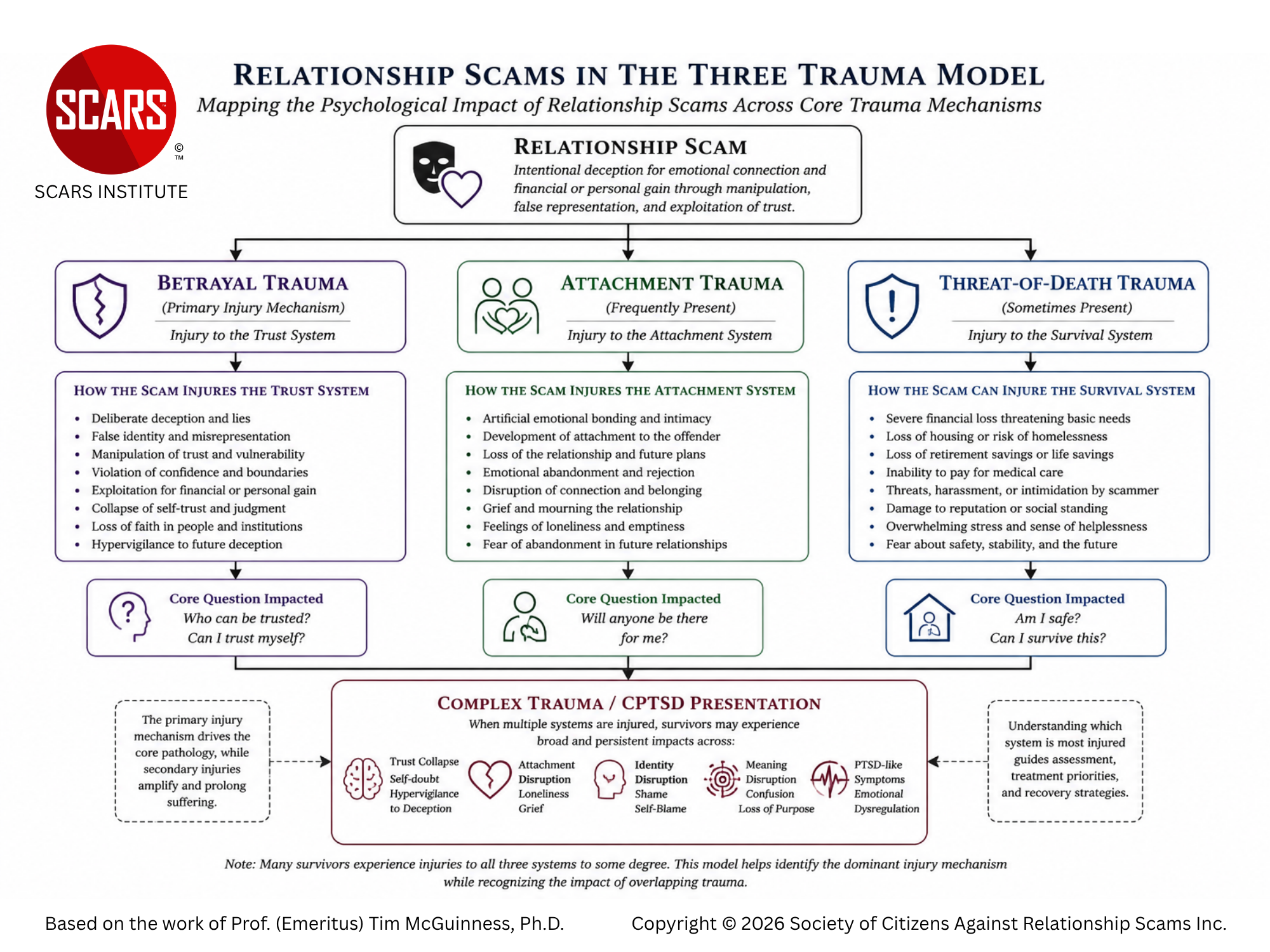

Glossary
- Adaptive Threat Response—An adaptive threat response is a protective reaction that helps a person detect danger and survive threatening conditions. It can include vigilance, avoidance, heightened arousal, and rapid defensive action. After trauma, this response can continue even when present danger has ended, creating distress and functional impairment. — Trauma Response
- Attachment Disruption—Attachment disruption occurs when an important emotional bond becomes unstable, unavailable, lost, or unreliable. It can affect a person’s sense of security, belonging, and emotional regulation. In the Three Trauma Model, attachment disruption is a central pathway through which Attachment Trauma develops. — Attachment Trauma
- Attachment System—The attachment system is the psychological and biological system that helps people form bonds, seek comfort, regulate distress, and maintain emotional security. It develops early in life through caregiving relationships and continues influencing relationships throughout adulthood. When this system is injured, a person can experience insecurity, abandonment fear, relational instability, and emotional dysregulation. — Psychological System
- Attachment Trauma—Attachment Trauma is psychological injury caused by disruption, neglect, abandonment, loss, or chronic instability within important attachment relationships. It often affects emotional regulation, self-concept, relationships, and the ability to feel secure with others. It can produce long-term developmental and relational difficulties without always producing classic PTSD symptoms. — Trauma Mechanism
- Betrayal Trauma—Betrayal Trauma is psychological injury caused when a trusted person, institution, relationship, or system becomes the source of harm. It damages the trust system by turning vulnerability, confidence, dependence, or emotional openness into pathways for exploitation. Relationship scams are presented as a modern example because trust is deliberately cultivated and weaponized. — Trauma Mechanism
- Betrayal Trauma Theory—Betrayal Trauma Theory explains how trauma can become especially damaging when harm is committed by someone the victim depends upon or trusts. It emphasizes that betrayal within trusted relationships can create unique psychological consequences. This theory supports the view that trust violations can produce serious trauma even without direct physical danger. — Trauma Theory
- Case Formulation—Case formulation is the clinical process of understanding how a person’s symptoms, history, trauma exposure, and current functioning fit together. Within the Three Trauma Model, case formulation includes identifying which psychological system sustained the dominant injury. This helps guide assessment, treatment priorities, and recovery planning. — Clinical Assessment
- Catastrophic Trust Violation—Catastrophic trust violation occurs when a person discovers that trust was used as the mechanism for harm. It can damage confidence in others, confidence in personal judgment, and assumptions about honesty or safety. Relationship scams often create this injury because affection, vulnerability, and future plans are manipulated for exploitation. — Betrayal Trauma
- Chronic Attachment Insecurity—Chronic attachment insecurity is a long-term pattern of feeling uncertain, unsafe, or unstable in close relationships. It often develops when attachment relationships have been inconsistent, unavailable, neglectful, or disrupted. This condition can affect intimacy, dependency, emotional regulation, and expectations about whether others will provide support. — Attachment Outcome
- Clinical Implications—Clinical implications are the practical effects a theory has for assessment, diagnosis, treatment, and recovery support. The Three Trauma Model suggests that clinicians should consider the injured psychological system, not only the traumatic event. This approach can help identify whether safety, attachment, or trust should become the primary treatment focus. — Clinical Application
- Complex Post-Traumatic Stress Disorder—Complex Post-Traumatic Stress Disorder is a trauma-related condition associated with prolonged, repeated, developmental, or cumulative psychological injury. It can involve PTSD symptoms along with disturbances in emotional regulation, self-concept, relationships, shame, and identity. Within the Three Trauma Model, CPTSD is treated as a possible outcome of chronic injury to survival, attachment, trust, or multiple systems. — Trauma Outcome
- Complex Trauma—Complex Trauma refers to psychological injury that develops through repeated, prolonged, cumulative, or developmental exposure to traumatic conditions. It often affects emotional regulation, identity, relationships, and long-term functioning. The Three Trauma Model presents Complex Trauma as an outcome pattern rather than a separate trauma mechanism. — Trauma Outcome
- Connection-Based Pathology—Connection-based pathology refers to symptoms and patterns that develop when the attachment system has been injured. It can include relational instability, emotional dysregulation, abandonment fear, dependency concerns, loneliness, and chronic insecurity. This form of pathology is most closely associated with Attachment Trauma. — Attachment Outcome
- Core Psychological System—A core psychological system is a foundational system that supports survival, attachment, trust, emotional regulation, relationships, and social functioning. The Three Trauma Model identifies survival, attachment, and trust as primary systems that can sustain trauma injury. Understanding which system is injured can improve trauma interpretation and treatment planning. — Psychological System
- Developmental Adaptation—Developmental adaptation is a pattern of behavior, emotion, or belief that develops in response to early life conditions. In Attachment Trauma, these adaptations often arise from neglect, abandonment, instability, or chronic emotional unavailability. They can persist into adulthood and shape relationships, identity, and emotional regulation. — Developmental Trauma
- Developmental Trauma—Developmental Trauma refers to psychological injury that occurs while core emotional, relational, and identity systems are still forming. It is often associated with childhood neglect, abuse, caregiver instability, or attachment disruption. It can produce long-term patterns in emotional regulation, self-worth, trust, and relationships. — Trauma Development
- Diagnostic Differentiation—Diagnostic differentiation is the process of distinguishing among possible causes, mechanisms, and presentations of psychological symptoms. Within the Three Trauma Model, it involves determining whether the dominant injury involves survival, attachment, trust, or overlapping systems. This helps avoid treating all trauma presentations as though they arise from the same mechanism. — Clinical Assessment
- Dominant Injury Mechanism—Dominant injury mechanism refers to the psychological system most responsible for a person’s current distress, impairment, and recovery needs. A traumatic experience can injure multiple systems, but one system can become the primary driver of symptoms. Identifying the dominant mechanism helps guide treatment and support priorities. — Assessment Principle
- Emotional Dysregulation—Emotional dysregulation is the difficulty in managing emotional intensity, emotional shifts, or distress responses. It can appear after attachment injuries, betrayal injuries, threat-based trauma, or complex trauma. In the Three Trauma Model, it is especially associated with Attachment Trauma and complex presentations involving multiple systems. — Trauma Symptom
- Event-Based Trauma Classification—Event-based trauma classification organizes trauma according to what happened, such as combat, assault, disaster, accident, abuse, or medical crisis. This approach provides useful descriptive information but can miss the underlying psychological system that was injured. The Three Trauma Model proposes that mechanism-based classification can add important clinical meaning. — Trauma Classification
- Fear-Based Pathology—Fear-based pathology refers to symptoms that develop when the survival system remains organized around danger after the threat has passed. It can include hypervigilance, avoidance, intrusive memories, startle responses, nightmares, and physiological arousal. This form of pathology is most closely associated with Threat-of-Death Trauma. — Threat-of-Death Trauma
- Financial Exploitation—Financial exploitation occurs when another person uses deception, pressure, influence, or misplaced trust to obtain money or assets. In the Three Trauma Model, financial exploitation can become Betrayal Trauma when trust is the pathway used to cause harm. Relationship scams often combine financial exploitation with attachment manipulation and identity disruption. — Betrayal Trauma
- Hypervigilance Toward Deception—Hypervigilance toward deception is persistent scanning for lies, manipulation, hidden motives, inconsistencies, or exploitation. It differs from threat-based hypervigilance because the perceived danger is dishonesty rather than physical harm. This response often develops after Betrayal Trauma and can affect relationships, decision-making, and recovery. — Betrayal Symptom
- Identity Collapse—Identity collapse occurs when trauma disrupts a person’s understanding of self, judgment, history, relationships, or place in the world. Betrayal Trauma can produce this collapse because the victim must reinterpret experiences that once felt meaningful or safe. Relationship scams can create identity collapse when trust, love, hope, and personal judgment all become destabilized. — Identity Impact
- Injury Mechanism—An injury mechanism is the underlying process through which psychological harm occurs. The Three Trauma Model identifies threats to survival, disruptions of attachment, and violations of trust as three primary injury mechanisms. This focus helps explain why different events can produce similar symptoms and similar events can produce different outcomes. — Trauma Framework
- Institutional Betrayal—Institutional betrayal occurs when an organization or system violates the trust of people who depend upon it for safety, fairness, protection, or support. It can occur through neglect, concealment, misconduct, minimization, or failure to protect. This form of betrayal can injure the trust system and produce significant psychological harm. — Betrayal Trauma
- Mechanism-Based Framework—A mechanism-based framework organizes trauma according to the psychological system injured rather than the event alone. The Three Trauma Model uses this approach to distinguish Threat-of-Death Trauma, Attachment Trauma, and Betrayal Trauma. It supports more precise assessment, treatment planning, and understanding of recovery pathways. — Trauma Framework
- Mixed Trauma Presentation—A mixed trauma presentation occurs when more than one psychological system is injured by the same traumatic experience. Domestic violence, childhood abuse, relationship scams, and institutional trauma can involve survival, attachment, and trust injuries together. The Three Trauma Model encourages identifying both the dominant injury and secondary injuries. — Clinical Assessment
- Pathology Type—Pathology type refers to the main pattern of psychological symptoms and adaptations that follows trauma. In the Three Trauma Model, fear-based pathology relates to survival injury, connection-based pathology relates to attachment injury, and trust-based pathology relates to betrayal injury. These patterns can overlap but often point toward different recovery needs. — Trauma Classification
- Post-Traumatic Stress Disorder—Post-Traumatic Stress Disorder is a trauma-related condition involving symptoms such as intrusive memories, avoidance, hypervigilance, emotional numbing, sleep disturbance, and persistent threat responses. It historically developed from research involving combat, disasters, violence, and other threat-based experiences. The Three Trauma Model proposes that PTSD may also arise from severe Betrayal Trauma when the trust system is catastrophically injured. — Trauma Diagnosis
- Primary Injury Mechanism—Primary injury mechanism is the main psychological pathway through which trauma causes lasting harm. It identifies whether the survival system, attachment system, or trust system is most affected. Recognizing the primary injury mechanism helps explain symptoms and supports more targeted recovery planning. — Assessment Principle
- Psychological Injury—Psychological injury is harm to the systems that support safety, connection, trust, identity, emotion, and meaning. It can develop through direct danger, disrupted attachment, betrayal, or overlapping traumatic experiences. The Three Trauma Model treats trauma as an injury to core psychological systems rather than only a reaction to external events. — Trauma Concept
- Relationship Scam—A relationship scam is a form of exploitation in which offenders create false emotional intimacy to obtain money, compliance, personal information, or other benefits. It is classified as Betrayal Trauma because trust, attachment, vulnerability, and hope are deliberately manipulated. Its psychological harm often extends beyond financial loss into identity, self-trust, and worldview disruption. — Betrayal Trauma
- Relationship Scam Victimization—Relationship scam victimization refers to the experience of being manipulated through a fraudulent relationship designed for exploitation. It can involve trust manipulation, artificial attachment, financial loss, emotional injury, shame, and self-doubt. Within the Three Trauma Model, it is especially important because it demonstrates severe trauma without direct physical threat. — Scam Victimization
- Safety Perception—Safety perception is a person’s sense of whether the environment, body, relationships, or future are safe. Threat-of-Death Trauma can damage this perception by keeping the survival system alert to danger after the event has ended. Recovery often requires helping the nervous system distinguish past danger from present conditions. — Threat-of-Death Trauma
- Self-Trust—Self-trust is confidence in personal judgment, perception, emotional interpretation, and decision-making. Betrayal Trauma can severely damage self-trust because the victim often questions why deception was not detected sooner. Rebuilding self-trust is a central recovery task for many relationship scam victims and other survivors of trust-based harm. — Recovery Need
- Social Reality—Social reality refers to a person’s working understanding of relationships, honesty, social rules, institutions, and human behavior. Betrayal Trauma can disrupt social reality by revealing that trust, affection, authority, or dependence was used to cause harm. Recovery often requires rebuilding a coherent and realistic understanding of people and relationships. — Betrayal Impact
- Survival System—The survival system is the psychological and biological system that detects danger, mobilizes defensive responses, and supports physical safety. It becomes central in Threat-of-Death Trauma when perceived danger overwhelms normal regulation. Injury to this system can produce fear-based symptoms such as hypervigilance, avoidance, intrusive memories, and heightened arousal. — Psychological System
- System Restoration—System restoration is the recovery process of helping injured psychological systems return to healthier functioning. In Threat-of-Death Trauma, restoration focuses on safety; in Attachment Trauma, it focuses on connection; in Betrayal Trauma, it focuses on trust. This concept frames recovery as more than symptom reduction. — Recovery Framework
- Threat-Based Trauma Theory—Threat-based trauma theory emphasizes the role of physical danger, survival threat, fear conditioning, and defensive responses in trauma development. It strongly influenced the historical development of PTSD research and treatment. The Three Trauma Model accepts its value while proposing that attachment and trust injuries also require distinct recognition. — Trauma Theory
- Threat-of-Death Trauma—Threat-of-Death Trauma is psychological injury caused by perceived or actual threats to life, bodily integrity, or physical survival. It activates the survival system and is closely aligned with classic PTSD models. Examples include combat, violent assault, serious accidents, natural disasters, kidnapping, terrorism, and life-threatening medical crises. — Trauma Mechanism
- Trauma Mechanism—A trauma mechanism is the core pathway through which traumatic harm affects psychological functioning. The Three Trauma Model identifies three such mechanisms: survival injury, attachment injury, and trust injury. This approach helps explain differences in symptoms, diagnoses, recovery needs, and treatment priorities. — Trauma Framework
- Trauma Pathway—A trauma pathway is the route through which a traumatic experience produces psychological symptoms and long-term adaptation. A pathway can involve survival, attachment, trust, or several systems at once. Identifying the pathway helps clarify whether the person’s distress is organized around safety, connection, or trust. — Trauma Framework
- Trauma Recovery—Trauma recovery is the process through which injured psychological systems regain healthier functioning, stability, and integration. It can involve restoring safety, strengthening attachment security, rebuilding trust, reducing symptoms, and reconstructing meaning. The Three Trauma Model emphasizes that recovery needs differ depending upon the system most injured. — Recovery Framework
- Trauma-Informed Care—Trauma-informed care is an approach that recognizes how trauma affects behavior, emotion, relationships, and functioning. Within the Three Trauma Model, effective trauma-informed care considers whether injury involves survival, attachment, trust, or overlapping mechanisms. This helps support people whose trauma does not fit traditional physical danger models. — Care Framework
- Trust Collapse—Trust collapse occurs when a person loses confidence in others, institutions, relationships, or personal judgment after betrayal. It can create suspicion, shame, withdrawal, self-doubt, and difficulty engaging in future relationships. Relationship scams often produce trust collapse because the victim discovers that emotional intimacy was deliberately constructed for exploitation. — Betrayal Impact
- Trust System—The trust system is the psychological system that allows people to rely on others, form relationships, cooperate, accept vulnerability, and make social decisions. It reduces uncertainty by helping individuals decide who, what, and which systems can be relied upon. When this system is injured through betrayal, the person can experience distrust, self-doubt, hypervigilance, and identity disruption. — Psychological System
- Trust-Based Pathology—Trust-based pathology refers to symptoms and adaptations that arise when the trust system is damaged. It can include hypervigilance toward deception, distrust, self-doubt, shame, identity disturbance, and avoidance of vulnerability. This form of pathology is most closely associated with Betrayal Trauma. — Betrayal Outcome
- Trust-Based Victimization—Trust-based victimization occurs when harm is caused through reliance, vulnerability, emotional confidence, authority, or relational dependence. It differs from force-based victimization because the offender uses trust as the access point for exploitation. Relationship scams, financial exploitation, institutional betrayal, and trusted-person abuse are examples of this pattern. — Betrayal Trauma
- Victim Recovery Support—Victim recovery support refers to assistance that helps injured individuals stabilize, understand their trauma, and rebuild affected psychological systems. For scam victims, this support often must address trust collapse, self-trust injury, shame, attachment loss, and meaning disruption. Effective support recognizes that the harm can be psychological, relational, and identity-based rather than only financial. — Recovery Support
- Weaponization of Trust—Weaponization of trust occurs when an offender deliberately uses trust, affection, dependence, authority, or vulnerability as a method for exploitation. It is the central process in Betrayal Trauma and is especially visible in relationship scams. This process helps explain why betrayal-based injuries can become severe even when physical danger is absent. — Betrayal Mechanism
- Worldview Disruption—Worldview disruption occurs when trauma damages a person’s assumptions about safety, fairness, honesty, relationships, institutions, or human nature. Betrayal Trauma often produces this disruption because the victim must reinterpret trusted experiences as sources of harm. Recovery can require rebuilding a more accurate and stable understanding of the world. — Trauma Impact
Resources
Foundations of this Whitepaper
Each of its major foundations in the SCARS Institute’s McGuinness Three Trauma Model is already supported by substantial trauma research. In fact, the model is largely an integration of three established research traditions:
- Attachment theory and attachment trauma research
- Survival-based trauma (PTSD and threat-of-death research)
- Betrayal Trauma Theory and institutional betrayal research
Research Supporting Attachment Trauma
The attachment component of the model rests on one of the most extensively studied theories in psychology.
John Bowlby proposed that attachment functions as a primary motivational system essential to emotional development. Subsequent research has repeatedly demonstrated that disruptions in attachment relationships affect emotional regulation, identity formation, interpersonal functioning, and vulnerability to later psychological difficulties.
Research has also demonstrated significant relationships between attachment insecurity and PTSD symptoms, Complex PTSD, emotional dysregulation, and trauma-related psychopathology.
Key studies:
- Cassidy, J. (2013). Contributions of Attachment Theory and Research. https://pmc.ncbi.nlm.nih.gov/articles/PMC4085672/
- Karatzias et al. (2022). Childhood Trauma, Attachment Orientation, and Complex PTSD Symptoms. https://pubmed.ncbi.nlm.nih.gov/33446294/
- Woodhouse et al. (2015). Meta-analysis of attachment and PTSD. https://pubmed.ncbi.nlm.nih.gov/26409250/
- Barazzone, N., Santos, I., McGowan, J. and Donaghay-Spire, E. (2019), The links between adult attachment and post-traumatic stress: A systematic review. Psychol Psychother Theory Res Pract, 92: 131-147. https://doi.org/10.1111/papt.12181
Research Supporting Threat-of-Death Trauma
This is the strongest and most established component of the model.
Modern PTSD research originated through the study of combat veterans, disaster survivors, assault victims, and others exposed to actual or perceived threats to survival. Decades of research have demonstrated that overwhelming activation of the survival system can produce intrusive memories, hypervigilance, avoidance, nightmares, physiological arousal, and long-term PTSD. This body of work forms the foundation of contemporary trauma theory and strongly supports the concept of a distinct survival-based trauma mechanism.
Key sources:
- PTSD diagnostic literature (DSM-based research)
- Fear conditioning research
- Combat trauma studies
- Disaster trauma studies
- https://www.ncbi.nlm.nih.gov/books/NBK207191/
Research Supporting Betrayal Trauma
This is the most important research base for the white paper because it provides direct evidence that severe psychological injury can emerge through trust violations rather than physical danger alone.
Jennifer Freyd introduced Betrayal Trauma Theory in the 1990s. Her work demonstrated that trauma occurring within trusted or dependent relationships has characteristics that differ from traditional threat-based trauma. The theory has generated decades of research involving childhood abuse, caregiver abuse, institutional betrayal, sexual assault, and trusted-person exploitation.
Research has repeatedly shown that betrayal-related trauma is associated with PTSD symptoms, dissociation, depression, anxiety, shame, self-blame, and long-term psychological distress.
Key studies:
- Freyd (1996). Betrayal Trauma: The Logic of Forgetting Childhood Abuse. https://dynamic.uoregon.edu/jjf/defineBT.html and https://dynamic.uoregon.edu/jjf/institutionalbetrayal/
- Martin et al. (2011). The Role of Cumulative Trauma, Betrayal, and Appraisals in Understanding Trauma Symptomatology. https://pmc.ncbi.nlm.nih.gov/articles/PMC3608140/
- Smith & Freyd (2013). Institutional Betrayal research.
Research Supporting the Overlap Between Attachment and Betrayal
One of the strongest findings supporting the Three Trauma Model is that attachment researchers and betrayal researchers have increasingly recognized that trauma occurring within trusted attachment relationships appears qualitatively different from trauma occurring outside those relationships.
Several papers explicitly discuss the intersection between Attachment Theory and Betrayal Trauma Theory and argue that abuse within attachment relationships produces distinctive psychological outcomes.
What Research Does NOT Yet Exist
The following claims remain hypotheses and would require formal testing:
- That all trauma can be organized into exactly three primary mechanisms.
- That PTSD prevalence differs systematically across the three mechanisms.
- That Betrayal Trauma accounts for a larger percentage of PTSD than currently recognized.
- That relationship scams should be classified primarily as Betrayal Trauma.
- That treatment outcomes improve when dominant injury mechanisms are identified.
- That survival, attachment, and trust constitute the three principal trauma systems.
These are the novel contributions of the white paper.
The Strongest Scientific Argument for the Model
The strongest argument is not that the model invents new concepts.
The strongest argument is that it integrates three already-established bodies of research:
- Attachment theory and attachment trauma research.
- Threat-of-death research and PTSD research.
- Betrayal Trauma Theory and institutional betrayal research.
All three fields already have substantial empirical support.
-/ 30 /-
IMPORTANT NOTE: This article is intended to be an introductory overview of complex psychological, neurological, physiological, or other concepts, written primarily to help victims of crime understand the wide-ranging actual or potential effects of psychological trauma they may be experiencing. The goal is to provide clarity and validation for the confusing and often overwhelming symptoms that can follow a traumatic event. It is critical to understand that this content is for informational purposes only and does not constitute or is not a substitute for professional medical advice, diagnosis, or treatment. If you are experiencing distress or believe you are suffering from trauma or its effects, it is essential to consult with a qualified mental health professional for personalized care and support.
TABLE OF CONTENTS
- The Three Trauma Model: A Mechanism-Based Framework for Understanding Psychological Trauma
- The Three Trauma Model: A Mechanism-Based Framework for Understanding Psychological Trauma
- PART 1: EXECUTIVE SUMMARY AND INTRODUCTION
- Summary
- Introduction
- The Limitations of Event-Based Trauma Classification
- The Origins of PTSD and Threat-Based Trauma Theory
- PART 2: THE THREE TRAUMA MODEL
- A Mechanism-Based Framework for Psychological Injury
- Type 1: Attachment Trauma
- Type 2: Threat-of-Death Trauma
- Type 3: Betrayal Trauma
- PART 3: MAPPING TRAUMA CATEGORIES TO THE THREE TRAUMA MODEL
- Reclassifying Trauma by Injury Mechanism
- A Proposed Distribution of PTSD Across Trauma Mechanisms
- Implications for Trauma Research
- Relationship Scams as a Betrayal Trauma Paradigm
- Relationship Scams and PTSD
- PART 4: CLINICAL IMPLICATIONS OF THE THREE TRAUMA MODEL
- Moving from Theory to Clinical Practice
- Recovery as System Restoration
- APPENDIX A: COMPARATIVE ANALYSIS OF THE THREE TRAUMA MECHANISMS
- Understanding Dominant Injury Mechanisms
- Comparative Characteristics of Attachment Trauma
- Comparative Characteristics of Threat-of-Death Trauma
- Comparative Characteristics of Betrayal Trauma
- Distinguishing the Three Core Questions
- The Potential Significance of a Mechanism-Based Framework
- APPENDIX B: DIAGNOSTIC DIFFERENTIATION AND ASSESSMENT FRAMEWORK
- Moving from Conceptual Understanding to Clinical Assessment
- Identifying Attachment Trauma
- Identifying Threat-of-Death Trauma
- Identifying Betrayal Trauma
- Assessing Mixed Trauma Presentations
- Implications for Assessment and Treatment Planning
- APPENDIX C: COMPARATIVE RECOVERY PATHWAYS
- Recovery as the Restoration of Psychological Systems
- Recovery from Attachment Trauma
- Recovery from Threat-of-Death Trauma
- Recovery from Betrayal Trauma
- Rebuilding Self-Trust
- Rebuilding Trust in Others
- Comparing the Three Recovery Pathways
- Recovery as Reintegration
- APPENDIX D: IMPLICATIONS FOR PUBLIC POLICY, VICTIM SERVICES, AND TRAUMA-INFORMED CARE
- Expanding Trauma-Informed Systems Beyond Threat-Based Models
- The Historical Emphasis on Physical Victimization
- Reconsidering How Harm Is Evaluated
- Implications for Victim Services
- Implications for Professional Training
- Trauma-Informed Organizations and Institutions
- Public Understanding of Trauma
- Implications for Scam Victim Advocacy
- Toward a More Comprehensive Trauma Framework
- SUPPLEMENTAL SECTION 1: LIMITATIONS OF THE THREE TRAUMA MODEL
- SUPPLEMENTAL SECTION 2: COMPLEX TRAUMA AND COMPLEX POST-TRAUMATIC STRESS DISORDER WITHIN THE THREE TRAUMA MODEL
- Complex Trauma as an Accumulation of Injury
- Complex Attachment Trauma
- Complex Threat-of-Death Trauma
- Complex Betrayal Trauma
- Relationship Scams and Complex Trauma
- CPTSD as a Severity Dimension Rather Than a Trauma Category
- Implications for Assessment and Treatment
- Supplemental Section 3: Overlapping Trauma Mechanisms and Multi-System Psychological Injury
- CONCLUSION
- Glossary
- Resources
Want the Definition of a Term?
Search Here
PUBLICATION CATEGORIES

Welcome to the SCARS INSTITUTE Journal of Scam Psychology & Recoverology®
A Journal of Applied Scam, Fraud, and Cybercrime Psychology/Recoverology – and Allied Sciences
A dedicated site for psychology, psychotraumatology, thanotology, recoverology, victimology, criminology, applied sociology and anthropology, and allied sciences, published by the SCARS INSTITUTE™ – Society of Citizens Against Relationship Scams Inc.
Please Tell Us What You
Learned From This?
Please Leave A Comment!
Commenting Is An Essential Part Of Healing
Read • Think • Write
Recent Comments
On Other Articles
A Note About Labeling!
We often use the term ‘scam victim’ in our articles, but this is a convenience to help those searching for information in search engines like Google. It is just a convenience and has no deeper meaning. If you have come through such an experience, YOU are a Survivor! It was not your fault. You are not alone! Axios!
A Question of Trust
At the SCARS Institute, we invite you to do your own research on the topics we speak about and publish, Our team investigates the subject being discussed, especially when it comes to understanding the scam victims-survivors experience. You can do Google searches but in many cases, you will have to wade through scientific papers and studies. However, remember that biases and perspectives matter and influence the outcome. Regardless, we encourage you to explore these topics as thoroughly as you can for your own awareness.
Statement About Victim Blaming
Some of our articles discuss various aspects of victims. This is both about better understanding victims (the science of victimology) and their behaviors and psychology. This helps us to educate victims/survivors about why these crimes happened and to not blame themselves, better develop recovery programs, and to help victims avoid scams in the future. At times this may sound like blaming the victim, but it does not blame scam victims, we are simply explaining the hows and whys of the experience victims have.
These articles, about the Psychology of Scams or Victim Psychology – meaning that all humans have psychological or cognitive characteristics in common that can either be exploited or work against us – help us all to understand the unique challenges victims face before, during, and after scams, fraud, or cybercrimes. These sometimes talk about some of the vulnerabilities the scammers exploit. Victims rarely have control of them or are even aware of them, until something like a scam happens and then they can learn how their mind works and how to overcome these mechanisms.
Articles like these help victims and others understand these processes and how to help prevent them from being exploited again or to help them recover more easily by understanding their post-scam behaviors. Learn more about the Psychology of Scams at www.ScamPsychology.org