




When There Is No Single Event
Recursive Psychological Injury, Self-Generated Stress, and the Possibility of Self-Perpetuating Trauma-Like States
Principal Category: Psychological Research – White Paper
Author:
• Tim McGuinness, Ph.D. – Anthropologist, Scientist, Polymath, Director of the Society of Citizens Against Relationship Scams Inc.
Abstract
Trauma is commonly discussed as though it is something caused directly by an external event. That formulation is incomplete. An event creates circumstances to which the human nervous system, mind, and body respond, but the event and the resulting psychological injury are not identical. Different individuals can experience similar events and develop very different psychological consequences, while some people experience significant and persistent psychological distress without being able to identify a single catastrophic event that explains it.
This raises an important theoretical question. Can people contribute to the development or continuation of their own psychological suffering through persistent attitudes, expectations, interpretations, and behaviors? More specifically, can characteristics such as entitlement, chronic grievance, rejection sensitivity, perfectionism, catastrophizing, resentment, avoidance, or rigid expectations create repeated experiences of perceived injury that eventually produce trauma-like psychological consequences?
Existing psychological research does not support “self-traumatization” as an established diagnosis or as a simple process through which thoughts alone create trauma. Research does, however, support several mechanisms that make the broader proposition plausible. Stress-generation research demonstrates that psychological characteristics and behaviors can contribute to subsequent stressful interpersonal experiences. Research on rejection sensitivity shows that expectations of rejection can influence how ambiguous behavior is interpreted and can provoke interpersonal responses that make actual rejection more likely. Psychological entitlement has been associated with hostility, interpersonal conflict, aggressive reactions to ego threat, and difficulty forgiving perceived offenses. Rumination can maintain emotional and physiological stress after an external incident has ended, while avoidance can prevent corrective learning and preserve fear.
Taken together, these mechanisms suggest the possibility of what can be termed Recursive Psychological Injury: a process in which beliefs and expectations influence perception, perception affects emotional response and behavior, behavior alters the surrounding social environment, and the resulting consequences reinforce the beliefs that contributed to the cycle. The suffering produced by such a process is real, even when the individual has unknowingly participated in creating some of the circumstances that sustain it. Understanding this distinction has important implications for psychological recovery because it identifies mechanisms occurring in the present that can potentially be recognized, interrupted, and changed.
When There Is No Single Event
Recursive Psychological Injury, Self-Generated Stress, and the Possibility of Self-Perpetuating Trauma-Like States
A SCARS Institute White Paper
Introduction
Trauma is often described in ordinary conversation as something that an event does to a person. Someone experiences an assault, accident, betrayal, disaster, death, or other overwhelming circumstance and is subsequently described as having been traumatized by it. While useful in everyday language, this formulation can obscure an important distinction between an event and the psychological consequences that follow from it.
Events create conditions that can overwhelm coping capacities, activate defensive responses, alter expectations, affect memory, and change the way people interpret themselves and their environments. The resulting psychological injury, however, emerges from the interaction between experience and the person’s nervous system, history, interpretation, meaning-making processes, emotional regulation, social environment, and subsequent behavior. This helps explain why exposure to apparently similar circumstances does not produce identical outcomes among different people.
Once trauma is understood as a response rather than simply as an event, another question becomes possible. What happens when there is no single identifiable event?
Some people develop profound distress across months or years without being able to locate one decisive moment when everything changed. Their difficulties can instead emerge from repeated interpersonal conflict, perceived rejection, persistent resentment, chronic vigilance, unrealistic expectations, recurring disappointment, social isolation, avoidance, rumination, or other patterns that gradually become self-reinforcing. No single interaction appears sufficient to explain the eventual level of suffering, yet the accumulated psychological consequences can become severe.
In these cases, the search for a single traumatic event can obscure the more relevant phenomenon. The problem might not principally be one event at all. It can instead be an ongoing process in which beliefs, perceptions, emotions, behavior, and environmental responses repeatedly influence one another.
This introduces the possibility of Recursive Psychological Injury.
The concept does not suggest that people consciously choose suffering or intentionally traumatize themselves. Nor does it imply that genuine external adversity can be explained away as a problem of attitude. Instead, it recognizes that human beings participate continuously in their environments. They interpret what happens, respond to those interpretations, influence the behavior of other people, and subsequently experience the consequences of those interactions. Under certain conditions, the resulting feedback process can become an important source of continuing psychological injury.
Beyond the Single-Event Model
Psychological research has increasingly demonstrated that stress and mental health operate transactionally. People are affected by their environments, but they also influence those environments through their behavior, expectations, relationships, decisions, and coping strategies. This makes the conventional model in which an external stressor simply acts upon a passive individual insufficient for understanding many forms of chronic distress.
The distinction is particularly important when considering interpersonal suffering. Human relationships are not static environmental conditions. Each person is continuously affecting the other. Expectations alter tone of voice, willingness to trust, interpretation of ambiguity, readiness to forgive, tolerance for disagreement, and reactions to disappointment. Those behaviors subsequently influence how other people respond.
A person who expects rejection can become unusually attentive to signs of rejection. Ambiguous behavior can therefore be interpreted more negatively than it otherwise would be. The resulting anxiety, accusation, withdrawal, jealousy, or defensiveness can make the relationship more difficult. The other person can eventually become more distant, producing a genuine rejection that appears to confirm the original expectation.
The important point is that the final rejection is real. The person did not imagine it. Yet the psychological expectation of rejection contributed to a chain of interactions that increased the probability of the feared outcome.
This distinction provides a useful foundation for understanding how psychological suffering can become recursive.
Stress Generation and Psychological Feedback
One of the clearest precedents for this idea is found in stress-generation research. Traditionally, psychological disorders were often conceptualized as responses to stressful life events. Constance Hammen and subsequent researchers demonstrated that the relationship can also operate in the opposite direction. Psychological characteristics, symptoms, interpersonal patterns, and behaviors can contribute to the occurrence of later stressful events, particularly interpersonal stress.
The significance of this finding extends well beyond depression, where much of the original research was conducted. It establishes a broader principle: people can participate in generating some of the stressors that subsequently affect them.
This does not mean that the person is deliberately producing suffering. In many cases, the behaviors involved are attempts to avoid suffering. Someone who fears abandonment can seek repeated reassurance. Someone who expects humiliation can become defensive before criticism has occurred. Someone who distrusts others can withhold vulnerability. Someone who fears failure can procrastinate because beginning a task exposes the possibility of failing. Each behavior makes sense within the person’s existing psychological framework.
The difficulty is that protective behavior can create consequences that reinforce the very fear it was intended to prevent. Excessive reassurance seeking can exhaust relationships. Defensive behavior can provoke conflict. Persistent distrust can prevent intimacy. Procrastination can increase the likelihood of failure. Avoidance can preserve fear because the person never acquires evidence that the feared situation can be tolerated.
The person can therefore become trapped inside a feedback system whose individual components appear reasonable when viewed separately but become damaging when repeated together.
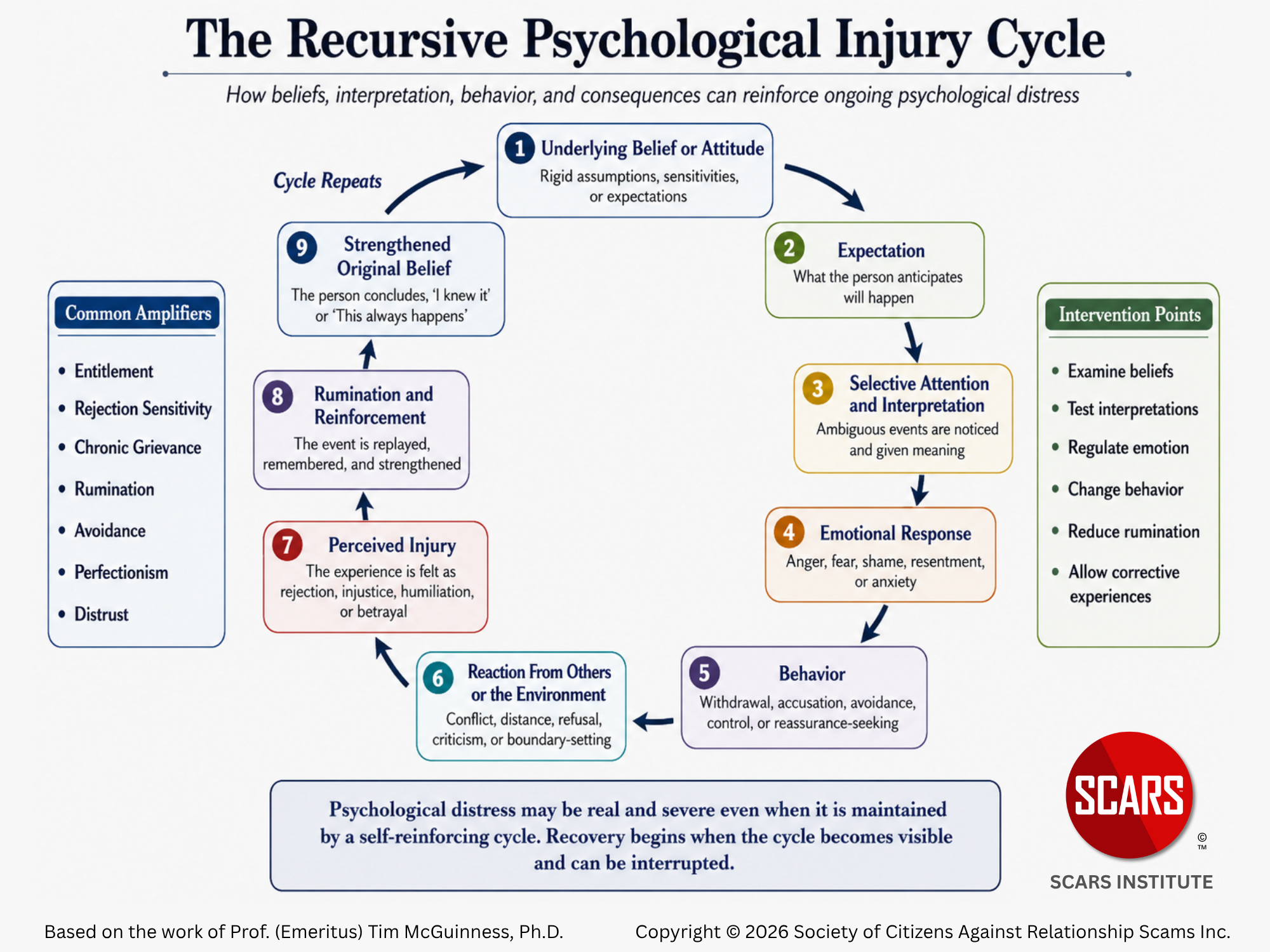
Recursive Psychological Injury
Recursive Psychological Injury describes the continuing interaction between internal expectations and external consequences through which psychological distress can reproduce itself.
The process usually begins with an underlying belief, assumption, sensitivity, or expectation. The person might believe that other people cannot be trusted, that rejection is inevitable, that failure is intolerable, that criticism represents humiliation, that certain outcomes are deserved, or that emotional safety requires complete control over circumstances.
These expectations influence attention. Human beings do not process every element of their environments equally. Existing beliefs direct attention toward information that appears important, particularly information associated with perceived threats. Someone concerned about rejection notices delayed responses, changes in tone, reduced attention, or ambiguous comments that another person might dismiss as insignificant.
Attention then influences interpretation. Once a potentially threatening signal has been noticed, it must be assigned meaning. A delayed telephone call can become evidence of abandonment. A disagreement can become disrespect. A boundary can become rejection. Constructive criticism can become humiliation. Another person’s success can become evidence of unfairness.
Interpretation produces emotional response. Anger, fear, shame, anxiety, resentment, or despair can arise not simply from what happened but from what the event has come to mean.
Emotion then influences behavior. The person can accuse, withdraw, attack, demand reassurance, retaliate, avoid, become controlling, or terminate contact. Other people respond to that behavior, often in ways that produce genuine interpersonal consequences.
Those consequences then become new experiences. A partner withdraws. A friend stops calling. A supervisor becomes more cautious. A family member establishes firmer boundaries. The person now possesses real evidence that something has gone wrong.
Without examination of the complete sequence, the conclusion becomes simple: “I knew this would happen.”
The original belief has apparently been proven correct. The cycle therefore begins again with greater conviction.
Entitlement as a Case Study
Psychological entitlement provides a particularly useful example because it illustrates how an attitude can magnify ordinary adversity into repeated perceived injury.
Entitlement exists along a continuum. Expecting fairness, dignity, reciprocity, and reasonable consideration from others is a normal part of social life. Difficulty arises when expectations become rigid and extend beyond reasonable reciprocity into assumptions that other people, institutions, or life itself are obligated to provide particular outcomes.
The psychologically entitled person can begin with a relatively simple assumption: “I deserve this.” The problem develops when deserving becomes entitlement and entitlement becomes expectation. The person’s internal statement changes from “I would like this” to “This should happen,” and eventually to “If this does not happen, someone has wronged me.”
That transformation is psychologically significant.
An unwanted outcome can then cease to be ordinary disappointment and become perceived injustice. A refusal becomes disrespect. Criticism becomes humiliation. Another person’s independence becomes betrayal. Failure to receive recognition becomes evidence of unfair treatment. When these interpretations recur, anger and grievance can become increasingly central to the person’s experience.
The resulting behavior can itself produce interpersonal consequences. The person can become demanding, accusatory, argumentative, hostile, contemptuous, or persistently focused on obtaining acknowledgment of the perceived wrong. Others can respond by withdrawing, becoming defensive, refusing further interaction, or imposing boundaries.
Those reactions are then experienced as additional offenses.
The entitled person can consequently accumulate a substantial history of genuinely unpleasant interpersonal experiences while remaining unaware of the degree to which their own expectations and reactions contributed to producing them.
This is not imaginary suffering. The conflicts, estrangements, disappointments, and losses are genuine. What becomes important is understanding the mechanism through which they repeatedly occur.
When Reality Violates the Internal Contract
Extreme entitlement reveals a broader psychological principle that applies well beyond entitlement itself. Human beings frequently carry implicit assumptions about how life is supposed to operate. These assumptions function almost like unwritten contracts with reality.
A person can believe that effort should guarantee success, love should guarantee permanence, good intentions should guarantee appreciation, fairness should prevent misfortune, loyalty should prevent betrayal, intelligence should prevent mistakes, or careful planning should prevent uncertainty. None of these expectations is entirely irrational. Problems develop when they become absolute.
Reality is considerably less cooperative.
People disappoint one another. Relationships end. Careers fail. Illness occurs. Aging changes capabilities. Children become independent. Friends develop different priorities. Economic circumstances change. People misunderstand one another. Sometimes unfair things happen without anyone being able to restore fairness.
Psychological flexibility allows a person to experience these events as painful without requiring them to represent a fundamental violation of how existence is supposed to work. Rigidity makes that much more difficult.
The greater the distance between what a person believes must happen and what reality actually delivers, the more frequently ordinary life can become experienced as injury.
In this sense, an attitude can become a vulnerability multiplier. It does not necessarily create the external event, but it influences how much psychological significance the event receives and what happens afterward.
Rejection Sensitivity and Self-Fulfilling Injury
Rejection sensitivity illustrates a closely related process. Individuals who strongly expect rejection can become unusually vigilant for indications that others are withdrawing, disapproving, or becoming less interested. Ambiguous interpersonal information can therefore acquire negative meaning very quickly.
A partner who is quiet after work might simply be tired. A rejection-sensitive person can interpret the same behavior as evidence that affection has diminished. Once that interpretation is made, anxiety increases. The individual can seek reassurance, become accusatory, withdraw emotionally, or attempt to test the relationship.
Those behaviors alter the interaction.
The partner, who initially might only have been tired, can now become irritated or defensive. Continued repetition can place genuine strain on the relationship. Eventually the feared withdrawal can actually occur.
At that point, the rejection-sensitive individual has powerful evidence supporting the original belief that people eventually leave.
The process therefore resembles a self-fulfilling prophecy, but that expression can make the phenomenon sound trivial. The psychological consequences are not trivial. Repeated rejection, damaged relationships, loneliness, shame, and loss can become profound sources of suffering.
The important insight is that expectation was not merely an observer of the process. It was one participant in it.
Rumination and the Event That Refuses to End
The recursive process becomes even more consequential when rumination is involved.
Human beings possess the remarkable ability to reproduce stressful experiences long after the external circumstances have ended. A humiliating conversation can last five minutes while the psychological reconstruction of that conversation continues for days, months, or even years.
The person recalls what was said, imagines what should have been said, anticipates future confrontations, assigns motives to the other person, rehearses arguments, and revisits the emotional meaning of the event. The external interaction ended long ago, yet the nervous system continues responding to internally generated representations of it.
Rumination can therefore extend the psychological life of an event far beyond its objective duration.
This is particularly important when grievance is involved. The individual can repeatedly recreate the offense in memory, each time renewing anger, humiliation, resentment, or helplessness. What began as an isolated experience gradually becomes a continuing psychological presence.
The event no longer needs to happen again because the mind has learned how to reproduce it.
At that point, the original distinction between external and internal stress begins to blur. The external world supplied the first experience, but memory and cognition are now capable of repeatedly regenerating part of its emotional impact.
Avoidance and the Preservation of Threat
Avoidance provides another mechanism through which distress can become self-perpetuating.
When something produces fear or emotional discomfort, withdrawing from it often provides immediate relief. Because relief is rewarding, avoidance becomes more likely the next time a similar situation appears.
The short-term effect feels protective. The long-term consequence can be very different.
A person who avoids social situations because of anticipated rejection loses opportunities to discover that many interactions are safe. Someone who avoids driving after a frightening incident never receives repeated evidence that driving can again become ordinary. Someone who refuses emotionally difficult conversations because conflict feels intolerable does not develop confidence in managing disagreement.
Avoidance therefore removes opportunities for corrective learning.
The person’s prediction remains largely untested. The feared situation can consequently become more intimidating with time rather than less.
Again, the person is not deliberately creating distress. The behavior is intended to reduce it. Yet a strategy that produces immediate comfort can sometimes preserve the conditions that make future distress more likely.
When There Is No Event
The question of whether psychological trauma can exist without an event becomes clearer when considered from this perspective.
There usually are events. There can simply be no single event that adequately explains the resulting psychological condition.
Instead, the person can experience hundreds of relatively ordinary incidents that acquire extraordinary significance through a recurring interpretive and behavioral process. A disagreement becomes another example of disrespect. A delayed reply becomes another abandonment. An unsuccessful effort becomes another confirmation of inadequacy. A boundary becomes another betrayal.
Over time, the accumulated pattern can become more psychologically important than any individual occurrence.
The person’s suffering has therefore not developed from nothing. It has developed from a process.
That distinction is critical.
A single-event model searches backward for the moment when psychological injury occurred. A recursive model also examines what continues happening in the present. It asks whether expectations, interpretations, behaviors, memories, and emotional responses are still producing the conditions through which distress is repeatedly renewed.
The relevant unit of analysis is no longer simply the event. It is the cycle.
When the Cycle Becomes the Environment
The most consequential stage occurs when the recursive process becomes sufficiently established that the person experiences it as simply the way the world is.
Someone who repeatedly expects betrayal can eventually inhabit a world that appears full of untrustworthy people. A person who continually anticipates humiliation can experience ordinary social environments as threatening. Someone organized around grievance can encounter evidence of injustice almost everywhere.
The external environment has not necessarily changed to the same degree as the person’s experience of it.
What has changed is the psychological environment through which reality is processed.
Attention, memory, expectations, emotion, and behavior begin operating together. Attention detects information consistent with existing beliefs. Memory retrieves confirming experiences more readily. Emotional reactions strengthen perceived importance. Behavior influences other people. Their responses provide new evidence.
Eventually, the loop itself becomes part of the environment.
The individual awakens each day inside a psychological system that has already begun interpreting the world before any new interaction has occurred.
This can produce persistent vigilance, resentment, distrust, avoidance, isolation, emotional activation, and recurring interpersonal conflict. Some of these experiences can resemble aspects of trauma-related distress even when the pathway through which they developed differs from conventional traumatic exposure.
Why “Self-Traumatization” Is an Inadequate Term
It can be tempting to describe this process as self-traumatization. The expression captures the intuitive idea that people can participate in creating psychological conditions that injure them. It nevertheless carries serious conceptual problems.
The word “self” can imply intentionality. Most people caught inside these processes are not deliberately generating suffering. Their behaviors generally make sense from inside their existing worldview. Avoidance feels protective. Suspicion feels prudent. Entitlement feels like fairness. Rumination feels like problem solving. Resentment feels like maintaining moral accountability. Reassurance seeking feels like preserving connection.
The person experiences the behavior as a solution. That is one reason the cycle can be so difficult to recognize.
The term self-traumatization can also become moralizing. It risks suggesting that suffering is deserved because the individual helped produce some of the circumstances surrounding it. Such a conclusion would misunderstand the model entirely.
A more useful concept is Recursive Psychological Injury. Another possible description is Self-Perpetuating Psychological Injury. Both emphasize the continuing process without implying that the person consciously chose its origin.
The distinction allows responsibility to be discussed without converting responsibility into blame.
Responsibility Without Blame
Recognition of personal participation in a psychological cycle can initially be uncomfortable because contemporary discussions of emotional suffering often move toward one of two extremes. The individual is either treated as entirely powerless before circumstances or blamed for creating the difficulties.
Neither position adequately captures human psychological reality.
People can be genuinely harmed by circumstances while also developing responses that later contribute to additional problems. A person can have learned distrust through betrayal and nevertheless reach a point where excessive distrust prevents healthy relationships. Someone can have developed avoidance after genuine danger and later discover that avoidance now prevents recovery. A person can have experienced unfairness and eventually become so grievance-oriented that every disappointment is interpreted through the same framework.
Understanding these mechanisms does not erase what originally happened. It identifies what can still change.
Responsibility in this context concerns the future rather than assigning moral responsibility for the past. Once a person becomes aware that a particular pattern is repeatedly producing harmful consequences, that awareness creates an opportunity to respond differently.
This is fundamentally an argument for agency.
Implications for Recovery
The distinction between historical injury and recursive injury has important implications for recovery.
If psychological suffering arises entirely from something that happened in the past, recovery necessarily involves learning to live differently with an event that cannot be undone. When a substantial portion of the suffering is being maintained through a continuing cycle, however, part of the problem remains active in the present.
That means it can potentially be interrupted.
Recovery begins by making the sequence visible. The person learns to distinguish what happened from what was assumed about what happened. They become more capable of identifying the expectations brought into an interaction, recognizing emotional escalation before behavior follows, and examining how their response affects what other people subsequently do.
This process also requires greater tolerance for ambiguity. Not every delayed response is abandonment. Not every disagreement is rejection. Not every criticism is humiliation. Not every unwanted outcome represents injustice. Not every boundary is an attack.
Learning these distinctions does not require passivity or abandoning legitimate self-protection. It requires increasing accuracy.
Recovery also involves recognizing when rumination has stopped serving understanding and has become a mechanism for repeatedly reproducing emotional injury. It requires recognizing when avoidance is providing immediate relief while preventing corrective experience. It can require accepting that other people possess agency and are not obligated to behave according to one’s internal expectations.
Most importantly, recovery requires the ability to ask a more useful question than “Why does this keep happening to me?”
The more productive question is: What happened, what did I believe it meant, how did I respond, what happened because of that response, and what can I do differently when the cycle begins again?
That question does not absolve other people of responsibility.
It restores the individual’s own ability to influence what happens next.
Limitations of the Concept
Recursive Psychological Injury should be understood as a proposed conceptual framework rather than an established psychiatric diagnosis. The individual mechanisms described within it have substantial foundations in psychological research, but combining them into a unified model requires further theoretical development and empirical testing.
The concept must also be used cautiously because some behaviors that appear self-generating can originate in genuine previous adversity. Chronic distrust can emerge after betrayal. Rejection sensitivity can develop from repeated rejection. Hypervigilance can follow dangerous environments. Avoidance can begin as a rational response to genuine threat. Entitlement itself can interact with developmental, personality, family, and cultural influences.
External reality also matters. Abuse, discrimination, exploitation, poverty, illness, crime, and unstable environments cannot reasonably be reduced to failures of interpretation. A model concerned with recursive processes must never become an excuse for ignoring actual external harm.
The purpose is therefore not to relocate all responsibility for psychological suffering into the individual. It is to recognize that internal and external processes continuously interact.
Human beings are neither passive recipients of experience nor absolute creators of their circumstances. They are participants in feedback systems.
Research Implications
The hypothesis is testable and presents several useful directions for research. Longitudinal studies could examine whether combinations of rigid expectations, threat-oriented interpretation, rumination, avoidance, and particular interpersonal behaviors predict subsequent increases in self-generated stressful events. Researchers could then determine whether those events intensify the original beliefs and emotional responses.
Daily experience methods could be particularly valuable because recursive psychological injury is fundamentally sequential. Participants could report expectations before interpersonal interactions, interpretations immediately afterward, emotional responses, resulting behavior, reactions from others, and subsequent rumination. This would make it possible to observe whether the proposed cycle occurs in natural environments rather than relying entirely on retrospective reports.
Physiological research could also examine whether repeated internally generated or interpersonal stress produces patterns of autonomic or endocrine activation comparable to those associated with externally imposed stressors. Intervention research could then determine whether disrupting one stage of the cycle changes subsequent outcomes.
Entitlement, rejection sensitivity, chronic grievance, perfectionism, and avoidance would offer particularly useful starting points because established research already supports significant portions of the proposed mechanisms.
The central research question would not be whether people can literally traumatize themselves through attitude alone.
It would be whether psychological dispositions can contribute to the creation, amplification, preservation, and repetition of stressful experiences sufficiently powerful to produce enduring psychological injury.
Conclusion
Trauma and psychological injury cannot be understood solely by cataloging external events. Human beings experience events through nervous systems shaped by memory, expectation, emotion, learning, interpretation, relationships, and previous experience. They also respond to those experiences in ways that influence what happens next.
For some forms of chronic suffering, there may be no single event that explains the resulting condition. Instead, psychological distress can emerge from a recursive relationship between the person and the environment. Beliefs influence perception, perception shapes emotional response, emotion influences behavior, behavior changes social circumstances, and those circumstances generate new experiences that reinforce the original beliefs.
Entitlement provides one clear illustration. When expectations about deserved treatment become rigid, ordinary disappointment can repeatedly become experienced as injustice. The resulting anger and interpersonal behavior can create genuine conflict and rejection, which subsequently confirm the person’s belief that others continually mistreat them. Rejection sensitivity, avoidance, rumination, chronic grievance, and other psychological patterns can operate through comparable feedback mechanisms.
Calling this self-traumatization would oversimplify a complex phenomenon and risk converting psychological explanation into blame. Recursive Psychological Injury offers a more precise formulation. It acknowledges that people can experience genuine suffering while simultaneously participating, often unknowingly, in processes that help maintain or reproduce that suffering.
This distinction also introduces an important source of hope. Historical events cannot be changed. Losses cannot be reversed, betrayals cannot be made not to have happened, and painful experiences cannot be removed from personal history. A recursive process, however, exists partly in the present.
Once the cycle can be seen, it can be examined. Once it can be examined, different responses become possible. Expectations can become more flexible, interpretations more accurate, emotional reactions more regulated, avoidance less necessary, rumination less dominant, and interpersonal behavior more deliberate.
The past remains part of the person’s history, but the machinery producing the next psychological injury does not have to remain unchanged.
That may be the most important distinction of all. Recovery cannot always prevent what happened before. It can change what happens next.
Sources & References
- Campbell, W. K., Bonacci, A. M., Shelton, J., Exline, J. J., & Bushman, B. J. (2004). Psychological entitlement: Interpersonal consequences and validation of a self-report measure. Journal of Personality Assessment, 83(1), 29–45. The study developed and validated the Psychological Entitlement Scale and found relationships between entitlement and competitive behavior, selfish approaches to relationships, and aggression following ego threat.
https://doi.org/10.1207/S15327752JPA8301_04
https://pubmed.ncbi.nlm.nih.gov/15271594/ - Downey, G., & Feldman, S. I. (1996). Implications of rejection sensitivity for intimate relationships. Journal of Personality and Social Psychology, 70(6), 1327–1343. This foundational research demonstrated that people high in rejection sensitivity anxiously expect rejection, more readily perceive rejection in ambiguous interpersonal behavior, and can respond in ways associated with dissatisfaction and disruption in intimate relationships.
https://doi.org/10.1037/0022-3514.70.6.1327
https://pubmed.ncbi.nlm.nih.gov/8667172/ - Exline, J. J., Baumeister, R. F., Bushman, B. J., Campbell, W. K., & Finkel, E. J. (2004). Too proud to let go: Narcissistic entitlement as a barrier to forgiveness. Journal of Personality and Social Psychology, 87(6), 894–912. Across six studies, narcissistic entitlement predicted less forgiveness, greater insistence upon repayment following offenses, and smaller increases in forgiveness over time.
https://doi.org/10.1037/0022-3514.87.6.894
https://pubmed.ncbi.nlm.nih.gov/15598113/ - Flynn, M., & Rudolph, K. D. (2011). Stress generation and adolescent depression: Contribution of interpersonal stress responses. Journal of Abnormal Child Psychology, 39(8), 1187–1198. This prospective study found that ineffective responses to common interpersonal difficulties predicted subsequent self-generated interpersonal stress, which in turn contributed to later depression.
https://doi.org/10.1007/s10802-011-9527-1
https://pubmed.ncbi.nlm.nih.gov/21647600/
https://pmc.ncbi.nlm.nih.gov/articles/PMC3199357/ - Gianferante, D., Thoma, M. V., Hanlin, L., Chen, X., Breines, J. G., Zoccola, P. M., & Rohleder, N. (2014). Post-stress rumination predicts HPA axis responses to repeated acute stress. Psychoneuroendocrinology, 49, 244–252. Greater post-stress rumination was associated with greater cortisol responses and reduced habituation when participants encountered a repeated laboratory stressor, providing physiological evidence that continued cognition about a stressor can influence later stress activation.
https://doi.org/10.1016/j.psyneuen.2014.07.021
https://pubmed.ncbi.nlm.nih.gov/25127082/
https://pmc.ncbi.nlm.nih.gov/articles/PMC4165793/ - Hammen, C. (1991). Generation of stress in the course of unipolar depression. Journal of Abnormal Psychology, 100(4), 555–561. This foundational stress-generation study found that women with unipolar depression experienced elevated interpersonal stress and more stressful events whose occurrence was at least partly influenced by their characteristics, behavior, symptoms, or social circumstances. The work established the principle that psychological conditions can contribute to generating subsequent stress rather than functioning solely as reactions to stress.
https://doi.org/10.1037/0021-843X.100.4.555
https://pubmed.ncbi.nlm.nih.gov/1757669/ - Moeller, S. J., Crocker, J., & Bushman, B. J. (2009). Creating hostility and conflict: Effects of entitlement and self-image goals. Journal of Experimental Social Psychology, 45(2), 448–452. Longitudinal findings showed that entitlement predicted greater pursuit of self-image goals and that these goals subsequently predicted chronic interpersonal hostility and relationship conflict. This study is particularly relevant to the proposed recursive model because it demonstrates a pathway through which a psychological disposition can contribute prospectively to the creation of interpersonal conflict.
https://doi.org/10.1016/j.jesp.2008.11.005
https://pubmed.ncbi.nlm.nih.gov/20126295/
https://pmc.ncbi.nlm.nih.gov/articles/PMC2717041/ - Rudolph, K. D., Flynn, M., Abaied, J. L., Groot, A., & Thompson, R. (2009). Why is past depression the best predictor of future depression? Stress generation as a mechanism of depression continuity in girls. Journal of Clinical Child & Adolescent Psychology, 38(4), 473–485. In a three-wave longitudinal study, depression predicted generation of subsequent interpersonal stress in girls, and that interpersonal stress predicted later depression. The results provide direct evidence for a transactional cycle in which psychological functioning can alter the interpersonal environment and the resulting environment can subsequently affect psychological functioning.
https://doi.org/10.1080/15374410902976296
https://pubmed.ncbi.nlm.nih.gov/20183635/
https://pmc.ncbi.nlm.nih.gov/articles/PMC2829724/ - Schlotz, W., Hammerfald, K., Ehlert, U., & Gaab, J. (2011). Individual differences in the cortisol response to stress in young healthy men: Testing the roles of perceived stress reactivity and threat appraisal using multiphase latent growth curve modeling. Biological Psychology, 87(2), 257–264. The study found that cognitive appraisal of an anticipated socially evaluative situation as threatening was associated with stronger cortisol responses, supporting the white paper’s distinction between an external circumstance and the psychological meaning assigned to it.
https://doi.org/10.1016/j.biopsycho.2011.03.005
https://pubmed.ncbi.nlm.nih.gov/21419825/ - Spinhoven, P., Drost, J., de Rooij, M., van Hemert, A. M., & Penninx, B. W. J. H. (2014). A longitudinal study of experiential avoidance in emotional disorders. Behavior Therapy, 45(6), 840–850. In a sample of 2,316 adults followed longitudinally, experiential avoidance predicted changes in depressive and anxiety-related disorders and contributed to the longitudinal relationship between different classes of emotional disorders. The findings support the proposition that attempts to avoid unwanted internal experiences can function as maintaining mechanisms rather than merely as consequences of distress.
https://doi.org/10.1016/j.beth.2014.07.001
https://pubmed.ncbi.nlm.nih.gov/25311292/ - Zoccola, P. M., & Dickerson, S. S. (2015). Extending the recovery window: Effects of trait rumination on subsequent evening cortisol following a laboratory performance stressor. Psychoneuroendocrinology, 58, 67–78. Trait rumination was associated with greater total cortisol exposure extending into the evening after a laboratory stressor, supporting the proposition that cognition can prolong physiological consequences beyond the duration of the external event itself.
https://doi.org/10.1016/j.psyneuen.2015.04.014
https://pubmed.ncbi.nlm.nih.gov/25965871/

-/ 30 /-
IMPORTANT NOTE: This article is intended to be an introductory overview of complex psychological, neurological, physiological, or other concepts, written primarily to help victims of crime understand the wide-ranging actual or potential effects of psychological trauma they may be experiencing. The goal is to provide clarity and validation for the confusing and often overwhelming symptoms that can follow a traumatic event. It is critical to understand that this content is for informational purposes only and does not constitute or is not a substitute for professional medical advice, diagnosis, or treatment. If you are experiencing distress or believe you are suffering from trauma or its effects, it is essential to consult with a qualified mental health professional for personalized care and support.
TABLE OF CONTENTS
- When There Is No Single Event
- Recursive Psychological Injury, Self-Generated Stress, and the Possibility of Self-Perpetuating Trauma-Like States
- When There Is No Single Event
- Recursive Psychological Injury, Self-Generated Stress, and the Possibility of Self-Perpetuating Trauma-Like States
- Introduction
- Beyond the Single-Event Model
- Stress Generation and Psychological Feedback
- Recursive Psychological Injury
- Entitlement as a Case Study
- When Reality Violates the Internal Contract
- Rejection Sensitivity and Self-Fulfilling Injury
- Rumination and the Event That Refuses to End
- Avoidance and the Preservation of Threat
- When There Is No Event
- When the Cycle Becomes the Environment
- Why “Self-Traumatization” Is an Inadequate Term
- Responsibility Without Blame
- Implications for Recovery
- Limitations of the Concept
- Research Implications
- Conclusion
- Sources & References
Want the Definition of a Term?
Search Here
PUBLICATION CATEGORIES

Welcome to the SCARS INSTITUTE Journal of Scam Psychology & Recoverology®
A Journal of Applied Scam, Fraud, and Cybercrime Psychology/Recoverology – and Allied Sciences
A dedicated site for psychology, psychotraumatology, thanotology, recoverology, victimology, criminology, applied sociology and anthropology, and allied sciences, published by the SCARS INSTITUTE™ – Society of Citizens Against Relationship Scams Inc.
Please Tell Us What You
Learned From This?
Please Leave A Comment!
Commenting Is An Essential Part Of Healing
Read • Think • Write
Recent Comments
On Other Articles
A Note About Labeling!
We often use the term ‘scam victim’ in our articles, but this is a convenience to help those searching for information in search engines like Google. It is just a convenience and has no deeper meaning. If you have come through such an experience, YOU are a Survivor! It was not your fault. You are not alone! Axios!
A Question of Trust
At the SCARS Institute, we invite you to do your own research on the topics we speak about and publish, Our team investigates the subject being discussed, especially when it comes to understanding the scam victims-survivors experience. You can do Google searches but in many cases, you will have to wade through scientific papers and studies. However, remember that biases and perspectives matter and influence the outcome. Regardless, we encourage you to explore these topics as thoroughly as you can for your own awareness.
Statement About Victim Blaming
Some of our articles discuss various aspects of victims. This is both about better understanding victims (the science of victimology) and their behaviors and psychology. This helps us to educate victims/survivors about why these crimes happened and to not blame themselves, better develop recovery programs, and to help victims avoid scams in the future. At times this may sound like blaming the victim, but it does not blame scam victims, we are simply explaining the hows and whys of the experience victims have.
These articles, about the Psychology of Scams or Victim Psychology – meaning that all humans have psychological or cognitive characteristics in common that can either be exploited or work against us – help us all to understand the unique challenges victims face before, during, and after scams, fraud, or cybercrimes. These sometimes talk about some of the vulnerabilities the scammers exploit. Victims rarely have control of them or are even aware of them, until something like a scam happens and then they can learn how their mind works and how to overcome these mechanisms.
Articles like these help victims and others understand these processes and how to help prevent them from being exploited again or to help them recover more easily by understanding their post-scam behaviors. Learn more about the Psychology of Scams at www.ScamPsychology.org