



The Unified Protocol for Emotional Disorders
A Psychological Treatment Approach That Traumatized Scam Victims Can Discuss With Their Therapists
Principal Category: Psychological Therapy / Manual of Scam Psychology
Authors:
• Vianey Gonzalez B.Sc(Psych) – Licensed Psychologist, Specialty in Crime Victim Trauma Therapy, Neuropsychologist, Certified Deception Professional, Psychology Advisory Panel & Director of the Society of Citizens Against Relationship Scams Inc.
• Tim McGuinness, Ph.D. – Anthropologist, Scientist, Polymath, Director of the Society of Citizens Against Relationship Scams Inc.
Abstract
The Unified Protocol for the Transdiagnostic Treatment of Emotional Disorders is an evidence-based psychological psychotherapy developed to address emotional processes shared across anxiety, depression, and related conditions. It focuses on emotional awareness, cognitive flexibility, avoidance, emotion-driven behavior, physical sensations, and gradual exposure to difficult emotional experiences. Scam victims can experience several overlapping problems, including grief, shame, anxiety, depression, distrust, physiological distress, avoidance, and trauma-related symptoms, making a transdiagnostic approach potentially relevant. The Unified Protocol was not developed specifically for scam victims or betrayal trauma, and its effectiveness for this population has not been directly established. Qualified therapists can determine whether it is appropriate as a primary treatment, complementary approach, or alternative to other trauma-focused interventions based on individual clinical needs.
Keywords
Unified Protocol, Emotional Disorders, Scam Victim Recovery, Betrayal Trauma, Cognitive Behavioral Therapy, Transdiagnostic Treatment, Emotional Avoidance, Emotion Regulation, Trauma Therapy, Psychological Recovery

The Unified Protocol for Emotional Disorders
A Psychological Treatment Approach That Traumatized Scam Victims Can Discuss With Their Therapists
Author’s Note
The Unified Protocol offers an important perspective for scam victims and the professionals who support them because psychological injury after fraud rarely presents as one isolated emotional problem. Anxiety, grief, shame, anger, avoidance, distrust, depression, physiological reactions, and trauma-related distress can overlap and reinforce one another. The Unified Protocol provides therapists with an established transdiagnostic framework for examining some of the emotional processes operating beneath these different symptoms. It was not developed specifically for scam victims or betrayal trauma, and its applicability must therefore be determined individually by a qualified mental-health professional. The goal is to help victims become informed participants in their care and give them another evidence-based treatment approach to discuss with their therapists.
Introduction
For many traumatized scam victims, the psychological aftermath does not fit neatly into a single diagnostic category. One person can experience anxiety, grief, shame, anger, intrusive memories, distrust, panic, depression, avoidance, sleep disturbance, physiological arousal, difficulty making decisions, fear of relationships, and a continuing emotional attachment to the person or identity associated with the deception. These reactions can overlap and interact rather than appearing as separate problems that conveniently correspond to separate treatments.
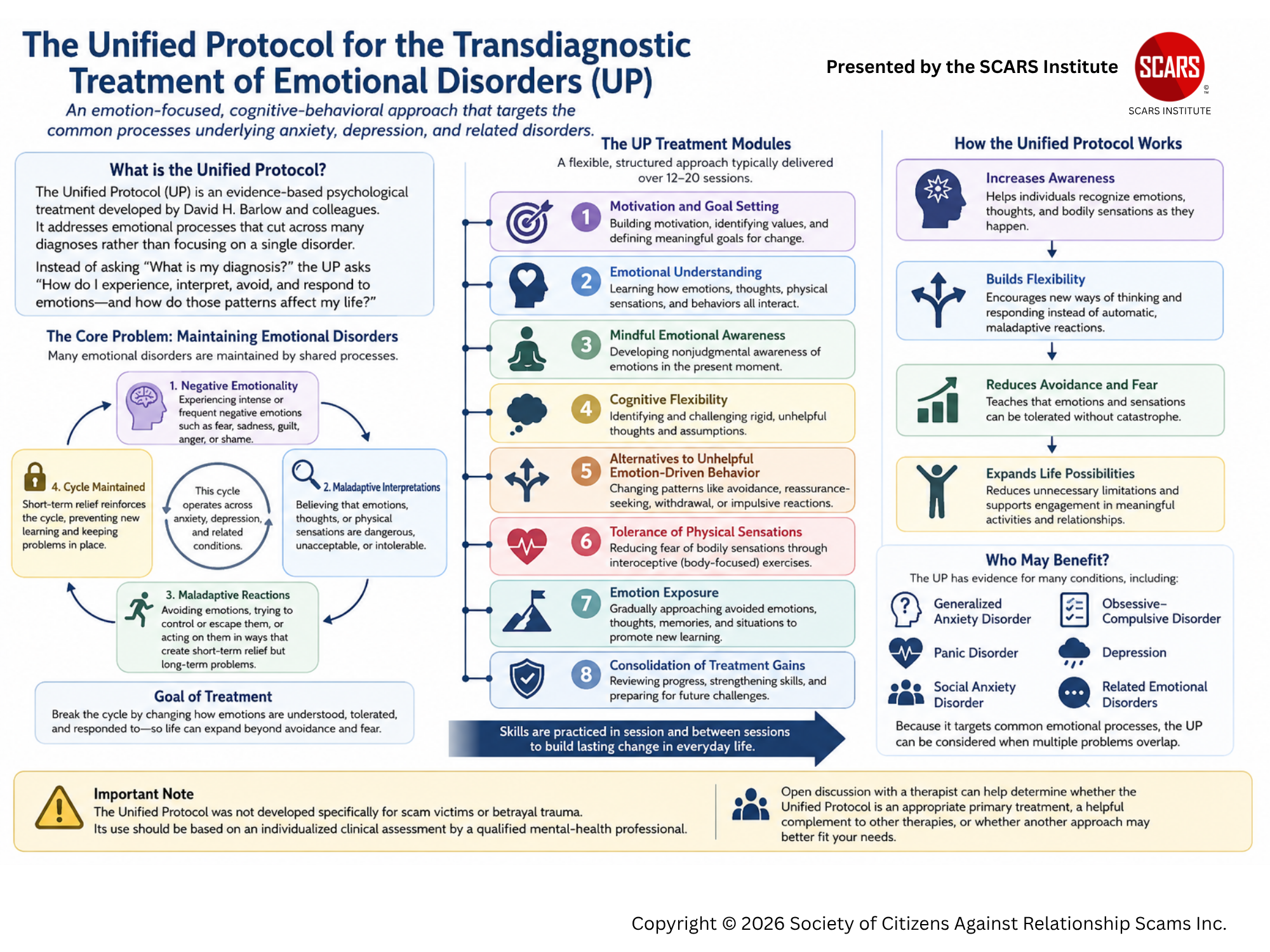
The Unified Protocol for the Transdiagnostic Treatment of Emotional Disorders, commonly called the Unified Protocol or UP, offers an interesting therapeutic approach to this kind of complexity. Developed principally by psychologist David H. Barlow and colleagues at Boston University, the Unified Protocol is an evidence-based, emotion-focused form of cognitive behavioral therapy designed to address psychological processes shared across anxiety, depressive, and related emotional disorders rather than treating every diagnosis as an entirely separate problem.
The Unified Protocol was not developed specifically for scam victims, relationship-scam victimization, or betrayal trauma. There is currently no adequate clinical evidence establishing it as a specialized treatment for scam-related psychological injury. However, its focus on emotional avoidance, maladaptive reactions to strong emotions, cognitive rigidity, emotion-driven behavior, uncomfortable bodily sensations, and exposure to avoided emotional experiences creates several potentially relevant connections to the problems traumatized scam victims commonly experience. Research has also begun examining the UP in trauma-exposed populations and people with PTSD, producing encouraging but still developing evidence.
For that reason, the Unified Protocol is something that some scam victims can reasonably discuss with their therapists. The purpose would not be to request a particular treatment merely because it sounds appropriate. Instead, the discussion can help the therapist and victim consider whether the emotional processes targeted by the UP correspond to the individual’s actual symptoms, diagnoses, recovery needs, trauma history, and stage of recovery.
What Is the Unified Protocol?
The Unified Protocol emerged from research showing considerable overlap among anxiety disorders, depression, and related emotional conditions. Traditional clinical practice often developed separate treatment manuals for panic disorder, generalized anxiety disorder, social anxiety disorder, obsessive-compulsive disorder, depression, and numerous other conditions. Barlow and colleagues argued that many of these conditions share important underlying psychological mechanisms, particularly heightened negative emotionality combined with a tendency to experience emotions themselves as dangerous, intolerable, unacceptable, or requiring immediate control.
The term transdiagnostic describes this approach. Rather than concentrating exclusively on the surface differences between diagnoses, a transdiagnostic treatment identifies processes that operate across several disorders. The UP therefore does not simply ask which diagnosis is present. It also examines how the individual experiences emotions, interprets those emotions, reacts to them, attempts to control them, and behaves because of them.
This distinction can be particularly valuable when psychological problems overlap. A person can simultaneously experience generalized anxiety, depressive symptoms, panic, anger, shame, avoidance, and trauma-related distress. Treating each symptom cluster as though it exists independently can produce fragmented treatment planning. A transdiagnostic approach instead asks whether several of those difficulties are being maintained by common processes.
The Unified Protocol is structured and skills-based. It teaches people to recognize emotional experiences more accurately, become more aware of the interaction among thoughts, physical sensations, and behaviors, develop greater cognitive flexibility, reduce maladaptive emotion-driven behaviors, tolerate uncomfortable bodily sensations, and gradually approach emotional experiences that have been avoided. Official UP training materials describe eight modules encompassing motivation and goal setting, emotional understanding, mindful emotional awareness, cognitive flexibility, alternatives to unhelpful emotion-driven behavior, tolerance of physical sensations, emotion exposure, and consolidation of treatment gains.
The goal is not to eliminate normal negative emotions.
Fear has a purpose. Sadness has a purpose. Anger, disgust, guilt, grief, and anxiety all carry information and can motivate adaptive behavior. The difficulty arises when people become frightened of their own emotions, organize their lives around avoiding them, interpret them rigidly, or repeatedly behave in ways that provide short-term relief while increasing long-term distress. This emphasis on changing the relationship to emotional experience is central to the UP.
A Psychological Therapy, Not a Psychiatric Medication Protocol
The Unified Protocol is fundamentally a psychological psychotherapy. It is a form of cognitive behavioral therapy and is not a medication protocol. It does not prescribe antidepressants, anti-anxiety medications, sleep medications, mood stabilizers, or other pharmaceuticals. Its therapeutic mechanisms involve learning, cognition, emotional awareness, behavioral change, exposure, and increased tolerance of internal experiences.
The distinction between psychology and psychiatry should not be overstated, however. Psychiatry is a medical specialty, and psychiatrists can provide psychotherapy as well as prescribe medication. A psychiatrist trained in the Unified Protocol could therefore use it therapeutically. Psychologists and other appropriately trained licensed mental-health professionals can also use the UP within their professional scope and training.
A victim considering the Unified Protocol would therefore normally discuss it with a therapist or other qualified mental-health provider rather than treating it as a self-administered medical intervention. The published protocol includes therapist guidance and patient exercises, but the clinical UP remains a structured psychotherapeutic treatment rather than simply a collection of general wellness techniques. The Unified Protocol Institute describes treatment as typically involving regular therapist sessions and between-session skills practice.
Psychiatric care can still be appropriate alongside psychological treatment when clinically indicated. Medication and psychotherapy are not mutually exclusive, and the UP does not establish that medication is unnecessary for a particular person. Those decisions belong within individualized clinical assessment and treatment planning.
Why Emotional Disorders Can Have Common Mechanisms
An important insight behind the Unified Protocol is that very different symptoms can sometimes be supported by similar psychological processes.
Consider avoidance. A person with panic disorder can avoid places where panic previously occurred. Someone with social anxiety can avoid conversations for fear of embarrassment. A depressed person can withdraw from activities because engagement feels emotionally difficult. A trauma survivor can avoid reminders of what happened. The circumstances differ, but avoidance can provide immediate emotional relief in each case.
That relief matters.
When avoidance reduces distress, the nervous system can learn that avoidance was necessary. The person receives less opportunity to discover that the situation, thought, emotion, or physical sensation can be tolerated. The feared experience can consequently retain or even increase its emotional power. The UP therefore places considerable emphasis on identifying avoidance and other emotion-driven behaviors and replacing ineffective responses with more adaptive actions.
The same principle applies to cognitive appraisal. An emotion does not exist in isolation from interpretation. A person who notices a racing heart and thinks that something catastrophic is happening can experience escalating fear. A person who experiences sadness and concludes that the sadness will never end can become more hopeless. Someone who experiences shame and treats that emotion as proof of personal worthlessness can intensify suffering beyond the original emotional response.
The Unified Protocol teaches cognitive flexibility rather than attempting to force artificially positive thinking. The objective is to identify automatic interpretations and consider alternative understandings so that the first thought generated by distress does not automatically become accepted as fact.
The Core Therapeutic Work
Early UP work establishes motivation, goals, and a clearer understanding of emotions. The person learns that emotional experiences typically contain interacting cognitive, physiological, and behavioral components. Thoughts, bodily sensations, and actions can influence one another rapidly enough that they appear to be one indivisible experience.
Mindful emotion awareness then teaches greater ability to observe emotional experiences in the present without immediately judging, suppressing, escaping, or reacting to them. This is not intended to make a person passive. It creates enough psychological space for an emotion to be noticed before automatic behavior takes control.
Cognitive flexibility focuses on interpretations and habitual patterns of thought. The therapist and patient can identify automatic assumptions, rigid conclusions, thinking traps, and deeper beliefs that influence emotional response. The goal is not to deny genuine danger, injustice, or suffering. It is to improve the accuracy and flexibility with which situations are understood.
Another component addresses emotion-driven behaviors. Strong emotion produces urges. Fear can produce escape. Shame can produce concealment. Anger can produce confrontation. Depression can produce withdrawal. The UP examines whether those actions are effective over both the short and long term and helps the patient practice alternatives when habitual emotional behavior is maintaining the problem.
The protocol also works with physical sensations associated with emotion. This can involve interoceptive exposure, in which uncomfortable bodily sensations are deliberately and safely experienced in a therapeutic context so that they become less frightening and less likely to trigger avoidance or catastrophic interpretation. UP training materials apply this principle beyond anxiety alone and explicitly include physical sensations associated with different emotional experiences.
Later work incorporates emotion exposure. Rather than structuring life around avoiding situations, thoughts, memories, sensations, or emotions that generate discomfort, the individual gradually approaches relevant experiences in a planned therapeutic manner. Exposure is intended to promote new learning, greater tolerance, reduced dependence on avoidance, and increased confidence in the ability to experience emotion without automatically surrendering behavioral control to it.
The final work consolidates skills, examines progress, and prepares the person to continue using what has been learned after formal treatment ends.
Why This Can Be Relevant to Traumatized Scam Victims
Fraud victimization can produce psychological effects extending far beyond financial loss. A 2026 systematic review found associations with anxiety, depression, psychological distress, shame, self-blame, reduced quality of life, and deterioration of interpersonal trust. The review also found that psychological harm can continue after financial issues have been resolved and can be strongly related to emotional manipulation, betrayal, and erosion of trust rather than simply to the amount of money lost.
Research specifically involving romance-scam victims similarly describes substantial emotional consequences. Rebecca Cole’s qualitative study of U.S. romance-scam victims identified emotional dysregulation, behavioral-health needs, sleep and physiological changes, financial consequences, legal difficulties, and suicidal ideation among participants. Other research describes profound emotional loss, shame, damaged trust, and the simultaneous loss of money and an emotionally significant relationship.
These consequences create several areas where a therapist might consider whether UP principles are useful.
- A victim can experience shame and then avoid discussing the crime. The avoidance protects the victim temporarily from anticipated judgment but can also increase isolation and prevent corrective experiences with people who respond compassionately.
- A victim can experience anxiety when receiving a bank notice, telephone call, email, or unfamiliar message. Avoiding financial correspondence can reduce anxiety immediately while making financial matters increasingly threatening.
- A victim can experience grief whenever memories of the fraudulent relationship arise and then attempt to suppress every reminder. The effort to eliminate memories can itself turn them into feared psychological events.
- Another victim can experience anger and repeatedly investigate the offender, reread conversations, search photographs, monitor social-media accounts, or reconstruct the crime. These behaviors can feel necessary because they promise explanation or control, while in some cases they can keep the offender psychologically central long after the immediate investigative value has ended.
- A victim can experience fear about future relationships and conclude that trusting anyone is too dangerous. Complete interpersonal avoidance can temporarily prevent another betrayal while also preventing the development of new experiences in which trust is earned gradually and safely.
These examples do not establish that the Unified Protocol is the correct treatment for every such problem. They demonstrate why its focus on emotional interpretation, avoidance, emotion-driven behavior, cognitive flexibility, physical reactions, and emotional approach could be clinically relevant.
The Important Difference Between Emotion Regulation and Emotion Suppression
Traumatized people can understandably interpret “emotion regulation” as learning how to stop feeling distress. That is not the central UP objective.
The UP recognizes emotions as adaptive and functional. Its approach is less concerned with making emotion disappear than with reducing maladaptive reactions to emotional experience.
For a scam victim, this distinction can be particularly important. Grief after betrayal does not automatically indicate that something has gone wrong in recovery. Anger about exploitation can be understandable. Fear after a profound violation of trust can be understandable. Shame can arise even when it is not deserved. Emotional pain can remain intense without being evidence that the victim is incapable of recovery.
The therapeutic question becomes what happens after the emotion appears.
If sadness produces complete withdrawal, if fear produces chronic avoidance, if shame produces secrecy and isolation, or if anger produces endless offender-centered rumination, the secondary response can begin maintaining suffering independently of the original crime. The Unified Protocol focuses heavily on that secondary relationship with emotion. This potentially makes it relevant to a recovery model that does not promise the elimination of painful memories but instead seeks to reduce the degree to which those memories and emotions control the person’s present life.
Betrayal Trauma, PTSD, and the Unified Protocol
The Unified Protocol should not be confused with a treatment specifically designed around betrayal trauma. It also should not automatically replace established trauma-focused therapies when those are clinically indicated.
The strongest UP evidence has historically involved anxiety and depressive disorders. Meta-analyses have found meaningful reductions in anxiety and depression across UP studies, and a major randomized clinical trial involving 223 patients found the UP comparable in efficacy to established diagnosis-specific CBT protocols for several anxiety disorders.
The evidence in trauma populations is promising but smaller. A randomized pilot study involving adults who developed posttraumatic psychopathology after severe physical injury found larger reductions in PTSD, anxiety, and depression symptoms among participants receiving the UP than among those receiving usual care.
An exploratory study involving trauma-exposed adults found similar improvement in anxiety, depression, and clinical severity among participants with and without trauma histories, while approximately half of participants with PTSD showed reductions across several measures.
A pilot randomized effectiveness trial involving trauma-exposed veterans also found improvement across treatment conditions, with the UP showing particularly encouraging changes in anxiety, depression, comorbidity, and psychosocial functioning. The investigators appropriately emphasized that the trial was small and that additional research was necessary.
More recent work has continued examining the role of transdiagnostic treatments alongside trauma-focused approaches. A 2025 study of veterans and family members with probable PTSD compared trajectories among people receiving trauma-focused therapies such as Cognitive Processing Therapy and Prolonged Exposure and transdiagnostic treatments including the Unified Protocol. The investigators found no overall difference in likelihood of clinically meaningful PTSD improvement between the broader treatment categories, while also emphasizing the need for larger and more rigorous studies to clarify patient-treatment matching.
This emerging evidence supports conversation rather than certainty.
A therapist might conclude that a trauma-focused treatment should be primary. Another might determine that emotional avoidance, depression, panic, generalized anxiety, or multiple co-occurring problems make the UP particularly useful. In some cases, a clinician might incorporate UP principles within a broader treatment plan rather than treating the protocol as the only intervention.
Why a Transdiagnostic Approach Can Be Attractive After Scam Victimization
The complexity of post-scam suffering is one reason the UP deserves attention.
A traumatized scam victim can arrive in therapy with several clinically relevant problems without experiencing them as separate illnesses. The victim might say that there is constant anxiety, unbearable shame, grief over the relationship, anger at the offender, fear about money, inability to trust, avoidance of social contact, and intrusive recollections.
A diagnosis-specific model can legitimately identify several conditions requiring treatment.
A transdiagnostic model adds another perspective by asking whether these different manifestations share mechanisms.
- Perhaps several are connected by intolerance of intense emotion.
- Perhaps avoidance is maintaining several problems simultaneously.
- Perhaps catastrophic interpretations of emotional and bodily experiences are amplifying distress.
- Perhaps the person has developed emotion-driven behaviors that once provided protection but now interfere with recovery.
- Perhaps the greatest problem is no longer the existence of sadness, anger, fear, or grief, but the belief that those emotions are unbearable and must immediately be escaped.
The UP gives the therapist a structured way to examine those possibilities.
What the Unified Protocol Does Not Provide
The UP should not be presented as a complete answer to everything experienced after relationship-scam victimization.
It does not recover lost money. It does not investigate offenders. It does not replace legal, financial, identity-protection, or crime-reporting assistance. It does not resolve every attachment issue simply because emotional regulation improves.
It was not designed specifically around the unusual relational structure of romance scams in which the victim can grieve a psychologically meaningful relationship while simultaneously discovering that the identity supporting that relationship was fabricated. Romance-fraud research has documented this unusual combination of relational loss, financial harm, shame, damaged trust, and psychological distress.
It also does not mean that every traumatized scam victim has an “emotional disorder.” Diagnosis requires clinical assessment. A person can experience substantial post-victimization distress without meeting criteria for PTSD, major depressive disorder, generalized anxiety disorder, or another psychiatric diagnosis.
Likewise, the existence of a transdiagnostic treatment does not make diagnosis irrelevant. Diagnosis can inform risk assessment, treatment planning, medication decisions, prognosis, insurance, and selection among evidence-based interventions. Transdiagnostic treatment simply offers another way of understanding mechanisms that cross diagnostic boundaries.
Most importantly, the available research does not establish that the Unified Protocol has been specifically validated for traumatized scam victims. Applying it in that population is therefore a clinical consideration based on symptom patterns and established mechanisms, not a claim of scam-specific treatment efficacy.
What a Scam Victim Can Ask a Therapist
A victim interested in the Unified Protocol does not need to arrive at therapy having decided that the UP is necessary. A more appropriate approach is to bring the concept into collaborative treatment planning. Questions can include:
- Is the therapist familiar with or trained in the Unified Protocol for Transdiagnostic Treatment of Emotional Disorders?
- Do the victim’s anxiety, depression, shame, avoidance, grief, anger, physiological reactions, or other symptoms fit the emotional processes that the UP targets?
- Would the Unified Protocol be appropriate as a primary treatment, an adjunct to another treatment, or not appropriate for the particular presentation?
- If PTSD or another trauma-related disorder is present, would a trauma-focused treatment be preferable, or could a transdiagnostic approach address important co-occurring problems?
- How would emotion exposure or interoceptive exposure be paced given the victim’s trauma history, stability, health, and current level of distress?
- How would the therapist distinguish necessary grief and appropriate emotional processing from avoidance or emotion-driven behaviors that are maintaining suffering?
These questions allow clinical judgment to remain where it belongs, between the patient and qualified therapist.
Considerations for Mental-Health Professionals
For professionals working with scam victims, the Unified Protocol offers a potentially useful framework because post-fraud presentations frequently cross traditional diagnostic boundaries. Fraud-related psychological injury can involve anxiety, depressive symptoms, shame, interpersonal distrust, trauma-related symptoms, physiological distress, and impaired functioning. Current systematic evidence indicates that these psychological and psychosocial effects are substantial but remain under-recognized within victim-response systems.
The UP can provide a common language for examining the emotional mechanisms operating beneath those presentations. Mindful awareness can address automatic reactions to internal states. Cognitive flexibility can help examine rigid conclusions arising from betrayal without denying genuine victimization. Work with emotion-driven behavior can identify avoidance, reassurance seeking, compulsive checking, social withdrawal, or other behaviors that provide short-term relief but obstruct longer-term adaptation. Interoceptive and emotional exposure can potentially help reduce fear of emotional and bodily experiences when clinically appropriate.
At the same time, clinicians should preserve the reality of the crime. A victim’s fear, anger, distrust, grief, or vigilance did not necessarily arise from distorted thinking. The person was actually deceived, exploited, manipulated, or betrayed. Cognitive flexibility should therefore never become an exercise in minimizing legitimate victimization or persuading the patient that accurate perceptions of harm are irrational.
The clinical objective is not to rewrite the historical facts.
It is to determine which present-day emotional processes continue to serve protection and which have become obstacles to living.
That distinction is particularly important in betrayal-related trauma.
What the Research Says About Effectiveness
The Unified Protocol now has a substantial research base. A 2021 meta-analysis examining 19 randomized controlled trials and 13 uncontrolled studies involving 2,183 participants found moderate to large improvements across anxiety and depressive symptoms, with gains also evident at follow-up.
Another systematic review and meta-analysis involving 15 studies and 1,244 participants found large reductions across several internalizing symptoms and evidence of improved adaptive emotion-regulation strategies.
The 2017 randomized equivalence trial conducted by Barlow and colleagues compared the UP with established single-disorder treatments among 223 adults with principal anxiety disorders. The UP was found to be equivalent to the diagnosis-specific protocols on primary outcomes, supporting the proposition that one transdiagnostic treatment can address several different emotional disorders effectively.
A 2024 state-of-the-science review by Farchione, Long, Spencer-Laitt, Moreno, and Barlow documented the continuing expansion of the UP research program and its application across settings and populations.
This evidence makes the Unified Protocol considerably more than an experimental theory about emotion. It is an established evidence-based psychotherapy with a substantial clinical research history.
What remains uncertain is how far those general findings can be translated specifically into the treatment of psychological injury following scams. That question has not yet received the direct research attention it deserves.
A Potential Role in Scam-Victim Recovery
The Unified Protocol offers a useful way of thinking about one of the central realities of recovery after betrayal: recovery does not require the disappearance of every painful emotion.
A person can remember what happened without reliving it as an immediate threat. Grief can remain part of personal history without organizing the entire future. Anger can acknowledge injustice without keeping the offender psychologically present every day. Fear can become information rather than a command to avoid every new relationship. Shame can be experienced without becoming proof of personal worthlessness.
The UP’s contribution is the proposition that emotional suffering is often maintained not only by what is felt, but also by what a person has learned to do in response to feeling it.
For some traumatized scam victims, that can be an important therapeutic question.
The relevant inquiry is not simply whether fear, grief, anger, shame, or anxiety remains. It is whether those emotions have become experiences the person must continually escape, suppress, obey, or organize life around.
When that pattern is present, the Unified Protocol provides an established psychological framework that a therapist can consider.
It should not be promoted as a universal treatment for scam victimization, nor as a replacement for individualized trauma assessment. It can instead be understood as another evidence-based therapeutic option within a broader recovery landscape, particularly when emotional avoidance, anxiety, depression, intense negative emotion, behavioral restriction, and multiple overlapping clinical problems are present.
For scam victims already working with therapists, the most appropriate next step is therefore simple: the Unified Protocol can be brought into the therapeutic conversation. The therapist can evaluate whether the approach corresponds to the individual’s symptoms and recovery needs, whether the clinician has appropriate training, whether another treatment should take priority, and whether UP principles could complement the work already underway.
Recovery after profound deception rarely consists of eliminating emotion. More often, recovery involves learning that painful emotions can be experienced without allowing them to determine every decision that follows. The Unified Protocol was created around that broader psychological challenge.
IMPORTANT NOTE
The Unified Protocol is a professional psychological treatment and should not be interpreted as a self-treatment recommendation for any particular scam victim. Scam victims experiencing significant depression, trauma symptoms, anxiety, suicidal thoughts, severe functional impairment, or other mental-health concerns should be individually assessed by an appropriately qualified mental-health professional. The suitability and sequencing of the Unified Protocol, trauma-focused treatment, medication, or other interventions depend on the individual’s clinical presentation and should be determined through professional treatment planning.
Conclusion
The Unified Protocol for the Transdiagnostic Treatment of Emotional Disorders offers a potentially valuable therapeutic framework for scam victims whose psychological difficulties extend across anxiety, depression, shame, grief, avoidance, physiological distress, distrust, and other overlapping emotional problems. Its significance lies partly in recognizing that apparently different symptoms can sometimes be maintained by common processes, including emotional avoidance, rigid interpretation, fear of internal experiences, and behaviors driven by attempts to escape uncomfortable emotions.
For traumatized scam victims, this perspective can help distinguish between experiencing a painful emotion and becoming controlled by the behaviors that follow it. Grief does not necessarily need to disappear for recovery to advance. Anger does not have to be denied. Fear does not need to be treated as weakness, and shame does not have to become a permanent judgment about personal worth. The therapeutic concern becomes whether these emotions are producing avoidance, isolation, compulsive behaviors, withdrawal, or other responses that continue restricting the victim’s life.
The Unified Protocol should not be regarded as a universal treatment for scam-related trauma or as a substitute for individualized clinical assessment. Trauma-focused therapies, psychiatric care, medication, and other psychological interventions can be more appropriate depending upon the person’s symptoms, diagnoses, stability, health, and treatment history. Existing research supports the Unified Protocol as an evidence-based psychotherapy for emotional disorders, while its specific application to traumatized scam victims remains an area requiring further research.
Its practical value for scam victims is therefore found in informed therapeutic discussion. A victim can ask whether emotional avoidance, cognitive rigidity, emotion-driven behavior, or fear of emotional and bodily experiences is contributing to continuing distress and whether the Unified Protocol could appropriately address those processes. Recovery does not require eliminating every painful memory or emotion. It increasingly allows those experiences to exist without permitting them to determine the direction of the person’s life.

Glossary
- Adaptive Emotion-Regulation Strategies — Adaptive emotion-regulation strategies are methods that help a person respond to difficult emotions without automatically escaping, suppressing, or acting on them. The Unified Protocol encourages responses that remain effective over both the immediate situation and the longer term. For scam victims, these strategies can support greater emotional stability while allowing grief, fear, anger, or shame to be experienced without controlling behavior. — Emotional Regulation
- Avoidance-Based Relief — Avoidance-based relief occurs when escaping an uncomfortable situation, thought, memory, emotion, or bodily sensation produces an immediate reduction in distress. That reduction can teach the nervous system that avoidance was necessary, which can strengthen the likelihood of avoiding the experience again. The Unified Protocol addresses this pattern because repeated short-term relief can preserve fear and interfere with corrective learning. — Behavioral Process
- Avoided Emotional Experiences — Avoided emotional experiences are feelings, memories, thoughts, situations, or physical sensations that a person attempts not to encounter because they have become associated with distress. Scam victims can avoid reminders of the crime, financial matters, conversations, relationships, or internal feelings connected with betrayal. The Unified Protocol gradually helps appropriate patients approach these experiences so they can develop greater tolerance and reduce dependence on avoidance. — Emotional Regulation
- Behavioral Restriction — Behavioral restriction occurs when emotional distress progressively narrows what a person feels able or willing to do. Fear, shame, depression, or distrust can reduce social contact, financial activity, relationships, travel, communication, or participation in previously meaningful activities. The Unified Protocol can help identify when protective behavior has become unnecessarily restrictive and is interfering with normal functioning or recovery. — Behavioral Process
- Between-Session Skills Practice — Between-session skills practice refers to the therapeutic exercises a patient completes outside formal Unified Protocol sessions. These activities allow emotional awareness, cognitive flexibility, behavioral change, and exposure skills to be practiced in ordinary life rather than remaining limited to the therapist’s office. Consistent practice can help therapeutic learning become increasingly usable when distress occurs in real situations. — Treatment Participation
- Clinical Appropriateness of the Unified Protocol — Clinical appropriateness of the Unified Protocol refers to whether the treatment fits an individual patient’s symptoms, diagnoses, emotional processes, stability, health, trauma history, and treatment needs. The protocol should not be selected simply because a patient experiences emotional distress after a scam. A qualified clinician determines whether the UP should be primary, complementary to another therapy, or replaced by a treatment better suited to the person’s presentation. — Clinical Assessment
- Clinical UP — Clinical UP refers to the professional therapeutic application of the Unified Protocol rather than the general use of emotional-awareness concepts or self-help exercises. It involves structured psychotherapy, therapist guidance, skills development, exposure work, and individualized clinical judgment. Scam victims should understand that learning about the protocol is different from receiving the protocol as a professional psychological treatment. — Psychological Treatment
- Cognitive Flexibility — Cognitive flexibility is the ability to examine an automatic interpretation without treating the first conclusion produced by distress as unquestionable fact. The Unified Protocol helps patients identify assumptions, rigid conclusions, and habitual thinking patterns while considering reasonable alternative interpretations. For scam victims, cognitive flexibility can support more accurate understanding without denying the reality of deception, exploitation, betrayal, or financial harm. — Cognitive Process
- Common Emotional Mechanisms — Common emotional mechanisms are psychological processes that can operate beneath several apparently different emotional problems. Avoidance, rigid interpretation, fear of emotional experience, and emotion-driven behavior can contribute to anxiety, depression, panic, shame, or trauma-related distress even when the outward symptoms differ. The Unified Protocol targets these shared mechanisms rather than treating every symptom as an entirely independent problem. — Transdiagnostic Process
- Co-occurring Clinical Problems — Co-occurring clinical problems are multiple psychological difficulties that exist at the same time and can interact with one another. A scam victim can experience anxiety, depressive symptoms, shame, panic, avoidance, grief, physiological distress, and trauma-related symptoms without experiencing them as separate conditions. The Unified Protocol can be relevant when a therapist determines that shared emotional processes contribute to several of these difficulties. — Clinical Presentation
- Cross-Diagnostic Symptom Overlap — Cross-diagnostic symptom overlap occurs when emotional and behavioral difficulties appear across more than one diagnostic category. Anxiety, depression, panic, avoidance, physiological activation, and emotional dysregulation can overlap substantially rather than remaining confined to separate disorders. The Unified Protocol was developed partly in response to this overlap and addresses mechanisms that cross traditional diagnostic boundaries. — Diagnostic Framework
- Diagnosis-Specific CBT Protocols — Diagnosis-specific CBT protocols are cognitive behavioral treatments developed to address particular disorders such as panic disorder, generalized anxiety disorder, social anxiety disorder, or other defined conditions. These approaches remain evidence-based and clinically valuable, but they differ from the Unified Protocol’s transdiagnostic structure. Research comparing the UP with established diagnosis-specific treatments has found that the UP can produce comparable outcomes for several anxiety disorders. — Psychological Treatment
- Diagnostic Boundaries — Diagnostic boundaries are the distinctions used to separate one recognized psychological disorder from another. The Unified Protocol does not eliminate the importance of diagnosis, but it recognizes that meaningful emotional processes often operate across those boundaries. This perspective can be useful when a scam victim presents with several interacting symptoms that cannot be understood adequately by examining each diagnosis in isolation. — Diagnostic Framework
- Emotion Exposure — Emotion exposure is a therapeutic process in which a patient gradually approaches situations, memories, thoughts, feelings, or sensations that generate difficult emotions instead of continually avoiding them. Exposure is planned and clinically guided rather than being an uncontrolled confrontation with overwhelming distress. The purpose is to promote new learning, increased emotional tolerance, reduced avoidance, and greater confidence in experiencing emotion without automatically surrendering behavioral control. — Exposure Therapy
- Emotion-Focused Cognitive Behavioral Therapy — Emotion-focused cognitive behavioral therapy combines cognitive and behavioral principles with direct attention to how emotions are experienced, interpreted, avoided, and acted upon. The Unified Protocol is an evidence-based form of this approach. Its emphasis extends beyond changing thoughts because it also addresses emotional awareness, physical sensations, behavioral responses, avoidance, and exposure. — Psychological Treatment
- Emotion-Driven Behavior — Emotion-driven behavior refers to actions strongly influenced by the immediate urge created by an emotional state. Fear can produce escape, shame can produce concealment, anger can produce confrontation, and depression can produce withdrawal. The Unified Protocol helps patients examine whether these responses remain useful or whether they provide temporary relief while maintaining longer-term problems. — Behavioral Process
- Emotional Approach — Emotional approach refers to deliberately moving toward appropriate emotional experiences instead of organizing life around escaping or suppressing them. The Unified Protocol uses gradual therapeutic practice to increase the person’s ability to remain present with distressing feelings and situations. For scam victims, emotional approach can become relevant when avoidance of memories, financial matters, relationships, or difficult conversations begins limiting recovery. — Emotional Regulation
- Emotional Awareness — Emotional awareness is the ability to recognize and understand emotional experiences as they occur. The Unified Protocol teaches patients to notice the interaction among thoughts, bodily sensations, emotions, and behavioral urges rather than experiencing them as one confusing and uncontrollable reaction. Greater awareness can help a scam victim recognize what is happening internally before an automatic response determines what happens next. — Emotional Regulation
- Emotional Disorder — Emotional disorder is a broad clinical concept used within the Unified Protocol framework for conditions involving significant difficulties with emotional experience and regulation. Anxiety and depressive disorders are among the major conditions historically addressed through the protocol. The term does not mean that every scam victim experiencing intense grief, fear, shame, or anger has a diagnosable emotional disorder, because diagnosis requires individualized clinical assessment. — Clinical Psychology
- Emotional Interpretation — Emotional interpretation is the meaning a person assigns to an emotional experience, bodily sensation, memory, or situation. A racing heart can be interpreted as catastrophe, sadness can be interpreted as permanent hopelessness, and shame can be interpreted as evidence of personal worthlessness. The Unified Protocol helps patients examine these interpretations so emotional distress does not automatically determine what they believe is true. — Cognitive Process
- Emotional Process Targeting — Emotional process targeting focuses treatment on the mechanisms that shape how a person experiences and responds to emotion rather than addressing only the surface symptom or diagnostic label. The Unified Protocol examines processes such as avoidance, cognitive rigidity, emotion-driven behavior, and fear of uncomfortable internal experiences. This approach can be useful when several different symptoms appear to share the same maintaining mechanisms. — Transdiagnostic Treatment
- Emotional Tolerance — Emotional tolerance is the developing capacity to experience uncomfortable emotions without immediately suppressing, escaping, neutralizing, or obeying them. The Unified Protocol does not require patients to enjoy fear, grief, anger, or shame. It helps them learn that difficult emotions can often be experienced safely while they continue making deliberate choices rather than allowing distress to dictate behavior. — Emotional Regulation
- Evidence-Based Psychotherapy — Evidence-based psychotherapy is psychological treatment supported by systematic clinical research rather than solely by theory, tradition, or anecdotal experience. The Unified Protocol has been evaluated through randomized trials, systematic reviews, meta-analyses, and continuing clinical research. Its evidence base is strongest for anxiety, depression, and related emotional disorders, while its specific use with traumatized scam victims still requires direct study. — Evidence-Based Practice
- Exposure-Based New Learning — Exposure-based new learning occurs when a person approaches a previously avoided emotional experience and discovers information that differs from the feared prediction. Repeated experiences can demonstrate that distress is tolerable, that an emotion does not automatically create catastrophe, or that avoidance is not always necessary. This learning process can gradually weaken the behavioral power of fear and other difficult emotional states. — Learning Process
- Fear of Internal Experiences — Fear of internal experiences occurs when thoughts, memories, emotions, or bodily reactions themselves become perceived as dangerous, intolerable, or unacceptable. A person can then begin avoiding situations primarily because those situations might produce an unwanted internal response. The Unified Protocol addresses this fear by helping patients develop greater tolerance for emotional experiences without automatically treating them as threats. — Emotional Regulation
- Fear of Physical Sensations — Fear of physical sensations occurs when bodily experiences associated with emotion become threatening in their own right. Changes in heart rate, breathing, muscle tension, dizziness, heat, trembling, or other sensations can be interpreted catastrophically and can trigger further emotional escalation. The Unified Protocol can use carefully planned interoceptive exercises to reduce unnecessary fear of these sensations when clinically appropriate. — Physiological Response
- Individualized Clinical Assessment — Individualized clinical assessment is the professional evaluation of a person’s symptoms, diagnoses, risks, functioning, health, history, and treatment needs before determining an appropriate therapeutic approach. The presence of post-scam distress alone does not establish that the Unified Protocol is the correct intervention. A clinician uses assessment to determine whether UP, trauma-focused therapy, psychiatric care, medication, or another treatment should be considered. — Clinical Assessment
- Interoceptive Exposure — Interoceptive exposure is the deliberate and clinically controlled practice of experiencing uncomfortable physical sensations associated with emotion. The goal is to reduce catastrophic interpretations and increase confidence that bodily sensations can be tolerated without automatically triggering escape or avoidance. Within the Unified Protocol, this technique can be used with sensations associated with a range of emotional experiences rather than anxiety alone. — Exposure Therapy
- Maladaptive Reactions to Strong Emotions — Maladaptive reactions to strong emotions are responses that reduce distress temporarily but create or maintain problems over time. These responses can include suppression, avoidance, withdrawal, compulsive checking, concealment, or other behaviors that become organized around escaping emotional discomfort. The Unified Protocol focuses on helping patients recognize these patterns and develop responses that function more effectively over the longer term. — Behavioral Process
- Mindful Emotion Awareness — Mindful emotion awareness is the practice of observing an emotional experience in the present without immediately judging, suppressing, escaping, or reacting to it. The Unified Protocol uses this skill to create psychological space between feeling an emotion and automatically acting upon the urge it produces. For scam victims, this can support greater choice when fear, shame, grief, anger, or other intense reactions become activated. — Emotional Regulation
- Motivation and Goal Setting — Motivation and goal setting form an early component of the Unified Protocol and help establish why treatment matters and what meaningful changes the patient wants to achieve. Clear goals connect therapeutic exercises with everyday functioning rather than treating symptom reduction as the only objective. For a scam victim, goals can involve restoring activity, relationships, confidence, emotional tolerance, or other areas of life affected by victimization. — Treatment Planning
- Multiple Overlapping Clinical Problems — Multiple overlapping clinical problems occur when several emotional, behavioral, physiological, or functional difficulties are present simultaneously and influence one another. Scam victims can experience anxiety, depression, shame, avoidance, grief, distrust, intrusive recollections, and physiological distress within the same recovery period. A transdiagnostic approach allows a therapist to examine whether common emotional processes are contributing to several problems at once. — Clinical Presentation
- Negative Emotionality — Negative emotionality refers to a heightened tendency to experience difficult emotional states such as fear, sadness, anger, guilt, anxiety, or related distress. The Unified Protocol was developed partly around evidence that heightened negative emotionality contributes across several emotional disorders. Treatment does not attempt to remove normal negative emotions but instead addresses the ways those emotions are interpreted, avoided, and managed. — Emotional Process
- Patient-Treatment Matching — Patient-treatment matching is the clinical process of determining which therapeutic approach best corresponds to an individual’s symptoms, diagnoses, preferences, risks, functioning, and recovery needs. The Unified Protocol is one evidence-based option among several psychological treatments. Research involving trauma-exposed populations continues to examine which patients benefit most from transdiagnostic approaches and which require more specifically trauma-focused interventions. — Treatment Planning
- Physical Sensation Tolerance — Physical sensation tolerance is the ability to experience bodily changes associated with emotion without immediately interpreting them as dangerous or intolerable. Increased tolerance can reduce the urge to avoid situations primarily because they produce uncomfortable physiological reactions. The Unified Protocol deliberately addresses bodily sensations because physical experience can become an important part of the cycle maintaining emotional distress. — Physiological Regulation
- Present-Day Emotional Processes — Present-day emotional processes are the current patterns through which a person interprets, experiences, avoids, and responds to emotion after the original harmful event has ended. A victim’s fear, anger, grief, or distrust can have understandable origins in genuine deception and betrayal while some current responses can eventually become obstacles to functioning. Therapy examines which processes remain protective and which are unnecessarily restricting the person’s life. — Recovery Process
- Professional Treatment Planning — Professional treatment planning is the collaborative clinical process through which a qualified provider selects, sequences, and monitors interventions based on the patient’s individual presentation. The Unified Protocol can be used as a primary intervention, combined with other treatments, or considered inappropriate depending on assessment findings. Medication, trauma-focused treatment, psychiatric care, and other psychological therapies can remain appropriate components of the overall plan. — Treatment Planning
- Psychological Psychotherapy — Psychological psychotherapy refers to treatment that works primarily through psychological learning, cognition, emotional awareness, behavioral change, and therapeutic experience rather than through medication. The Unified Protocol belongs to this category and is based on cognitive behavioral principles. Psychiatrists, psychologists, and other appropriately trained mental-health clinicians can provide psychotherapy within their professional scope and qualifications. — Psychological Treatment
- Psychosocial Functioning — Psychosocial functioning refers to how effectively a person manages psychological well-being, relationships, social participation, responsibilities, and everyday life. Trauma-exposed populations receiving Unified Protocol treatment have been studied for changes not only in symptoms but also in broader functioning. For scam victims, improved functioning can include renewed social engagement, greater independence, increased confidence, and reduced restriction caused by emotional distress. — Functional Recovery
- Secondary Relationship With Emotion — The secondary relationship with emotion refers to what a person begins doing because an emotion has appeared. Sadness can be followed by withdrawal, fear by chronic avoidance, shame by secrecy, and anger by repeated offender-focused behavior. The Unified Protocol pays particular attention to these secondary responses because they can begin maintaining suffering even when the original emotion remains understandable. — Emotional Regulation
- Shared Psychological Processes — Shared psychological processes are mechanisms that contribute to more than one emotional condition or symptom cluster. Avoidance, rigid interpretations, negative emotionality, and maladaptive emotion-driven behaviors can operate across anxiety, depression, panic, and other emotional presentations. The Unified Protocol addresses these common mechanisms so treatment does not always require an entirely separate therapeutic structure for every diagnosis. — Transdiagnostic Process
- Short-Term Relief From Avoidance — Short-term relief from avoidance is the immediate reduction in emotional discomfort that can occur after a person escapes or avoids something distressing. The relief can unintentionally reinforce the behavior because the nervous system learns that escape appeared to solve the problem. Over time, this learning can prevent corrective experiences and allow the feared situation, memory, or sensation to retain its emotional power. — Behavioral Learning
- Skills-Based Treatment — Skills-based treatment teaches specific psychological abilities that patients practice repeatedly rather than relying only on discussion or insight. The Unified Protocol develops skills involving emotional understanding, mindful awareness, cognitive flexibility, alternative behavioral responses, tolerance of physical sensations, and exposure. Repeated practice helps patients use these abilities outside therapy when difficult emotions arise in ordinary life. — Psychological Treatment
- Structured Psychotherapeutic Treatment — Structured psychotherapeutic treatment follows an organized therapeutic framework with defined treatment components, goals, exercises, and clinical procedures. The Unified Protocol uses a series of modules that progressively develop emotional understanding, awareness, flexibility, behavioral change, sensation tolerance, exposure, and consolidation. Structure provides consistency while still allowing a qualified therapist to adapt treatment to the patient’s clinical needs. — Treatment Structure
- Therapist-Guided Emotional Exposure — Therapist-guided emotional exposure is professionally planned practice involving situations, thoughts, memories, sensations, or emotions that a patient has been avoiding. The therapist helps determine the appropriateness, pacing, intensity, and therapeutic purpose of the exposure rather than asking the patient to confront distress indiscriminately. This distinction is especially important when a scam victim also has trauma-related symptoms or other clinical vulnerabilities. — Exposure Therapy
- Transdiagnostic Framework — A transdiagnostic framework organizes treatment around psychological processes that operate across multiple diagnostic conditions instead of assuming that every disorder requires an entirely separate conceptual model. The Unified Protocol uses this framework to address common emotional mechanisms underlying anxiety, depression, and related presentations. This perspective can be useful when a scam victim presents with several overlapping forms of distress rather than one isolated symptom cluster. — Clinical Framework
- Transdiagnostic Treatment — Transdiagnostic treatment is psychotherapy designed to address psychological mechanisms shared by multiple disorders or clinical presentations. The Unified Protocol represents a major evidence-based example of this approach. It examines how emotions are experienced, interpreted, avoided, controlled, and translated into behavior rather than limiting treatment exclusively to one diagnostic category. — Psychological Treatment
- Treatment Gain Consolidation — Treatment gain consolidation is the process of reviewing and strengthening therapeutic skills as formal treatment progresses toward completion. The Unified Protocol uses this stage to examine progress, reinforce effective strategies, anticipate future difficulties, and prepare the patient to continue applying learned skills independently. Consolidation helps reduce the possibility that useful therapeutic learning will remain dependent on the immediate presence of the therapist. — Treatment Maintenance
- Unified Protocol — The Unified Protocol is the commonly used name for the Unified Protocol for the Transdiagnostic Treatment of Emotional Disorders. It is an evidence-based, emotion-focused cognitive behavioral psychotherapy developed primarily by David H. Barlow and colleagues to treat processes shared across anxiety, depressive, and related emotional disorders. Its potential relevance to scam victims lies in its attention to avoidance, emotional interpretation, bodily sensations, emotion-driven behavior, and overlapping psychological problems. — Psychological Treatment
- Unified Protocol for the Transdiagnostic Treatment of Emotional Disorders — The Unified Protocol for the Transdiagnostic Treatment of Emotional Disorders is a structured psychological treatment designed to address common mechanisms underlying several emotional disorders. It combines cognitive behavioral methods with emotional awareness, cognitive flexibility, behavioral change, interoceptive work, and exposure to avoided emotional experiences. It was not developed specifically for scam victims or betrayal-related trauma, so its use with those populations requires individualized professional assessment rather than assuming universal applicability. — Transdiagnostic Psychotherapy
- UP Treatment Modules — UP treatment modules are the organized therapeutic components through which the Unified Protocol develops emotional skills and progressively addresses maladaptive patterns. The article identifies motivation and goal setting, emotional understanding, mindful emotional awareness, cognitive flexibility, alternatives to unhelpful emotion-driven behavior, tolerance of physical sensations, emotion exposure, and consolidation of treatment gains. Together, these modules provide a structured pathway while allowing clinicians to consider individual treatment needs. — Treatment Structure
- UP Treatment Suitability — UP treatment suitability refers to whether the Unified Protocol is an appropriate clinical option for a particular patient. Suitability depends on the person’s symptoms, diagnoses, trauma history, emotional processes, health, stability, treatment history, and other individual considerations. Scam victims can discuss the approach with qualified therapists, but the decision to use it should emerge from collaborative professional assessment rather than self-diagnosis or self-prescription. — Clinical Assessment
Sources & References
- Barlow, D. H., Harris, B. A., Eustis, E. H., & Farchione, T. J. (2020). The Unified Protocol for Transdiagnostic Treatment of Emotional Disorders. World Psychiatry, 19(2), 245–246.
https://doi.org/10.1002/wps.20748
https://pubmed.ncbi.nlm.nih.gov/32394551/
https://pmc.ncbi.nlm.nih.gov/articles/PMC7215073/ - Ellard, K. K., Fairholme, C. P., Boisseau, C. L., Farchione, T. J., & Barlow, D. H. (2010). Unified Protocol for the Transdiagnostic Treatment of Emotional Disorders: Protocol Development and Initial Outcome Data. Cognitive and Behavioral Practice, 17(1), 88–101.
https://doi.org/10.1016/j.cbpra.2009.06.002
https://pubmed.ncbi.nlm.nih.gov/33762811/
https://pmc.ncbi.nlm.nih.gov/articles/PMC7986982/ - Farchione, T. J., Fairholme, C. P., Ellard, K. K., Boisseau, C. L., Thompson-Hollands, J., Carl, J. R., Gallagher, M. W., & Barlow, D. H. (2012). Unified Protocol for Transdiagnostic Treatment of Emotional Disorders: A Randomized Controlled Trial. Behavior Therapy, 43(3), 666–678.
https://doi.org/10.1016/j.beth.2012.01.001
https://pubmed.ncbi.nlm.nih.gov/22697453/
https://pmc.ncbi.nlm.nih.gov/articles/PMC3383087/ - Barlow, D. H., Farchione, T. J., Bullis, J. R., Gallagher, M. W., Murray-Latin, H., Sauer-Zavala, S., Bentley, K. H., Thompson-Hollands, J., Conklin, L. R., Boswell, J. F., Ametaj, A. A., Carl, J. R., Boettcher, H. T., & Cassiello-Robbins, C. (2017). The Unified Protocol for Transdiagnostic Treatment of Emotional Disorders Compared With Diagnosis-Specific Protocols for Anxiety Disorders: A Randomized Clinical Trial. JAMA Psychiatry, 74(9), 875–884.
https://doi.org/10.1001/jamapsychiatry.2017.2164
https://pubmed.ncbi.nlm.nih.gov/28768327/
https://pmc.ncbi.nlm.nih.gov/articles/PMC5710228/ - Carlucci, L., Saggino, A., & Balsamo, M. (2021). On the efficacy of the Unified Protocol for Transdiagnostic Treatment of Emotional Disorders: A systematic review and meta-analysis. Clinical Psychology Review, 87, 101999.
https://doi.org/10.1016/j.cpr.2021.101999
https://pubmed.ncbi.nlm.nih.gov/34098412/ - Sakiris, N., & Berle, D. (2019). A systematic review and meta-analysis of the Unified Protocol as a transdiagnostic emotion regulation based intervention. Clinical Psychology Review, 72, 101751.
https://doi.org/10.1016/j.cpr.2019.101751
https://pubmed.ncbi.nlm.nih.gov/31271848/ - Farchione, T. J., Long, L. J., Spencer-Laitt, D., Moreno, J., & Barlow, D. H. (2024). State of the Science: The Unified Protocol for Transdiagnostic Treatment of Emotional Disorders. Behavior Therapy, 55(6), 1189–1204.
https://doi.org/10.1016/j.beth.2024.04.007
https://pubmed.ncbi.nlm.nih.gov/39443061/ - Gutner, C. A., Song, J., Canale, C. A., Suvak, M. K., Litwack, S. D., Niles, B. L., & Wiltsey Stirman, S. (2022). A pilot randomized effectiveness trial of the Unified Protocol in trauma-exposed veterans. Depression and Anxiety, 39(12), 813–823.
https://doi.org/10.1002/da.23288
https://pubmed.ncbi.nlm.nih.gov/36258655/
https://pmc.ncbi.nlm.nih.gov/articles/PMC9729399/ - O’Donnell, M. L., Lau, W., Chisholm, K., Agathos, J., Little, J., Terhaag, S., Brand, R., Putica, A., Holmes, A. C. N., Katona, L., Felmingham, K. L., Murray, K., Hosseiny, F., & Gallagher, M. W. (2021). A Pilot Study of the Efficacy of the Unified Protocol for Transdiagnostic Treatment of Emotional Disorders in Treating Posttraumatic Psychopathology: A Randomized Controlled Trial. Journal of Traumatic Stress, 34(3), 563–574.
https://doi.org/10.1002/jts.22650
https://pubmed.ncbi.nlm.nih.gov/33453140/ - Eustis, E. H., Hayes-Skelton, S. A., Orsillo, S. M., & Roemer, L., et al. (2021). A Preliminary Evaluation of the Unified Protocol among Trauma-Exposed Adults With and Without PTSD.
https://pubmed.ncbi.nlm.nih.gov/34770243/
https://pmc.ncbi.nlm.nih.gov/articles/PMC8583442/ - Wilner Tirpak, J., Cassiello-Robbins, C., Ametaj, A., Olesnycky, O. S., Sauer-Zavala, S., Farchione, T. J., & Barlow, D. H. (2021). Skill Acquisition During Transdiagnostic Treatment With the Unified Protocol. Behavior Therapy.
https://doi.org/10.1016/j.beth.2021.03.001
https://pubmed.ncbi.nlm.nih.gov/34656189/ - Bai, J., Ho, M.-H., Sung, H.-T., Hung, C.-S., & Tsai, J.-H. (2026). Mental health and psychosocial sequelae of fraud victimization: A systematic review. Frontiers in Psychology, 17, 1805536.
https://doi.org/10.3389/fpsyg.2026.1805536
https://pubmed.ncbi.nlm.nih.gov/42137076/ - Cole, R. (2024). A qualitative investigation of the emotional, physiological, financial, and legal consequences of online romance scams in the United States. Journal of Economic Criminology, 6, 100108.
https://doi.org/10.1016/j.jeconc.2024.100108
https://www.sciencedirect.com/science/article/pii/S2949791424000605 - Aborisade, R. A., et al. (2024). Emotional and financial costs of online dating scam: A phenomenological narrative of the experiences of victims of Nigerian romance fraudsters. Journal of Economic Criminology, 3, 100044.
https://doi.org/10.1016/j.jeconc.2023.100044
https://www.sciencedirect.com/science/article/pii/S2949791423000441 - Coluccia, A., Pozza, A., Ferretti, F., Carabellese, F., Masti, A., & Gualtieri, G. (2020). Online Romance Scams: Relational Dynamics and Psychological Characteristics of the Victims and Scammers. A Scoping Review. Clinical Practice & Epidemiology in Mental Health, 16, 24–35.
https://doi.org/10.2174/1745017902016010024
https://pubmed.ncbi.nlm.nih.gov/32508967/ - Unified Protocol Institute. Unified Protocol treatment and clinical training information.
https://unifiedprotocol.com/
https://unifiedprotocol.com/find-a-provider/
-/ 30 /-
IMPORTANT NOTE: This article is intended to be an introductory overview of complex psychological, neurological, physiological, or other concepts, written primarily to help victims of crime understand the wide-ranging actual or potential effects of psychological trauma they may be experiencing. The goal is to provide clarity and validation for the confusing and often overwhelming symptoms that can follow a traumatic event. It is critical to understand that this content is for informational purposes only and does not constitute or is not a substitute for professional medical advice, diagnosis, or treatment. If you are experiencing distress or believe you are suffering from trauma or its effects, it is essential to consult with a qualified mental health professional for personalized care and support.
TABLE OF CONTENTS
- The Unified Protocol for Emotional Disorders
- A Psychological Treatment Approach That Traumatized Scam Victims Can Discuss With Their Therapists
- The Unified Protocol for Emotional Disorders
- A Psychological Treatment Approach That Traumatized Scam Victims Can Discuss With Their Therapists
- Author’s Note
- Introduction
- What Is the Unified Protocol?
- A Psychological Therapy, Not a Psychiatric Medication Protocol
- Why Emotional Disorders Can Have Common Mechanisms
- The Core Therapeutic Work
- Why This Can Be Relevant to Traumatized Scam Victims
- The Important Difference Between Emotion Regulation and Emotion Suppression
- Betrayal Trauma, PTSD, and the Unified Protocol
- Why a Transdiagnostic Approach Can Be Attractive After Scam Victimization
- What the Unified Protocol Does Not Provide
- What a Scam Victim Can Ask a Therapist
- Considerations for Mental-Health Professionals
- What the Research Says About Effectiveness
- A Potential Role in Scam-Victim Recovery
- IMPORTANT NOTE
- Conclusion
- Glossary
- Sources & References
Want the Definition of a Term?
Search Here
PUBLICATION CATEGORIES
Welcome to the SCARS INSTITUTE Journal of Scam Psychology & Recoverology®
A Journal of Applied Scam, Fraud, and Cybercrime Psychology/Recoverology – and Allied Sciences
A dedicated site for psychology, psychotraumatology, thanotology, recoverology, victimology, criminology, applied sociology and anthropology, and allied sciences, published by the SCARS INSTITUTE™ – Society of Citizens Against Relationship Scams Inc.
Please Tell Us What You
Learned From This?
Please Leave A Comment!
Commenting Is An Essential Part Of Healing
Read • Think • Write
Recent Comments
On Other Articles
A Note About Labeling!
We often use the term ‘scam victim’ in our articles, but this is a convenience to help those searching for information in search engines like Google. It is just a convenience and has no deeper meaning. If you have come through such an experience, YOU are a Survivor! It was not your fault. You are not alone! Axios!
A Question of Trust
At the SCARS Institute, we invite you to do your own research on the topics we speak about and publish, Our team investigates the subject being discussed, especially when it comes to understanding the scam victims-survivors experience. You can do Google searches but in many cases, you will have to wade through scientific papers and studies. However, remember that biases and perspectives matter and influence the outcome. Regardless, we encourage you to explore these topics as thoroughly as you can for your own awareness.
Statement About Victim Blaming
Some of our articles discuss various aspects of victims. This is both about better understanding victims (the science of victimology) and their behaviors and psychology. This helps us to educate victims/survivors about why these crimes happened and to not blame themselves, better develop recovery programs, and to help victims avoid scams in the future. At times this may sound like blaming the victim, but it does not blame scam victims, we are simply explaining the hows and whys of the experience victims have.
These articles, about the Psychology of Scams or Victim Psychology – meaning that all humans have psychological or cognitive characteristics in common that can either be exploited or work against us – help us all to understand the unique challenges victims face before, during, and after scams, fraud, or cybercrimes. These sometimes talk about some of the vulnerabilities the scammers exploit. Victims rarely have control of them or are even aware of them, until something like a scam happens and then they can learn how their mind works and how to overcome these mechanisms.
Articles like these help victims and others understand these processes and how to help prevent them from being exploited again or to help them recover more easily by understanding their post-scam behaviors. Learn more about the Psychology of Scams at www.ScamPsychology.org